
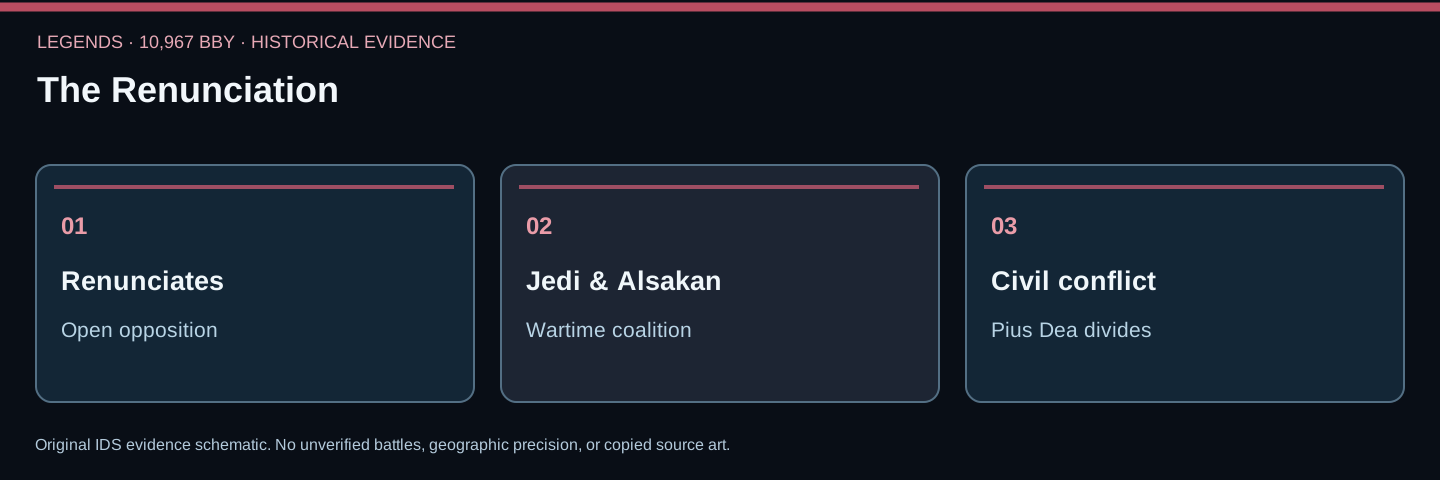
In 10,967 BBY, the Renunciates revealed themselves after generations of secret organizing. Their declaration split Pius Dea from within and ignited the Seventh Alsakan Conflict, also called the Pius Dea Civil War. Alsakan, the Jedi, Caamasi, Duros, Herglics, Hutts, and other opponents joined Renunciate forces against Pius Dea Faithful across worlds including Fondor, Ixtlar, Cyrillia, and Ord Carida.
The hidden movement becomes public
Renunciates had remained embedded inside Pius Dea institutions while rejecting the regime's doctrine.
Their public declaration transformed covert dissent into civil war.
A coalition built across old enemies
Alsakani, Jedi, Caamasi, Duros, Herglics, and Hutts fought alongside dissident Republic forces.
The alliance joined groups divided by earlier wars because ending Pius Dea rule had become a shared objective.
Fighting across the Republic
Renunciate and allied forces attacked Faithful strongholds at Fondor, Ixtlar, Cyrillia, and other strategic sites.
The conflict was simultaneously a civil war inside Republic institutions and an interstate war involving previously seceded or alien powers.
Why this counts as an Alsakan Conflict
Alsakan again stood against Coruscant-centered authority, but the conflict differed sharply from earlier rivalry wars.
The central issue was now the overthrow of the Pius Dea regime rather than ordinary competition for Republic leadership.
Anthropological assessment
This event shows how political institutions, infrastructure, and collective identity interact across deep time. IDS separates documented facts from later reconstruction and avoids filling gaps with invented detail.
Pius Dea Era · 11,198–10,966 BBY · Legends
The Renunciates publicly fracture the Pius Dea
In 10,967 BBY, followers of a dissident movement inside the Pius Dea revealed their opposition to the regime. The Renunciation turned years of covert religious and political organization into an open conflict with the Faithful. The Seventh Alsakan Conflict is therefore more than another war between two familiar rival planets. Alsakan's longstanding opposition to Coruscant intersected with an internal fracture of the governing faith and with the intervention of the Jedi and allied populations subjected to crusading rule.
The coalition included Caamasi, Duros, Herglics and Hutts alongside Alsakani and Republic defectors. Their reasons for cooperating were not necessarily identical. Some sought an end to persecution, others wanted a change in the capital's political order, and officers inside the regime rejected its doctrine from firsthand experience. The key historical fact is that these groups coordinated despite distinct histories. Fighting at Fondor, Ixtlar, Cyrillia and Ord Carida indicates a system-wide struggle, but the sources do not provide a complete tactical chronology for every named location.
A split faith becomes a split state
When political legitimacy depends on a shared religion, a disagreement within that religion can undermine the state more deeply than an external attack. The Renunciates could challenge the government in a language familiar to its supporters while forming alliances with outsiders who had been persecuted by it.
Coalition does not mean uniform experience
The Jedi had spent centuries withdrawn from Republic political authority, while others had remained within or beyond its borders. Their common purpose in 10,967 BBY did not erase those differences. Recording them makes the story more comprehensible than a list of allied species alone.
Was the Renunciation a sudden rebellion with no earlier organizing?
No. Caamasi diplomacy and resistance inside the Pius Dea developed over a much longer period after the Jedi ended the Recusal.
Source record: The Essential Guide to Warfare (2012), the Seventh Alsakan Conflict and Renunciates. Publisher's sourcebook listing →. This account distinguishes the map or reference facts from IDS interpretation; no unsupported battle statistics, exact dates or invented dialogue.
Source-critical historical reading · 10,967 BBY
A government religion fractures from the inside
The Renunciation was not a foreign invasion of an otherwise united government. For generations some Pius Dea adherents and Republic officers had concealed their opposition to the regime's policies. Their public declaration in 10,967 BBY became part of the Seventh Alsakan Conflict, a civil struggle in which rival groups could claim authority over institutions that had previously served the same state.
The anti-Pius Dea coalition included the Jedi, Caamasi, Alsakani, and several non-Human communities. Each had different experiences of Republic power. This diversity matters because the end of a discriminatory regime need not be explained as the achievement of one homogeneous liberation army. Naval divisions, regional alliances and resistance within the official religious tradition all affected the outcome.
The fighting involved several worlds, but the reference history does not authorize a precise loss ledger for every location. The separate Battle of Ord Carida and later engagement at Uquine should remain distinct. Their differences illustrate how contested legitimacy moves from public defection to armed conflict and ultimately the removal of a government.
Test your historical judgment: Was the Renunciation solely a Jedi attack launched without opposition from within Pius Dea?
Correction: No. The Renunciates were an internal opposition movement, joined by a larger coalition.
Compare next related event → · Pius Dea historical guide →
Source: Jason Fry with Paul R. Urquhart, The Essential Guide to Warfare (2012), publisher edition. Fine-grained page references and unresolved tactical details require original-book comparison; IDS interpretation is separate from reported facts.
Sources and further reading
- Jason Fry with Paul R. Urquhart, Star Wars: The Essential Guide to Warfare, Del Rey, 2012.
- Alsakan Conflicts/Legends, Wookieepedia