
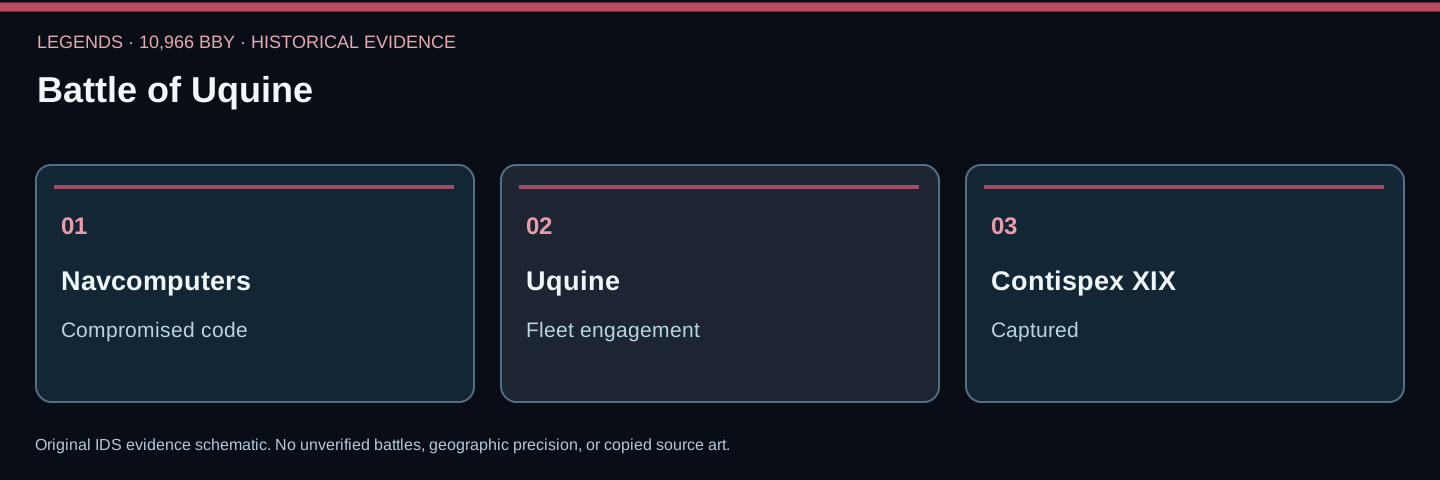
In 10,966 BBY, the thousand-year Pius Dea regime collapsed at the Battle of Uquine. The Bureau of Ships and Services activated rogue code it had secretly planted in the navigation computers of Pius Dea cathedral ships. Thousands of vessels jumped uncontrollably into hyperspace. A disabled vanguard emerged at Uquine under the guns of Renunciate battleships, while Jedi boarded the Flame of Sinthara and captured Supreme Chancellor Contispex XIX.
The Bureau of Ships and Services breaks neutrality
BoSS had long presented itself as a neutral institution overseeing navigation and shipping systems.
Caamasi and anti-Pius Dea conspirators persuaded it that continued neutrality enabled the regime. Its access to standardized navigation infrastructure made sabotage possible.
Rogue navicomputer code
BoSS seeded cathedral ships with code that forced random hyperspace jumps and disabled navigation, communications, and hyperdrives.
The Pius Dea fleet's technical standardization became a systemic vulnerability.
The ambush at Uquine
A Pius Dea vanguard emerged at Uquine unable to maneuver effectively and faced prepared Renunciate battleships.
The anti-Pius Dea fleet methodically destroyed the disabled warships.
Contispex XIX is captured
Jedi boarded the Chancellor's cathedral ship, Flame of Sinthara, and seized Contispex XIX.
He was taken to Caamas, tried for crimes against the galaxy, convicted, and imprisoned for the rest of his life.
A millennium of theocratic rule ends
The Battle of Uquine ended the Pius Dea Era and the Contispex dynasty's control of the Republic.
The faith was purged from major Republic institutions over subsequent generations, although isolated adherents survived aboard stranded cathedral ships.
Anthropological assessment
This event shows how political institutions, infrastructure, and collective identity interact across deep time. IDS separates documented facts from later reconstruction and avoids filling gaps with invented detail.
Pius Dea Era · 11,100–10,966 BBY · Legends
The fleet catastrophe that ended a thousand-year regime
The decisive events at Uquine in 10,966 BBY involved the Bureau of Ships and Services as well as the fleets openly engaged in the Pius Dea Civil War. The BoSS had placed malicious navigation code into cathedral ships, then triggered systems that sent numerous vessels on uncontrollable jumps. Many were lost in unexplored space with navigation, communications or propulsion systems disabled. A Pius Dea vanguard instead emerged at Uquine, where the Renunciates had a prepared battle fleet. The disarmed ships were destroyed and Jedi captured Supreme Chancellor Contispex XIX aboard the Flame of Sinthara.
It is tempting to narrate this solely as the triumph of a superior coalition fleet. Doing so would obscure how control over standardized technical infrastructure changed the outcome. The BoSS possessed privileges and knowledge available to neither an ordinary ship's officer nor a frontline army. Its decision to abandon neutrality allowed a covert technical intervention to disable an entire political order's military mobility. The broader defeat also brought different human costs: combat casualties, people stranded aboard ships, and populations harmed by the preceding centuries of crusades.
The Bureau's role was not a conventional naval attack
A fleet commander depends on navigation systems that ordinarily appear routine and politically neutral. Covert alteration of those systems can make battleships ineffective before they encounter an opponent. The Uquine result shows why infrastructure administrators may hold strategic power far beyond their visible military rank.
Capture and reconstruction are separate steps
The removal of Contispex XIX closed the immediate chapter of Pius Dea rule. The later choice of Biel Ductavis, rebuilding of the navy and exclusion of Faithful officeholders belonged to the reconstruction of government. Defeating an abusive ruler did not itself create trustworthy institutions.
Were all disabled Pius Dea cathedral ships destroyed in a battle at Uquine?
No. A vanguard emerged at Uquine; many other ships were forced into remote hyperspace routes and remained stranded elsewhere. The two outcomes should not be conflated.
Source record: The Essential Guide to Warfare (2012), Battle of Uquine; Star Wars Insider 133, '10 Key Battles'. Publisher book listing →. Legends only; source facts and interpretive reasoning are kept separate.
Source-critical historical reading · 10,966 BBY
How administrative technology became part of regime change
The defeat of the Pius Dea leadership depended on more than ship-to-ship fire. The Bureau of Ships and Services helped undermine the regime by inserting rogue code into the navigation computers of cathedral ships. This makes a technical bureaucracy part of the historical explanation of government collapse. Workers who controlled information and navigation systems could redirect enormous military assets without commanding the full fleet themselves.
The consequences were severe. Some cathedral ships became lost far from mapped routes, exposing crews to prolonged isolation. Other vessels faced Renunciate forces at Uquine, while Jedi captured Contispex XIX. A source-critical article must distinguish the general technological operation from the particular final battle. It should also avoid treating everyone aboard a trapped vessel as an equally responsible supporter of the regime.
The ending matters because it demonstrates how a political order can lose its control over infrastructure before it formally loses the office of Supreme Chancellor. The later transition to Biel Ductavis belongs in a separate article. The approximate mechanics can be described, but no surviving published reference supplies a complete record of every ship's final position.
Test your historical judgment: Was the downfall of Pius Dea only a conventional fleet battle at Uquine?
Correction: No. The rogue navicomputer operation and capture of Contispex XIX were also central.
Compare next related event → · Pius Dea historical guide →
Source: Jason Fry with Paul R. Urquhart, The Essential Guide to Warfare (2012), publisher edition. Fine-grained page references and unresolved tactical details require original-book comparison; IDS interpretation is separate from reported facts.
Sources and further reading
- Jason Fry with Paul R. Urquhart, Star Wars: The Essential Guide to Warfare, Del Rey, 2012.
- “10 Key Battles,” Star Wars Insider 133.
- Battle of Uquine, Wookieepedia