
In 11,100 BBY, Caamasi emissaries reached the Jedi stronghold on Ossus and convinced the Order to end the Recusal that had begun in 11,933 BBY. Rather than launch a simple external war, the Jedi joined Caamasi and Alsakani partners in a long strategy to encourage dissent inside Pius Dea itself. Converts to the secret anti-Pius Dea faith became known as Renunciates.
Caamasi diplomacy changes Jedi policy
The Caamasi persuaded the Jedi that continued isolation allowed Pius Dea abuses to continue without effective opposition from the Order.
Diplomacy, not military defeat, ended the Recusal.
A strategy of internal change
The anti-Pius Dea coalition worked to spread a competing faith and political identity among Pius Dea adherents.
The objective was to split the regime from within rather than rely only on outside invasion.
The Renunciates
Pius Dea members who rejected the regime's ideology became Renunciates while often remaining embedded in Republic institutions.
Their hidden positions later proved decisive inside the navy and other state systems.
Ossus shifts from refuge to organizing center
For more than eight centuries Ossus had been the center of Jedi withdrawal.
The decision to re-enter galactic politics transformed the same institutional base into a center of coordinated resistance.
Anthropological assessment
This event shows how political institutions, infrastructure, and collective identity interact across deep time. IDS separates documented facts from later reconstruction and avoids filling gaps with invented detail.
Pius Dea Era · 11,198–10,966 BBY · Legends
Caamasi diplomacy reopens the Jedi–Republic question
When the Jedi withdrew from Republic political life in 11,933 BBY, they refused to lend institutional legitimacy to a government waging coercive campaigns under Pius Dea authority. Their retreat to Ossus protected some independence, but it did not halt the regime. By approximately 11,100 BBY, Caamasi representatives persuaded the Order that continued separation had its own costs. The resulting change was not a decision to embrace the Contispex dynasty. It was a decision to organize more active opposition to it.
The Jedi's new relationships with Caamasi and Alsakani partners gave the resistance a different foundation from a single military intervention. Instead of treating every believer in the Pius Dea religion as an enemy to be eliminated, the coalition cultivated an alternative movement inside the faith. That effort eventually produced the Renunciates. The elapsed time matters: the clandestine movement grew over generations and was not a ready-made navy or government in the year the Recusal ended.
Religious isolation and moral responsibility
The Recusal showed that a religious order could reject association with a state whose actions it considered wrong. Rejoining political activity required a different judgment: that disengagement had become insufficient as a response to persecution. The moral difficulty lay in deciding how to intervene without simply replacing one domination with another.
Political change through intermediaries
The Caamasi role illustrates how communities without command of the largest fleets can alter galactic politics through persuasion and trust. Allies who already knew the Pius Dea's institutions could spread doubt more effectively than outsiders simply issuing threats. The Renunciation eventually depended on such relationships.
Did the Jedi return to serving the Pius Dea Chancellor in 11,100 BBY?
No. They ended their isolation to oppose Pius Dea rule alongside the Caamasi and other partners. The overt civil war began later, in 10,967 BBY.
Source record: The Essential Guide to Warfare (2012), Recusal and Renunciation chronology. Publisher's sourcebook listing →. This account distinguishes the map or reference facts from IDS interpretation; no unsupported battle statistics, exact dates or invented dialogue.
Source-critical historical reading · c. 11,100 BBY
A religious institution changes its relationship to the Republic
The end of the Jedi Recusal represents a change of institutional policy, not proof that the Republic became tolerant as soon as the Jedi chose to act. Caamasi mediation helped bring the Order into an opposition network with Alsakan and dissidents within Pius Dea. The movement that later emerged as the Renunciates had its own political history and was not merely a Jedi military unit.
The earlier Recusal matters because it separates opposition to Pius Dea theology from the practical decision to challenge a regime entrenched in the Republic's navy and administration. Acting too early could have exposed supporters; remaining disengaged left vulnerable populations without allies. That tension makes this a significant case of institutional responsibility rather than a scene of inevitable heroic action.
The surviving narrative gives dates and major actors but does not preserve the exact negotiations, individual votes of every Jedi council member or identities of every underground organizer. An accurate chronology identifies the long organizing phase before the open Renunciation rather than moving directly from one meeting to a 10,967 BBY battlefield.
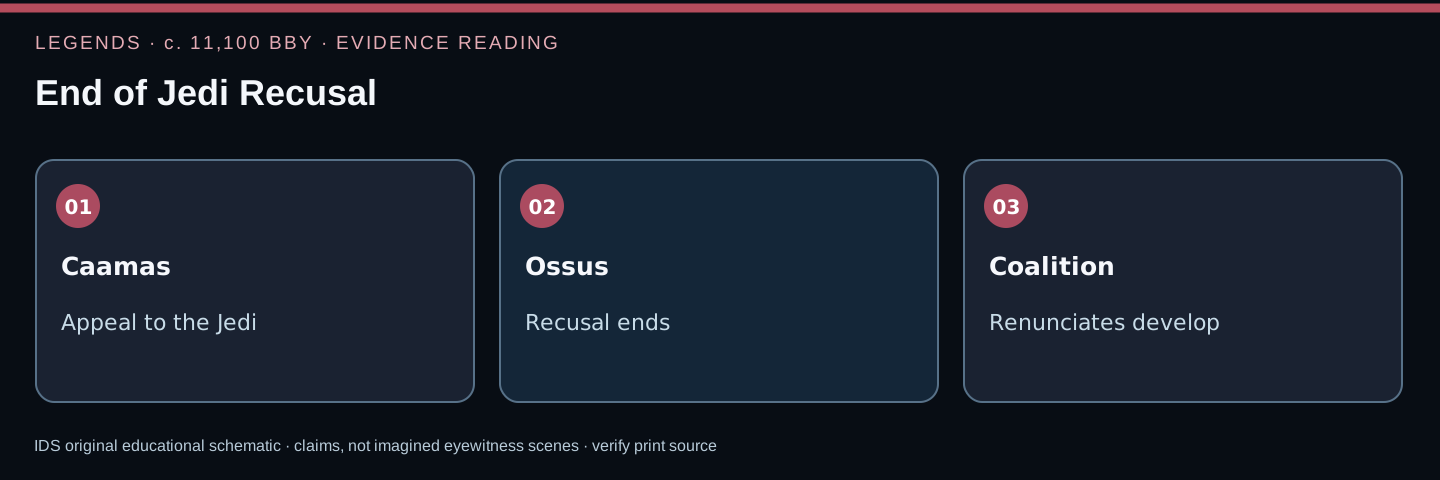
Test the evidence: Did ending the Jedi Recusal instantly end the Pius Dea regime?
Correction: No. Coalition-building and secret dissent preceded the open conflict by more than a century.
Continue the Pius Dea historical sequence → · Full campaign research guide →
Primary reference: Jason Fry and Paul R. Urquhart, The Essential Guide to Warfare (2012), publisher listing. The older Legends reference account needs exact print-page collation; political interpretation is separate from the stated event.
Sources and further reading
- Jason Fry with Paul R. Urquhart, Star Wars: The Essential Guide to Warfare, Del Rey, 2012.
- Recusal, Wookieepedia
- Renunciate, Wookieepedia