
Around 11,100 BBY, the Pius Dea regime's military expansion had stalled. The government increasingly redirected coercion inward through Inquisitions in the Core Worlds and Colonies. Apostates, heretics, unbelievers, and people judged impure were subjected to investigation, mass trials, punishment, and execution.
From frontier crusade to internal purification
For centuries Pius Dea ideology had defined danger largely at the frontier. The Inquisitions brought the same logic into established Republic communities.
The boundary between foreign enemy and internal suspect narrowed.
Religious policing inside institutions
Pius Dea commissars were attached to military units to identify heretics and apostates.
The regime's control therefore operated through ordinary bureaucratic and military structures as well as spectacular crusades.
The Proscribed
Opponents could lose civil liberties, property, career access, and social mobility through designation as Proscribed.
Political exclusion became economic exclusion.
Repression creates conditions for internal resistance
The Inquisitions helped make dissatisfaction inside the faith itself more dangerous and more politically significant.
The Renunciate movement later exploited this internal fracture.
Anthropological assessment
This event shows how political institutions, infrastructure, and collective identity interact across deep time. IDS separates documented facts from later reconstruction and avoids filling gaps with invented detail.
Pius Dea Era · 11,198–10,966 BBY · Legends
When crusading doctrine turned inward
The Inquisitions beginning around 11,100 BBY were a change in the way Pius Dea leaders defined danger. For much of the previous era the regime had directed large campaigns toward populations at the Republic's frontiers. By the later centuries of crusading rule, enemies could also be defined inside the Core Worlds and the Colonies. This is not evidence that all earlier persecution had occurred abroad. It shows an explicit extension of punitive religious classification into established Republic communities, where ordinary professional and political relationships could become grounds for suspicion.
The source history describes accusations of apostasy, unbelief and impurity, along with mass trials and execution. What is not available is a credible complete register of the people prosecuted or the composition of each local tribunal. An accurate account must therefore distinguish the existence of the system from imagined testimony by a particular victim or inquisitor. The Inquisitions also belong to the history of the state, because judgments could affect legal status, employment and the ability to claim protection from public institutions.
Who could become an enemy?
A government that ties citizenship to religious obedience can make political membership conditional on approved belief. A frontier policy distinguishes outsiders from insiders; an inquisition can erase that reassurance by treating previously accepted residents as possible opponents. The effect is to widen the scope of surveillance without requiring a new external invasion.
Resistance from within
The pressure of internal persecution helped create the context in which critics of the Pius Dea could act together. The later Renunciate movement was not identical to the population subjected to the first Inquisitions; it developed through decades of organizing and coalition work. These stages must be separated rather than described as an instant revolution.
Does a starting date of 11,100 BBY establish an exact number of executions?
No. The references date the beginning of a continuing system, but do not preserve a complete prosecution or casualty register. Exact totals would be invented.
Source record: The Essential Guide to Warfare (2012), Pius Dea historical survey; 11,100 BBY Legends chronology. Publisher's sourcebook listing →. This account distinguishes the map or reference facts from IDS interpretation; no unsupported battle statistics, exact dates or invented dialogue.
Source-critical historical reading · c. 11,100 BBY
When a state turns persecution toward its own population
By roughly 11,100 BBY, the Pius Dea government increasingly used inquisitorial institutions inside the Core and Colonies. This shift matters because the regime's coercion was not limited to military campaigns across borders. The categories of apostate, heretic and unbeliever could be applied to people already living under Republic institutions, making religion a criterion of political acceptability.
An anthropological account distinguishes an accusation of impurity from evidence that an accused person committed an offense. A tribunal created by the regime could declare a religious identity dangerous while exercising legal power over the accused. The resulting records, if preserved, would document government categories, not neutral proof of the accused people's beliefs.
The 11,100 BBY entry is a broad historical marker for a continuing system of persecution, not a date for a single raid. The available guide does not give a reliable planet-by-planet register of prosecutions or a complete execution total. The diagram deliberately shows institutional stages rather than invented victims or named judges.
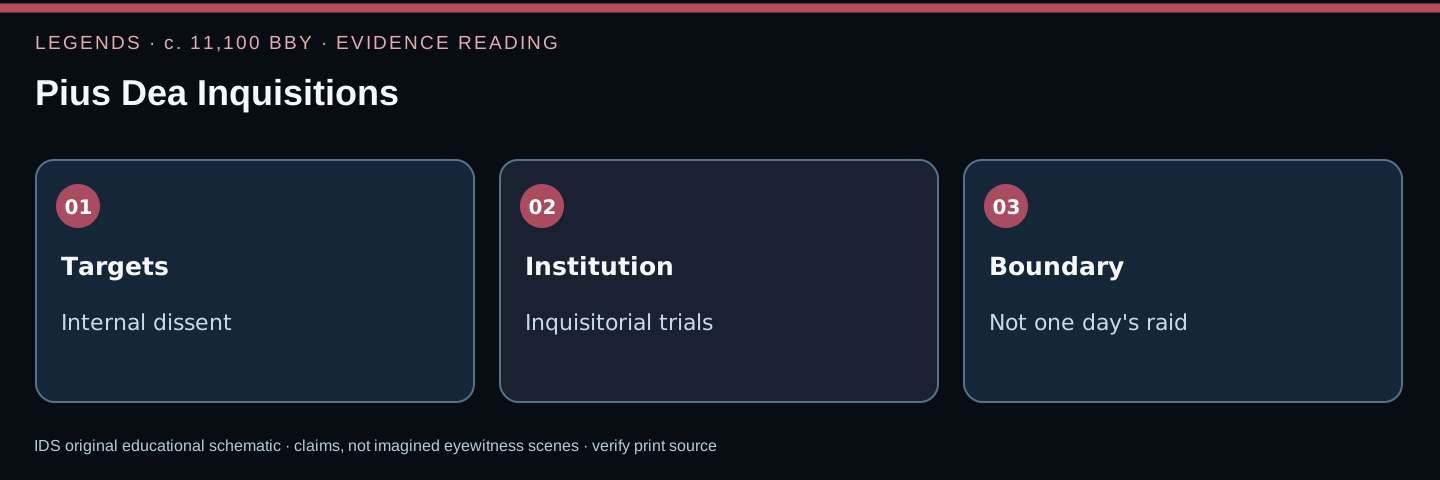
Test the evidence: Does calling a person a heretic prove the individual threatened Republic security?
Correction: No. The label describes a Pius Dea regime accusation; evidence of particular conduct is a separate historical question.
Continue the Pius Dea historical sequence → · Full campaign research guide →
Primary reference: Jason Fry and Paul R. Urquhart, The Essential Guide to Warfare (2012), publisher listing. The older Legends reference account needs exact print-page collation; political interpretation is separate from the stated event.
Sources and further reading
- Jason Fry with Paul R. Urquhart, Star Wars: The Essential Guide to Warfare, Del Rey, 2012.
- Pius Dea, Wookieepedia