
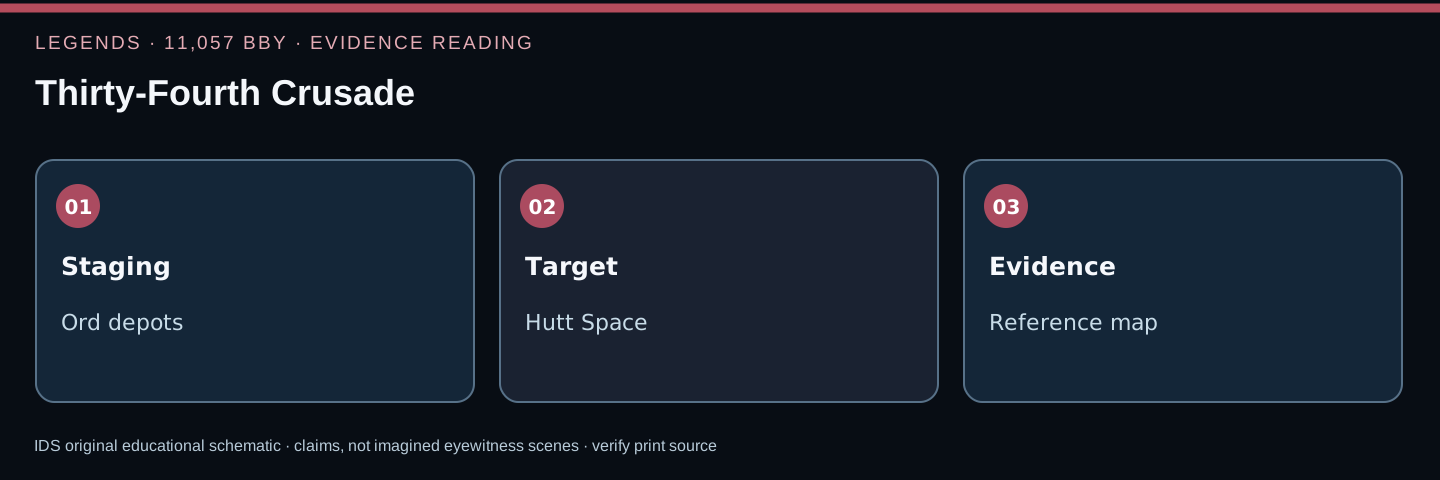
In 11,057 BBY, the Pius Dea Republic launched the Thirty-Fourth Crusade, the last numbered crusade in the surviving chronology. Once again the target was Hutt Space. Republic forces used Ord Dycoll, Ord Wylan, Ord Klina, Ord Ortag, and Ord Lonesome as staging bases for attacks toward Circumtore, Hollastin, Nar Kaaga, Riileb, and the southern Hutt frontier.
The last numbered crusade
More than nine hundred years had passed since Contispex I's first invasion of Hutt Space.
The return to Hutt targets near the end of the era shows the durability of the regime's original enemy image.
A mature military logistics network
Five Ord facilities supported attacks into the region.
The Pius Dea state had converted frontier depots into a standardized architecture for repeated war.
Hutt resistance across a millennium
Hutt communities survived recurring Republic invasions and later joined the coalition that helped destroy Pius Dea rule.
Long conflict created durable political memory on both sides.
Anthropological assessment
This event shows how political institutions, infrastructure, and collective identity interact across deep time. IDS separates documented facts from later reconstruction and avoids filling gaps with invented detail.
Pius Dea Era · 11,198–10,966 BBY · Legends
The persistence of a millennium-old enemy image
The Thirty-Fourth Pius Dea Crusade began in 11,057 BBY, centuries after Contispex I's first attacks on Hutt Space. The campaign's documented routes pass through a network of Ord bases before approaching different parts of Hutt-controlled space. This was a mature system of military staging, not simply an improvised raid prompted by one ruler. The continued choice of Hutt targets reveals how old categories of enemy and threat could survive changes in Chancellors and generations of naval officers.
The map of crusades provides better evidence for direction and the use of named bases than for the personal motives of any particular ship's captain. The designation Thirty-Fourth also requires care: it is the last numbered crusade identified in this sequence, not proof that all political repression or fleet actions stopped immediately afterward. The Pius Dea remained in power until 10,966 BBY and intensified suspicion toward people under its own jurisdiction.
Depots as a durable institution
Repeated offensives depend on facilities and personnel who persist between campaigns. An Ord station could become a permanent piece of infrastructure through which mobilization, supply and military culture were reproduced. A later generation could participate without having witnessed the grievance used to justify the first invasion.
Frontier memory from the other side
For inhabitants of Hutt Space, the Republic's recurring movements would have appeared as continuing external coercion rather than the normal work of a galactic government. The Hutts' eventual participation in a coalition against Pius Dea rule is understandable within that longer experience of hostility.
Was 11,057 BBY the final year of Pius Dea power?
No. It marks the start of the Thirty-Fourth numbered crusade. The regime survived until its defeat in 10,966 BBY.
Source record: The Essential Guide to Warfare (2012), crusade routes and Ord depot network. Publisher's sourcebook listing →. This account distinguishes the map or reference facts from IDS interpretation; no unsupported battle statistics, exact dates or invented dialogue.
Source-critical historical reading · 11,057 BBY
How a long crusading state sustained repeated invasions
The Thirty-Fourth Pius Dea Crusade demonstrates continuity of institutions under a government whose authority was weakening elsewhere. Launching another campaign toward Hutt Space required staging depots, navigational knowledge and commands to crews. A count of numbered crusades therefore records not just religious hostility but the long-term capacity of a state to organize ships, supplies and personnel for repeated coercive expeditions.
The Republic's use of Ord worlds makes the logistics significant. Military depots can become part of the civilian economy of the places hosting them, and they can institutionalize conflict by making future attacks administratively easier. This observation does not mean that every resident of an Ord world approved the policy or that every ship sailed along one documented corridor.
Legends sources identify this numbered campaign's timing and broad destinations, but a strategic reference map is not a witness to every engagement. We should not invent the appearance of cathedral ships at a specific settlement, the losses of Hutt communities or a victorious conclusion merely because the invasion began. The original IDS schematic emphasizes the limits of surviving evidence.
Test the evidence: Does numbering a crusade establish that it won every battle or occupied every listed destination?
Correction: No. The source establishes a named campaign and its broad targets, not universal success.
Continue the Pius Dea historical sequence → · Full campaign research guide →
Primary reference: Jason Fry and Paul R. Urquhart, The Essential Guide to Warfare (2012), publisher listing. The older Legends reference account needs exact print-page collation; political interpretation is separate from the stated event.
Sources and further reading
- Jason Fry with Paul R. Urquhart, Star Wars: The Essential Guide to Warfare, Del Rey, 2012.
- Thirty-Fourth Pius Dea Crusade, Wookieepedia