
LEGENDS · 137 ABY · Dac · orbital reconnaissance
Dogfight Above Dac: Rogue Squadron discovers the poisoned oceans
A six-fighter clash reveals the full scale of biological warfare and triggers Gar Stazi's effort to evacuate the planet.
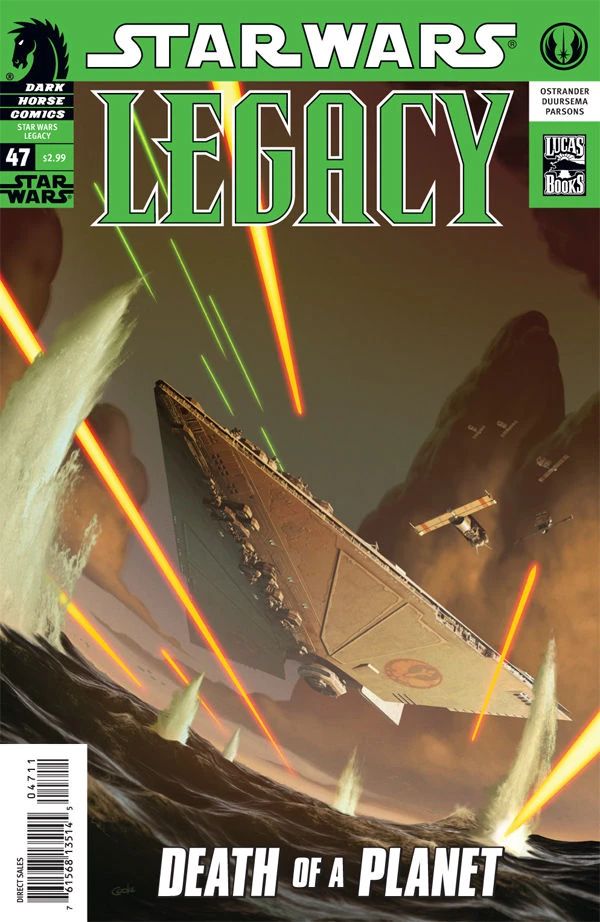
Continuity and method: This entry covers Star Wars Legends. Published comic art identifies the original source but is not a documentary photograph. Factual plot events are distinguished from anthropological interpretation and unrecorded dialogue or casualty totals are not invented.
A reconnaissance mission over a dying world
In 137 ABY the Galactic Alliance Remnant continued to gather intelligence above Dac while the Sith Empire occupied the planet. The Mon Calamari had already suffered mass killings after supporting the Alliance. A more devastating attack followed when Sith scientist Vul Isen released viral spores into the oceans on orders connected to Darth Wyyrlok's Final Protocol. The weapon targeted Dac's biosphere itself, causing catastrophic loss of life. Rogue Squadron's next reconnaissance sortie therefore became much more than a routine patrol.
The sight that revealed the scale of the crime
Three days after the release of the spores, Rogue Leader Anj Dahl brought a flight of CF9 Crossfire starfighters over Dac. Pilot Ronto noticed what looked like a new landmass in the sea. Mon Calamari Rogue pilot Monia Gahan recognized that the apparent island was made up of the bodies of dead inhabitants. The discovery changed the patrol's objective instantly. They now carried evidence of a mass atrocity that required emergency action, and their highest priority became relaying accurate information to Gar Stazi.
Six Imperial Predators intercept the Rogues
Six Predator-class starfighters from the Sith-Imperial Navy moved to engage the Alliance craft. Dahl ordered her pilots to withdraw and report the discovery rather than fight unnecessarily. Her decision recognized the importance of intelligence. Destroying enemy fighters would have little value if the message about the biological catastrophe never reached the fleet. The tension between combat and reporting is an important part of the incident and distinguishes it from a conventional encounter over territorial control.
Andurgo breaks formation
Rogue Squadron pilot Andurgo, enraged by the evidence of genocide, ignored the withdrawal order and attacked the Imperials. He destroyed the first Predator. His refusal to retreat forced Dahl to choose between enforcing her immediate command and protecting a subordinate who was now exposed to hostile fire. Rather than leave him behind, Dahl brought the remaining Rogues into the battle. The situation was caused by a disobedient action, but its resolution required rapid mutual protection.
The squadron wins the short battle
The Rogues destroyed all six pursuing Predator fighters. Andurgo's Crossfire received minor damage but remained capable of entering hyperspace. Dahl chose not to pursue an immediate punishment for his disobedience. The Alliance force avoided further engagement and left to report its findings. The incident has a clear tactical outcome, but it should not be exaggerated into the defeat of the Sith fleet over Dac. Six starfighters were lost by the attackers, while the larger planetary occupation remained in place.
Evidence reaches Gar Stazi
Upon returning to the Core Fleet, the pilots reported the mass poisoning. Stazi concluded that a large-scale evacuation was necessary before the remaining life of Dac was destroyed. News spread and volunteers, Alliance ships, Jedi, and Mon Calamari Rangers helped organize the rescue. The resulting evacuation involved much larger naval forces and complex political coordination. This dogfight mattered not because it won the later battle on its own, but because it supplied information that created a response while there was still time to save some inhabitants.
Anthropological assessment: witnessing and the ethics of intervention
Rogue Squadron's encounter demonstrates that recording a crime can matter more than punishing the first perpetrators encountered. The bodies seen from the cockpit were evidence of collective violence, not simply a tactical intelligence marker. Monia Gahan's knowledge made her able to interpret what the patrol saw. Dahl attempted to preserve that information while Andurgo reacted to the injustice by engaging immediately. The episode invites analysis of the relationship between bearing witness, responding to trauma, obeying military orders, and preserving a capacity to protect survivors.
Source, date and independent episode
This event is depicted in Star Wars: Legacy (2006) #47, released April 28, 2010. Its in-universe year is 137 ABY. The six-Predator encounter and Rogue Squadron's report must be distinguished from the Final Protocol attack that caused the deaths and the later mass evacuation of Dac. Those are separate timeline events. The cover is authentic published issue art and is identified as such, not a screenshot of the precise six-fighter engagement.
Interactive evidence challenge
Choose one answer per question, then see the complete assessment at the bottom.
Original publication and source record
Primary issue publications are the basis for the events. Secondary references help identify dates and names.