
- World
- Ilum
- Site
- Emperor's Fortress
- Mission type
- Reconnaissance
- Wider story
- Galactic Threads
- Historical layer
- Malgus's earlier New Empire
In 3623 BBY, the Alliance sent a reconnaissance team to investigate the Emperor's Fortress on Ilum. The site was not an arbitrary ruin. Centuries of recent history had already made Ilum a center of Jedi-Sith competition, and the fortress itself was closely associated with Darth Malgus's earlier breakaway empire. Returning to it during the search for Malgus and Darth Nul layered a new investigation onto an old rebellion.
Ilum has accumulated multiple layers of war
The planet's kyber deposits drew Jedi and Sith attention long before Malgus. During the Cold War and Galactic War it became a direct battlefield, and Malgus later used the fortress during his attempt to establish a New Empire.
A return to the site therefore means investigators are literally moving through several layers of political history.
Reconnaissance makes ruins actionable
A ruin matters strategically only when someone asks new questions of it. The team searched not for antiquarian interest but for evidence connected to present actors.
Old architecture becomes intelligence when current conflicts give its surviving traces new relevance.
The mission carries real human cost
The reconnaissance operation resulted in deaths among personnel sent to investigate. This keeps the story from becoming only an abstract puzzle about Sith history.
Knowledge gathering is itself a form of dangerous labor in wartime.
Event sequence
Shae releases the prisoner to pursue the Hidden Chain crisis.
Alliance teams follow multiple leads.
The Emperor's Fortress becomes a reconnaissance target.
Personnel investigate the old stronghold.
The mission advances the search while killing members of the reconnaissance team.
Explore the event
Why return to a place Malgus used years earlier?
Past bases can preserve habits, contacts, equipment, hidden spaces, or evidence revealing how a person thinks and where later plans might lead.
Is a ruin automatically an archive?
Not formally, but any abandoned site can preserve material traces. Archaeology and intelligence often overlap when investigators infer behavior from surviving objects and spaces.
Why distinguish this from later Galactic Threads chapters?
Real-world story delays created dating ambiguity after 7.5. This mission is securely grouped with 3623 BBY, while later content needs more explicit caution.
Anthropological assessment
The Emperor's Fortress is a layered landscape of power. Buildings survive governments and can be repeatedly reinterpreted by new occupants, enemies, historians, and investigators.
The reconnaissance mission also reminds us that knowledge production has labor costs. Intelligence histories often foreground commanders while obscuring the people who physically enter dangerous sites and sometimes die gathering evidence.
Sources and further reading
- 3623 BBY, Wookieepedia.
- Star Wars: The Old Republic, mission “Dark Heart of the Fortress.”
3623 BBY · Legends · Historical source commentary
Documented events and political anthropology
The event and the surviving evidence
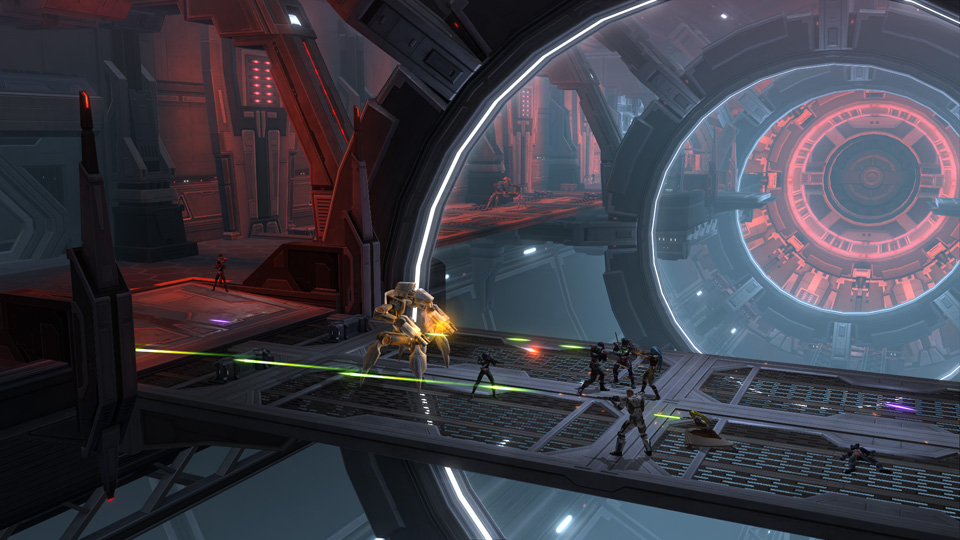
A destroyed imperial installation can remain dangerous after the government that built it loses control. SWTOR's Galactic Threads update introduces the Propagator Core XR-53, a Rakatan replicator droid salvaging resources from wreckage associated with the Emperor's Fortress on Ilum. This is more specific than a generic return to an Imperial base; the encounter concerns surviving machinery that is attempting to reconstruct itself.
Institutions, technology and collective life
The wreckage's continued operation shows how infrastructure outlives political authority. Technological artifacts can become autonomous hazards and resources for later groups. The publisher patch supports XR-53's origin and its repair behavior but does not prove precise numbers for every piece of the wreck or every intervening expedition.
Historical dating and what remains uncertain
The BBY date is an editorial Legends chronology placement. Release chronology is not necessarily fictional chronology, and story branches can modify outcomes. Unreported troop totals, dialogue and casualties are not reconstructed as facts.
Official source: SWTOR story record →
Test your historical judgment
Submit both questions to see a score with explanations and historical corrections.