
- World
- Yavin 4
- Leader
- Exar Kun
- Population
- Massassi
- Role
- Sith stronghold
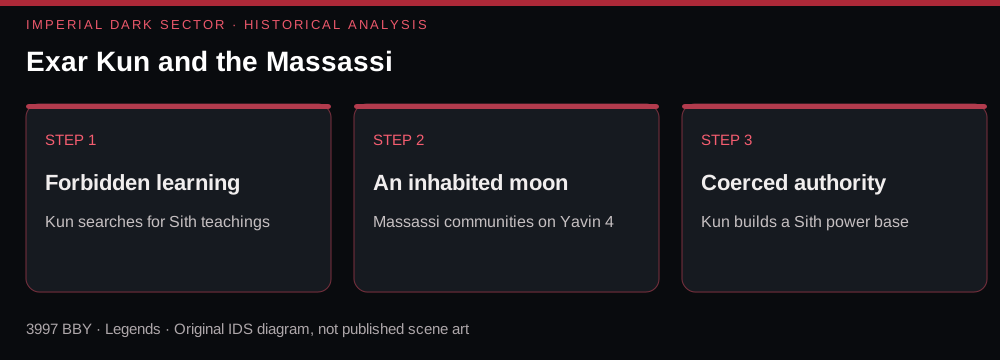
Exar Kun arrived on Yavin 4 in 3997 BBY as a former Jedi already committed to forbidden Sith learning. The jungle moon was not empty. Massassi communities descended from Naga Sadow's followers had preserved temples, rituals, and social continuity for roughly a thousand years. Kun treated that living society and its archaeological landscape as resources from which he could build a new Sith movement centered on himself.
3997 BBY · Legends · Comic source edition
Exar Kun takes control of a living Massassi world
What the story confirms
Issue four follows Exar Kun's search for forbidden Sith power, and the wider storyline brings him to Yavin 4. He encountered temples and Massassi descendants of Naga Sadow's followers. The structures were not isolated curiosities: they were embedded within a living society whose people could be forced into service.
What the usual retelling overlooks
Kun transformed the moon into a power base by taking control of its people and its sacred material heritage. A dramatic description of ancient ruins can otherwise obscure the fact that a living community was involved. His coercive use of Sith alchemy and later exploitation of Massassi labor need to be presented alongside his personal ascent.
Was Yavin 4 an uninhabited archaeological site when Exar Kun arrived?
No. Massassi communities lived there and had preserved traditions linked to the much older Sith exile. Kun imposed his own authority on an existing society.
Publisher's issue record: Marvel — Dark Lords of the Sith #4 →. An issue synopsis can verify the story's broad premise and publication details; specific scene details in the full comics still require panel-by-panel verification. The hero is an original labelled IDS illustration, not reproduced comic art.
Kun destroys the teacher he no longer needs
Freedon Nadd's spirit had guided Kun toward deeper Sith knowledge while expecting to use him as a successor or instrument. Once Kun gained sufficient power, he turned on the spirit and destroyed its immediate hold over him.
The relationship reproduces a recurring Sith pattern: knowledge is sought from a superior until superiority becomes intolerable.
The Massassi were a society, not scenery
The Massassi had lived on Yavin 4 since Naga Sadow's exile. They maintained communities, ritual specialists, monumental spaces, and inherited memories of Sith rule.
Kun's domination therefore constituted conquest of a living population, not merely discovery of abandoned ruins.
Sith alchemy transforms bodies as well as institutions
Kun used Sith practices on Massassi followers and exploited their physical and military capacities. Existing people became experimental subjects and instruments of war.
The process extends political domination into biological domination: the ruler claims authority not only over labor and allegiance but over bodies themselves.
Ancient architecture is repurposed for a new regime
Yavin's monumental spaces carried meanings inherited from Sadow's era. Kun reused and expanded them to anchor a political movement separated from the original builders by centuries.
This is archaeological appropriation in a literal sense: old sacred spaces gain new political meaning because a later ruler claims continuity with them.
A hidden moon becomes the center of a galactic movement
Yavin 4's isolation was strategically useful. Kun could train followers, experiment, and build power away from ordinary Republic oversight.
Its remoteness also made the Massassi more vulnerable. There was no nearby state authority capable of intervening on their behalf.
Event sequence
Kun follows Sith knowledge from Dxun to Yavin 4.
He breaks with and destroys Freedon Nadd's spirit.
Kun subjugates Massassi communities and appropriates temple complexes.
He confronts Ulic Qel-Droma; Marka Ragnos's spirit binds their movements together.
Yavin 4 becomes the hidden center of the Great Sith War.
Explore this entry
Were the Massassi simply Sith monsters?
No. Legends depicts them as descendants of an old Sith caste and a living community with its own social continuity. Later mutation and militarization should not erase that history.
Why did Kun choose Yavin 4?
It combined isolation, ancient Sith infrastructure, a population with inherited ritual knowledge, and distance from Republic observation.
What makes this an archaeological story?
Kun claims authority by possessing ancient places and knowledge. He uses material remains to construct a political genealogy linking himself to earlier Sith.
Anthropological assessment
Yavin 4 illustrates the political use of archaeology. Ancient monuments are not passive evidence when later leaders use them to claim authenticity, continuity, and sacred authority.
Kun's treatment of the Massassi also demonstrates colonial domination: a living community is redefined as labor, military capacity, experimental material, and proof of the conqueror's legitimacy.
Original comic / interpretive case study
A living society becomes an archaeological resource
When Exar Kun arrived on Yavin 4, he encountered the Massassi descendants of those who had served Naga Sadow many generations earlier. The monumental structures of the moon were therefore not simply abandoned scenery. They existed within a society with inherited practices and memories. Kun treated those people, their sacred sites and the knowledge associated with Sith alchemy as resources for building his authority. The politics of the site predated him, even though later accounts often present Yavin 4 chiefly as Kun's headquarters.
Kun's consolidation depended on his ability to control both bodies and historical narratives. He rejected Freedon Nadd as a mentor, appropriated old Sith symbols and used the Massassi in experiments and military preparations. Recruiting Jedi students from Ossus further enlarged his authority, but those new followers entered a system already built on the subordination of an existing population. In the later 3996 BBY ritual, Kun sacrificed Massassi lives in an attempt to preserve himself. That ending was not an unforeseen exception to otherwise benign leadership; it grew from the assumption that the people of Yavin 4 existed for his goals.
The language of discovery conceals conquest
A visitor arriving at ancient temples may treat surviving inscriptions and architecture as relics disconnected from living communities. On Yavin 4, the Massassi still inhabited the environment. Their later depiction as troops and sacrifices should not erase their prior social existence.
A hidden base depends on people
Kun's secrecy and experiments required labor, guards and people able to use local architecture. Isolated headquarters are rarely empty: their effectiveness can depend on populations outsiders scarcely see.
Was Yavin 4 uninhabited before Exar Kun appeared?
No. Massassi descendants of Naga Sadow's followers lived there. Kun established control over an existing society rather than creating it.
Original issue: Tales of the Jedi: Dark Lords of the Sith #5–6 (1995). Dates and continuity refer to Legends; analysis of institutions, memory and aftermath is interpretation rather than a depiction of unshown dialogue or events.
Sources and further reading
- Tales of the Jedi – Dark Lords of the Sith.
- Tales of the Jedi – The Sith War.
- Jedi vs. Sith: The Essential Guide to the Force.