
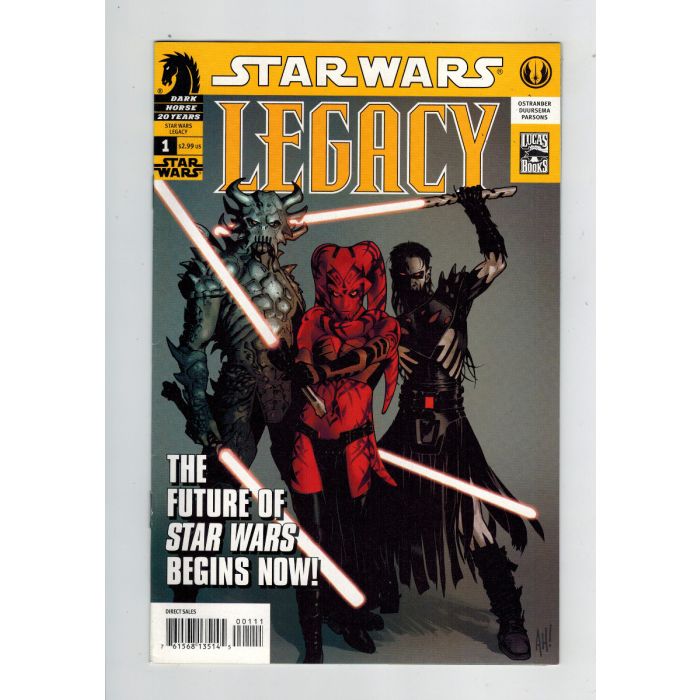
Continuity note: This story is Legends, not Canon. Its Fel Empire, Krayt's One Sith and the Skywalker descendants belong to the published Dark Horse Legacy timeline, distinct from events after the Battle of Exegol.
Three years of conflict break the Alliance
The Sith–Imperial War ended in 130 ABY after major Galactic Alliance military defeats. Coruscant came under Fel Imperial control, and the Galactic Alliance government surrendered. The war left an exhausted political community with little ability to protect its remaining institutions.
Victory rests on a dangerous alliance
The Fel Empire's success depended in part on aid from Darth Krayt's One Sith, whose real objectives diverged from those of Emperor Roan Fel. Imperial officials could celebrate the restoration of centralized rule without recognizing that their military partners were preparing a coup.

The Alliance survives as a remnant
Not all Alliance forces accepted the settlement. Admiral Gar Stazi and other surviving officers reorganized what remained of the fleet into a resistance movement. These forces preserved a competing political claim and would later cooperate with other enemies of the Sith.
The Jedi seek refuge
Jedi who resisted Sith participation retreated toward surviving strongholds such as Ossus. Their ability to maintain teaching communities and protect students was threatened by the same military structures that had defeated the Alliance.
Anthropological assessment
The defeat separates the legal end of a government from the continued existence of its communities and values. A surrender can dissolve central institutions while dissident military units and civilian networks continue to represent a former political order.
Interactive evidence lab
Did the Galactic Alliance disappear without any survivors?
No. Admiral Gar Stazi led the Galactic Alliance Remnant after the central government's defeat.
Explore the published event from different perspectives.
Ethics and institutions scenario
Choose a research approach to see its implications.
Select one option above.
These are interpretations, not rewritten outcomes for the Star Wars story.Legends · Original comic research · 127–139 ABY
Defeat did not erase the Alliance
The conclusion of the Sith–Imperial War deprived the Galactic Alliance of its central political position and much of its military strength. But its defeat did not mean that every person who served it accepted a new allegiance. Admiral Gar Stazi and surviving ships retained an Alliance identity and later fought the Sith Empire. It is important to distinguish the fall of a government from the disappearance of an institution's personnel, traditions and political commitments.
The Fel Empire could claim victory over the Alliance, yet its alliance with the One Sith was inherently unstable. Krayt's agents did not intend to remain permanent auxiliaries of Roan Fel. The military ending in 130 ABY was followed by an attempt to seize the Imperial government itself. The first Legacy collection supplies the published issues for this sequence but does not give a complete inventory of surviving Alliance units in its promotional description. Readers should not infer that every remaining fleet captain obeyed the same command.
IDS analyzes the persistence of political identity after institutional defeat. A surrendered capital and the continued existence of an organized remnant can be historically simultaneous. The Fel palace crisis traces the division among supposed victors. The attack on Ossus shows how a different institution, a religious teaching community, endured the same change of power.
Publisher record: Marvel Comics issue or collection. Original panels are required for precise scene dialogue and claims not supported by the catalog. The fictional year is not the publication year. Analysis of institutions and cultural practice is IDS interpretation.
Primary comics and research background
Star Wars: Legacy (2006) #0–1; Legends chronology 130 ABY. View issue or continuity details →.