
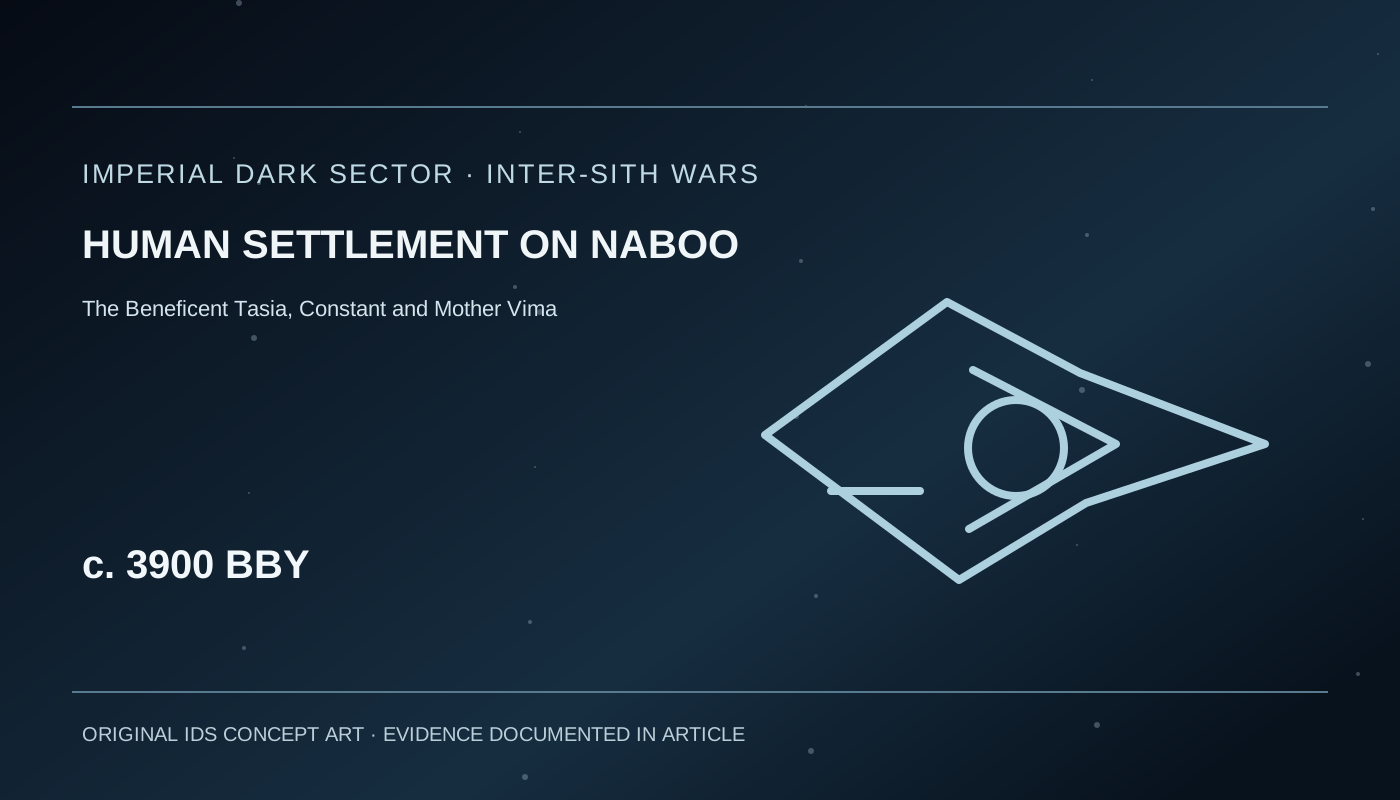
Queen Tasia sponsored one of her final expeditions as civil war consumed Grizmallt. Led by scout Kwilaan and blessed by a Jedi Master, the Beneficent Tasia and support ships Constant and Mother Vima carried refugees into the southern quadrant. Contact was lost and Grizmallt assumed the expedition had failed. Instead the ships reached the world then called Nabu, and the refugees established permanent Human colonies whose descendants became the Naboo.
c. 3900 BBY · Legends · Historical method
HUMAN SETTLEMENT ON NABOO
Evidence, dates and historical boundaries
About 3900 BBY, Queen Tasia’s three-ship expedition reached the world known to earlier Grizmallti as Nabu and later called Naboo. It had been known to Grizmallti visitors around 4000 BBY, but the refugee expedition founded enduring Human settlements in a later phase. Sources name the ships Beneficent Tasia, Constant and Mother Vima, led by Kwilaan. The expedition lost communication with home; some accounts describe one craft crashing while others landed. The colonists' descendants developed a distinctive Naboo Human culture. However, the planet was not uninhabited and the Humans were not its first sentient society.
Anthropological interpretation
The Grizmallti settlement was migration and colonization simultaneously: a refuge for people fleeing warfare and a new territorial claim in an already inhabited environment. Gungan communities had lived on the planet for generations and had their own political organizations, languages and ecological practices. Human settlers inherited elements of Grizmallti monarchy and Royal Script, later developing the Naboo Futhark. The transformation of writing and royal ceremony shows cultural continuity and change without making the settlers culturally identical to their ancestors.
Trace the historical sequence
- Earlier Grizmallti observers know the planet as Nabu
- The three-ship refugee expedition reaches Naboo c. 3900
- Human settler communities develop alongside preexisting Gungan societies
Primary research trail: The New Essential Chronology; Star Wars: Galactic Battlegrounds (2001); Secrets of Naboo; The Essential Atlas. Supporting references →. Original illustration is interpretive, not a verified literal event screenshot or comic art.
A lost expedition becomes a founding narrative
Grizmallt believes the ships vanished, while the migrants create a new society beyond routine communication.
Separation allows institutions, language, and identity to diverge.
Royal Grizmallti culture leaves visible descendants
Naboo writing and symbolism later retain connections to Grizmallti forms.
Migration carries material and political culture even when contact with the origin society breaks.
Anthropological assessment
Naboo's Human society begins through migration shaped by both colonial ambition and refugee flight.
Founding narratives often compress these mixed motives into a cleaner origin story than the historical situation supports.
Primary context · Old Republic research
The voyage that created a lasting Naboo settler society
The Grizmallti migration to Nabu around 3900 BBY was not the same event as the earlier discovery and aristocratic visits to the world. It marked the arrival of people who would remain and build a self-sustaining Human society. Queen Tasia sponsored the expedition, which traveled aboard the Beneficent Tasia, Constant and Mother Vima under the scout Kwilaan. The ships encountered serious difficulties, contact with the homeworld failed and at least one vessel crashed. Nevertheless the refugees survived and established settlements. The colony's later name, Naboo, came to identify a distinctive political and cultural community descended from the migrants.
Migration carries institutions as well as people. The settlers' descendants retained elements of Grizmallti writing and symbolism, but isolation encouraged new uses and meanings to emerge. The Royal Script of Grizmallt and the later Naboo Futhark are particularly useful for illustrating a long connection without assuming their users continued to belong to one unified state. The society that formed on Naboo was related to, but not a mere copy of, the political culture of the former homeworld. Its eventual monarchy and regional centers developed through further history that should not be projected wholesale onto the first landing.
The word settlement also has two perspectives. For arrivals who had fled civil war, landing created safety and the chance to build families and institutions. For the indigenous Gungans, these newcomers were entering a world with existing territory, history and political relationships. Initial contacts did not universally produce immediate violence: the Galactic Battlegrounds lore describes guarded coexistence and early settlement before hostility deepened over later decades. The chronology should preserve that distinction rather than assert an automatic war on the first day.
The meaning of a lost expedition
Grizmallt lost ordinary contact and assumed the ships had failed. The surviving migrants generated a new collective memory on Naboo. The event has opposite meanings when viewed from the abandoned homeworld and from the destination settlement.
Scripts and symbols travel
Naboo cultural forms retained traces of Grizmallti precedent while changing in a new society. The connection shows how material and written traditions can survive migration without every custom or political rule remaining identical.
Did the expedition find a completely uninhabited planet?
No. Gungan societies were indigenous to the world and predated Human migration. The 3900 BBY date refers to lasting Human settlement, not the beginning of Naboo's history.
Original reference works: Star Wars: Galactic Battlegrounds lore; The Essential Atlas; The New Essential Chronology; Secrets of Naboo. Interpretations of identity, governance and displacement are IDS analysis, not additional plot events. Compare secondary chronology and source listings →
Historical judgement · c. 3900 BBY
What do the sources actually establish?
Choose two answers to receive corrections, a score and deeper historical context. Revise your interpretations and try again.
Sources and further reading
- The New Essential Chronology.
- Secrets of Naboo.
- The Essential Atlas.