
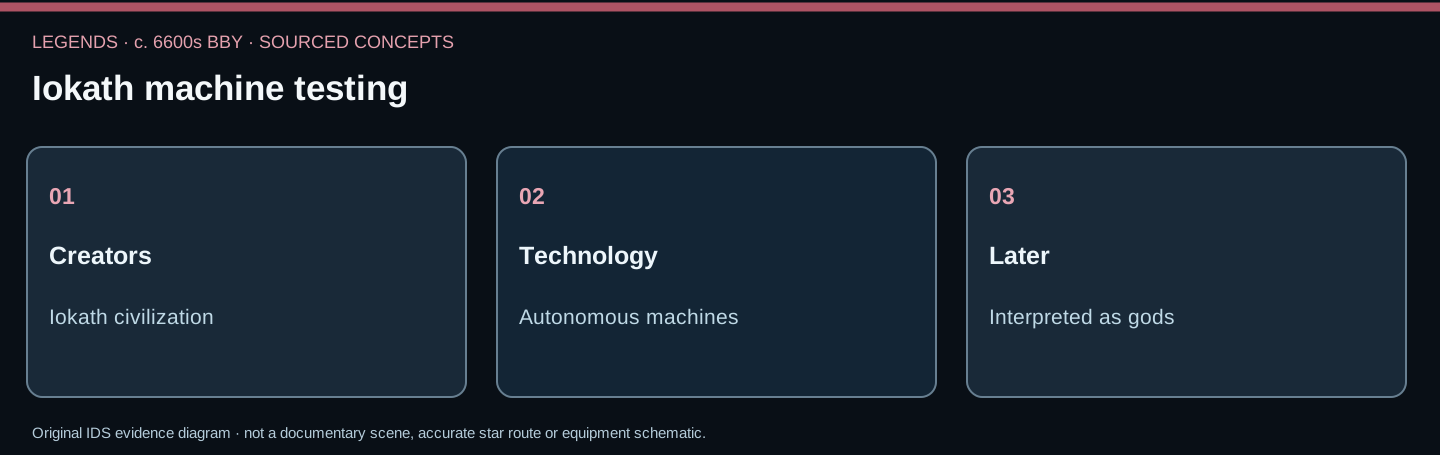
Around the 6600s BBY, the unidentified species that built the artificial world Iokath deployed massive autonomous machines into Wild Space for live testing. These constructs were treated by later societies as gods, but to their creators they were weapons and experiments. Entire environments became proving grounds for technologies designed on Iokath.
An artificial world and its creators
Iokath was constructed rather than naturally formed.
Its builders developed machines on a scale that later civilizations misunderstood as supernatural.
Inhabited worlds as test environments
The machines were deployed across Wild Space to observe destructive and strategic performance.
Testing therefore imposed technological risk on populations outside the creators' own world.
Weapons remembered as gods
Later cultures transformed encounters with the machines into mythic or religious narratives.
Extreme technology can become indistinguishable from divinity to societies without access to its technical origin.
Anthropological assessment
Iokath shows how unequal technological knowledge can produce religious interpretation. A machine designed as a weapon by one society can be remembered as a deity by another.
The experiments also raise a colonial problem at interstellar scale: distant populations were treated as environments for testing rather than as political communities with consent.
Legends · c. 6600s BBY · Evidence-based analysis
A machine's divine status depends on the society encountering it
The creators of Iokath constructed autonomous war machines powerful enough to affect societies far from their artificial world. Their experiments form part of the later Legends history explored in Star Wars: The Old Republic. Accounts of massive artificial beings worshiped as gods by later populations should distinguish the creators' technological purpose from the meanings other societies gave the machines after contact.
The label 'machine god' is therefore an interpretive category. To a society encountering overwhelming autonomous machinery, the distinction between superior engineering and divinity may not be obvious or politically convenient. From an anthropological perspective, the important question is how encounters with technology reshape authority, fear and ritual, not whether a later population correctly used a modern engineering vocabulary.
The surviving game accounts do not constitute a complete engineering archive from the 6600s BBY. The date is a retrospective Legends placement, and precise test routes, unknown laboratories or orders by unnamed inventors must not be fabricated. The original IDS illustration deliberately labels creators, deployed constructs and later interpretations separately.
Historical judgment: Does a later culture's worship of Iokath machines prove the machines were designed as deities by their creators?
Explanation: No. Their creators' use of technology and a later society's religious interpretation are different historical claims.
Compare related timeline event → · Complete chronology →
Reference family: Star Wars: The Old Republic, Iokath and Machine Gods game storyline. The original print or game source still requires detailed edition/panel or quest review; undocumented numerical claims and visual details are not supplied.
Sources and further reading
- Star Wars: The Old Republic — Knights of the Eternal Throne.
- Manderon Period, Wookieepedia