
- Site
- Iokath
- Threat
- Six machine gods
- First awakened
- Tyth
- Final threat
- Izax the Destroyer
The War on Iokath opened a second crisis beneath the political battle. Iokath's enormous combat machines—Tyth, Aivela, Esne, Nahut, Scyva, and Izax—were not decorative religious icons. They were engineered superweapons with identities, roles, and combat systems powerful enough to threaten the people fighting over the world.
A pantheon built as a weapons system
Iokath's creators encoded their war machines through the language of divinity. Tyth embodied rage, Nahut operated through concealment, Scyva functioned as a maternal machine figure, and Izax stood as the ultimate destroyer.
The names matter because machine identity shaped how later users understood the devices. Technology was presented as mythology even though its effects were mechanical and military.
Tyth turns conflict into fuel
Tyth's reactivation during the Iokath war linked the machine threat directly to the political violence around it. The factions' struggle over technology helped awaken technology designed to thrive amid struggle.
The irony is central: states hoping to gain strategic advantage created the conditions for a weapon none of them controlled.
Each machine reveals another layer of Iokath's defenses
Defeating one God did not shut down the system. Alliance teams instead moved through a chain of increasingly dangerous machine entities, including Aivela and Esne, the stealth-oriented Nahut, and Scyva.
The structure suggested a designed hierarchy rather than isolated robots accidentally left active.
Izax embodies the limits of inheritance
The final confrontation with Izax demonstrated how little the present-day factions actually controlled the machine world. Possessing access codes, territory, or even the Eternal Fleet did not mean inheriting the knowledge of Iokath's creators.
Survival required defeating the system piecemeal rather than becoming its new master.
3629 BBY · Legends · Evidence reviewed
Gods from the Machine: history and interpretation
Historical evidence
The Gods from the Machine are technological weapons built by Iokath's creators, not documented supernatural beings. Their names and scale of destruction explain why later populations describe them in divine language. Their encounters unfold across multiple releases of the Operation and should not be presented as one simultaneous fight.
Anthropological assessment
The machine-gods expose the limits of using weapons without understanding them. Combat around Tyth becomes part of the problem rather than a guaranteed solution. Calling these artifacts heritage is an analytical choice; that interpretation does not convert their engineered destructive abilities into historical religious belief.
Dating and source limits
The BBY year is a Legends chronology placement. A real-world update release date is not independent proof of an exact in-universe year. Playable branching results are not one fixed history.
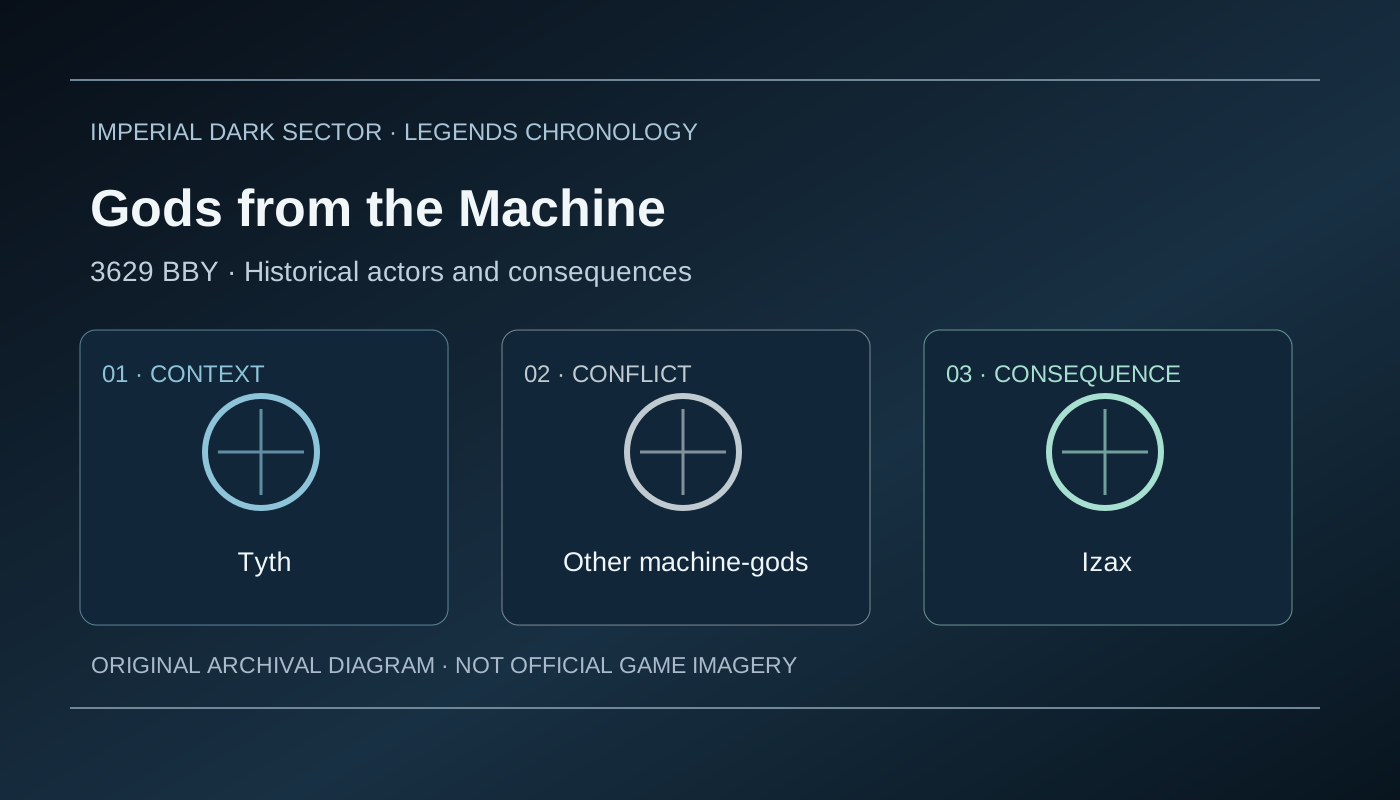
Publisher evidence: Official SWTOR update and source trail →. The diagram is original analytical art rather than a game screenshot.
Event sequence
The War on Iokath activates the God of Rage.
Linked machine intelligences expand the threat.
Stealth and superweapon systems deepen the crisis.
Alliance forces push toward the heart of the machine pantheon.
The Destroyer becomes the final major machine-god threat.
Explore this entry
Are the Machine Gods literally supernatural gods?
They are presented as ancient artificial superweapons and machine intelligences. The divine vocabulary reflects how their creators encoded identity and how later people understood their overwhelming power.
Why not just turn them off?
Iokath's surviving systems were autonomous, layered, and only partially understood. Modern factions could activate or trigger components without possessing full administrative mastery.
What does the crisis say about Iokath's creators?
Their society built war into the architecture of an artificial world and personified destructive functions as a pantheon. That suggests an institutional culture in which weapons, ritual identity, and political authority were deeply intertwined.
Anthropological assessment
The Machine Gods blur religion and engineering. A society can make machines culturally sacred without those machines ceasing to be material technologies.
For later societies, the distinction becomes even less stable. People encounter artifacts whose original technical logic has been lost, so mythic language becomes one practical way to classify powers they cannot reproduce.
3629 BBY · Old Republic · Legends
Why this event matters: Technology and the Machine Gods
The crisis challenges assumptions about control over autonomous systems and inherited technological power.
Anthropological interpretation: The event can be examined through institutions, social loyalties and the control of resources or information. That analytical perspective should not be confused with additional source-documented scenes.
Evidence check: documented event or interpretation?
The event and its broad place in the chronology are source-based. The social implications above are interpretation; exact private motives, undocumented dialogue and unreported casualties are not asserted.
Sources and further reading
Test your historical judgment
Check both answers to receive corrections and an explanation of the evidence.