
- World
- Iokath
- Prize
- Ancient superweapons
- Major powers
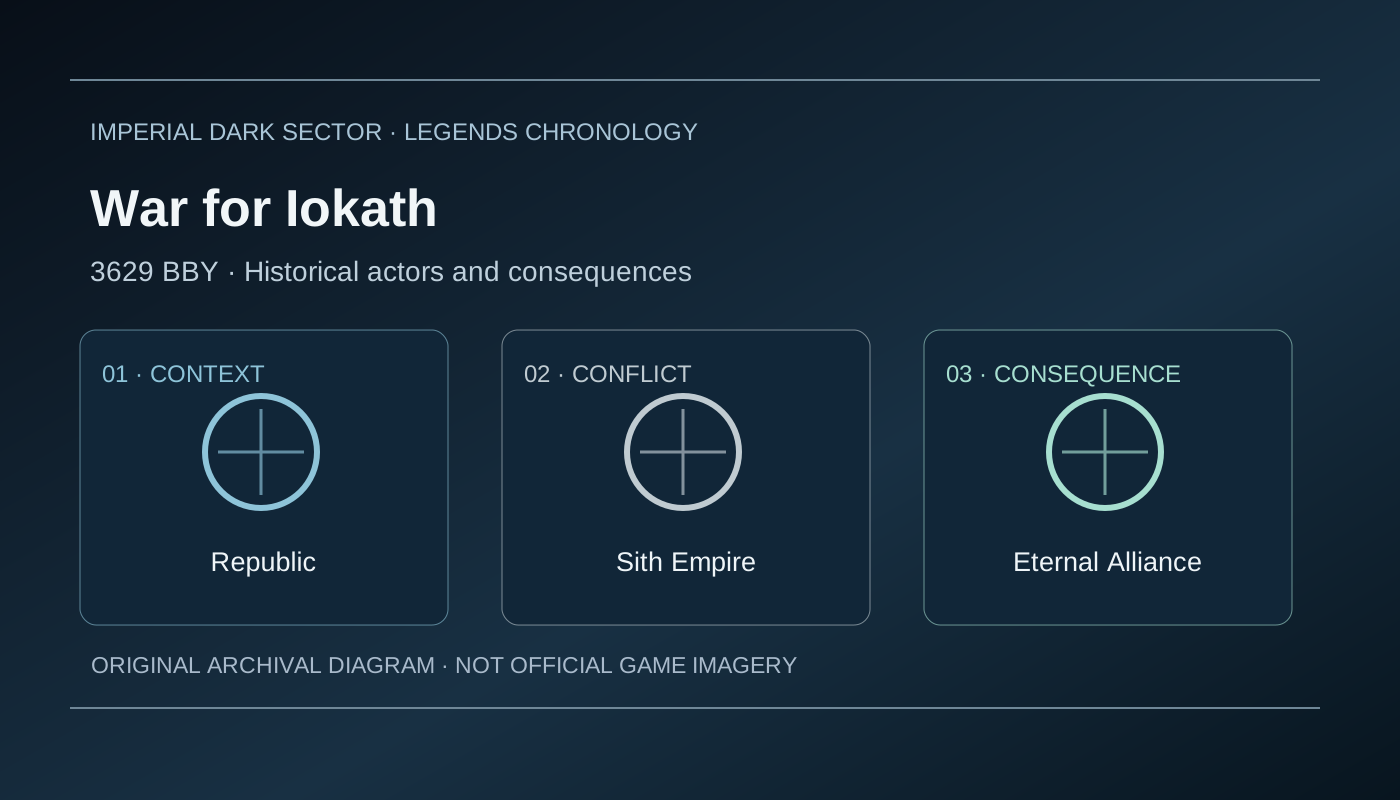
- Republic, Sith Empire, Eternal Alliance
- Key machine
- Tyth
In 3629 BBY, reports of a superweapon on Iokath shattered the uneasy post-Zakuul balance. The Galactic Republic and Sith Empire both moved forces to the artificial machine world, even though Iokath lay at the technological heart of the Eternal Alliance's own rise. The Commander was forced to choose a battlefield alignment while automated systems and dormant war machines reactivated around all three factions.
Why Iokath could destabilize the galaxy
Iokath was not merely another weapons cache. Its builders created technology capable of exterminating civilizations, the Eternal Fleet, the Gravestone, and machine-gods designed as planetary or system-scale weapons. Whoever mastered that infrastructure could recreate the asymmetry that had allowed Zakuul to dominate both Republic and Empire.
The Republic and Sith therefore treated access as an existential question. Letting a rival gain Iokath technology could make ordinary fleet strength irrelevant.
The Alliance loses the luxury of standing above the old war
After taking the Eternal Throne, the Alliance had attempted to exist as an independent third power. Iokath forced the Commander back into the Republic-Sith rivalry. Both states wanted the Commander's fleet and access, but neither accepted permanent Alliance superiority.
The choice of battlefield partner thus became a decision about identity: whether the Alliance was an autonomous postwar order or a temporary coalition destined to realign with older institutions.
Tyth awakens
The conflict triggers the reactivation of Tyth, one of the machine entities called the Gods from the Machine. Tyth was built around destructive combat behavior and could feed on surrounding conflict.
That design gives the battle an unusual feedback loop: political violence does not merely occur around a weapon; violence itself helps activate and empower the technological system.
No faction truly masters Iokath
Despite the struggle for control, Iokath remains dangerous, only partly understood, and full of autonomous systems. The war does not end with one government cleanly inheriting the creators' technology.
The inability to convert occupation into technological mastery foreshadows the Machine Gods crisis and demonstrates the limits of treating ancient infrastructure as ordinary captured matériel.
3629 BBY · Legends · Evidence reviewed
War for Iokath: history and interpretation
Historical evidence
The machine world held resources and superweapons capable of changing the strategic balance. Both old galactic powers feared leaving such technology to the other. The Commander's alliance with Republic or Empire is player-dependent, but the struggle over dangerous Iokath systems is common to the storyline.
Anthropological assessment
Iokath is also a contest over the material remains of a vanished civilization. Archaeological study and military exploitation become inseparable when an artifact can still kill. Physical occupation does not guarantee command of autonomous weapons or reliable knowledge of their operation.
Dating and source limits
The BBY year is a Legends chronology placement. A real-world update release date is not independent proof of an exact in-universe year. Playable branching results are not one fixed history.
Publisher evidence: Official SWTOR update and source trail →. The diagram is original analytical art rather than a game screenshot.
Event sequence
Republic and Sith forces race toward Iokath.
The Commander intervenes rather than remaining neutral.
Old Republic-Sith rivalry returns around ancient infrastructure.
The God of Rage becomes an active threat.
Iokath remains contested and the machine-god threat expands.
Explore this entry
Why did both old superpowers risk fighting the Alliance?
Because Iokath technology could overturn the entire balance of power. Allowing a rival to monopolize a civilization-killing weapon looked more dangerous than provoking the Alliance.
Is Darth Acina's death fixed?
No. SWTOR branches depending on player alignment. Some reference chronologies present one outcome, but the game itself permits alternatives, so IDS marks the leadership death as branch-dependent.
Why is Iokath an archaeological story too?
Every faction is interpreting and exploiting technology created by a vanished civilization whose purposes they only partly understand. The war is therefore also a struggle over ancient material culture.
Anthropological assessment
Iokath is an example of technological heritage becoming geopolitics. Ancient artifacts are not neutral remains when they can still function as weapons.
The crisis also demonstrates how a newly powerful third actor can be pulled back into an older bipolar conflict. Republic and Sith institutions survived Zakuul and quickly reasserted their rivalry once the common enemy disappeared.
3629 BBY · Old Republic · Legends
Why this event matters: The struggle for Iokath
Rival powers seek control over technology whose consequences extend beyond a conventional territorial dispute.
Anthropological interpretation: The event can be examined through institutions, social loyalties and the control of resources or information. That analytical perspective should not be confused with additional source-documented scenes.
Evidence check: documented event or interpretation?
The event and its broad place in the chronology are source-based. The social implications above are interpretation; exact private motives, undocumented dialogue and unreported casualties are not asserted.
Sources and further reading
- SWTOR Game Update 5.2: The War for Iokath
- SWTOR: “The War for Iokath: A Deadly Superweapon Emerges”
- 3629 BBY chronology
Test your historical judgment
Check both answers to receive corrections and an explanation of the evidence.