
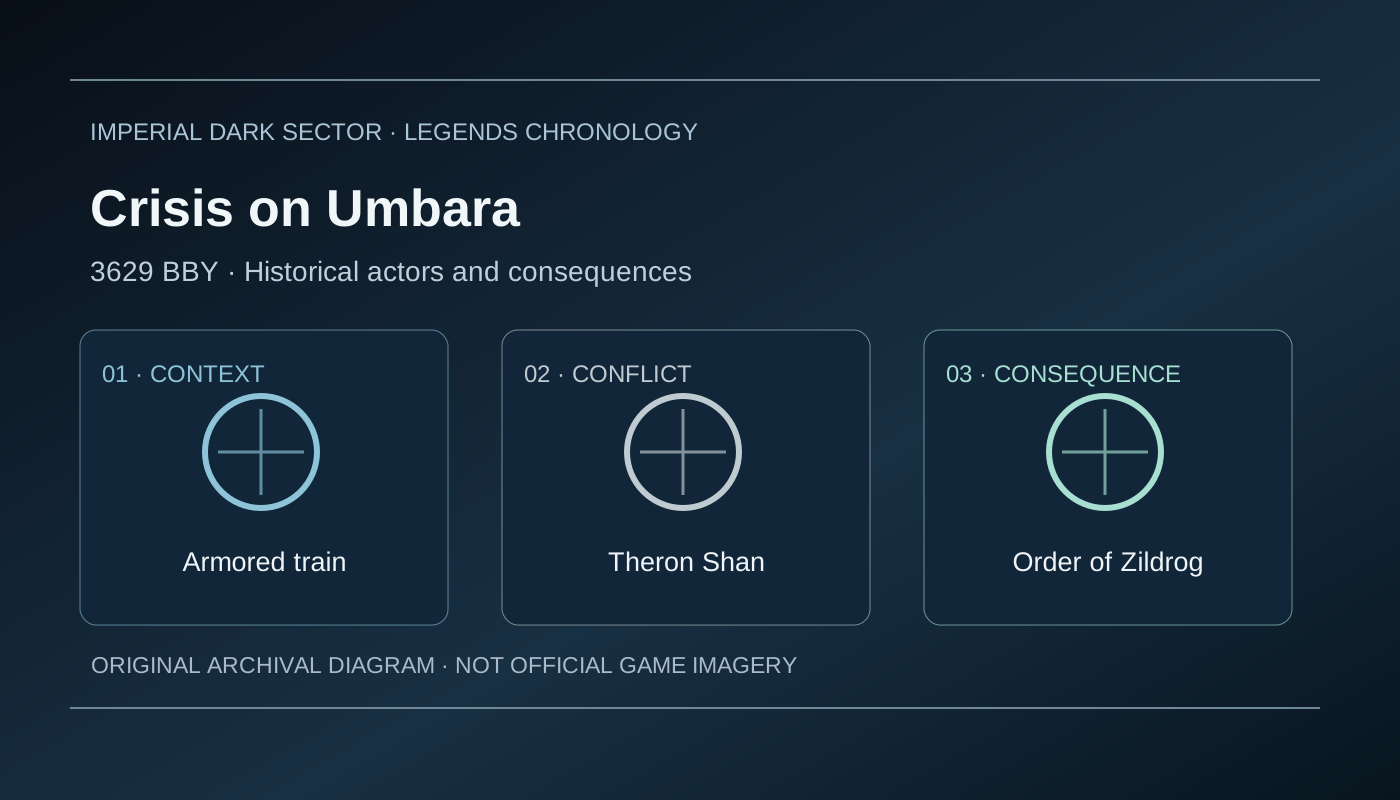
- World
- Umbara
- Target
- Adegan crystal shipment
- Suspected traitor
- Theron Shan
- Hidden enemy
- Order of Zildrog
Later in 3629 BBY, Alliance intelligence led the Commander to an armored train racing across Umbara. Theron Shan, one of the Alliance's principal intelligence figures, appeared to sabotage the mission, cooperate with enemies, and abandon the organization he had helped build. To almost everyone around him, the evidence looked like betrayal.
The battle takes place on infrastructure in motion
The central encounter unfolds across an Umbaran train carrying adegan crystals. The moving platform turns logistics into battlefield terrain: cars, cargo, defenses, and speed all become part of the conflict.
Adegan crystals were valuable strategic materials, making the train an economic and military target rather than an arbitrary setting.
Theron's credibility makes the betrayal believable
Theron had served the Republic Strategic Information Service before becoming one of the Alliance's most important agents. His access gave him the ability to cause real damage and made apparent defection especially threatening.
At the same time, that background made him one of the few people capable of sustaining a deep-cover operation against a hidden organization.
The Alliance has to act on incomplete evidence
Leaders cannot wait for perfect historical knowledge. In the moment, Theron's behavior looked hostile, people were dying, and strategic assets were at risk.
The crisis therefore becomes an intelligence problem: when does skepticism toward an apparent traitor become negligence, and when does certainty become manipulation by the real enemy?
The Order of Zildrog enters the timeline indirectly
The Order did not reveal its full agenda on Umbara. Instead, the organization became visible through Theron's apparent defection and the trail he left behind.
That concealment was part of its power. The Alliance knew an insider had turned against it before it understood the institution he was trying to penetrate.
3629 BBY · Legends · Evidence reviewed
Crisis on Umbara: history and interpretation
Historical evidence
Theron Shan's actions during the moving-train mission appear to confirm his betrayal of the Alliance. Subsequent revelations recast the episode as part of an infiltration operation. A reliable timeline keeps the participants' immediate suspicions separate from information learned later, even though both belong to the same historical narrative.
Anthropological assessment
The train's cargo, narrow passages, speed and dangerous terrain make infrastructure itself part of the battlefield. Commanders must respond without knowing the entire covert plan. The episode illustrates how incomplete intelligence shapes urgent decisions, not that all suspicion was irrational.
Dating and source limits
The BBY year is a Legends chronology placement. A real-world update release date is not independent proof of an exact in-universe year. Playable branching results are not one fixed history.
Publisher evidence: Official SWTOR update and source trail →. The diagram is original analytical art rather than a game screenshot.
Event sequence
The Commander pursues an armored train on Umbara.
His actions appear to sabotage the mission.
Theron flees and is treated as a rogue operative.
The search for motives and associates expands.
Copero and Nathema reveal the Order of Zildrog infiltration.
Explore this entry
What did the Alliance believe at this point?
That Theron had betrayed it and was working toward a destructive plan of his own or with hostile partners.
What was Theron actually doing?
He was attempting to penetrate the Order of Zildrog from inside. Revealing that goal too early could have exposed him to the organization.
Why is this useful historically?
It demonstrates hindsight bias. Later knowledge makes Theron's choices easier to interpret, but the people living through Umbara did not yet possess that explanation.
Anthropological assessment
Espionage depends on controlled identity. Deep-cover agents survive by making false relationships credible, which means allies may experience the deception as genuine betrayal.
Umbara also highlights how archives change moral judgment. The same action can be categorized as treason in one moment and covert service once hidden context becomes available.
3629 BBY · Old Republic · Legends
Historical context: Trust within the Eternal Alliance
Apparent betrayal exposes how coalitions depend on imperfect intelligence and contested personal loyalties.
Anthropological lens: Political power depends on control of institutions, transport and shared loyalties as well as battlefield outcomes. This paragraph is analysis, not an additional undocumented event.
Evidence check: what can we infer?
The documented event supports discussion of its wider context. It does not prove unrecorded dialogue, unnamed participants' intentions, exact casualties or precise logistical quantities.
Sources and further reading
- Star Wars: The Old Republic, Flashpoint: “Crisis on Umbara.”
- 3629 BBY chronology
Test your historical judgment
Check both answers to receive corrections and an explanation of the evidence.