
- World
- Coruscant
- Institution
- Jedi Order
- Site
- Jedi Temple
- Milestone
- Major additions
- Date
- c. 3500 BBY
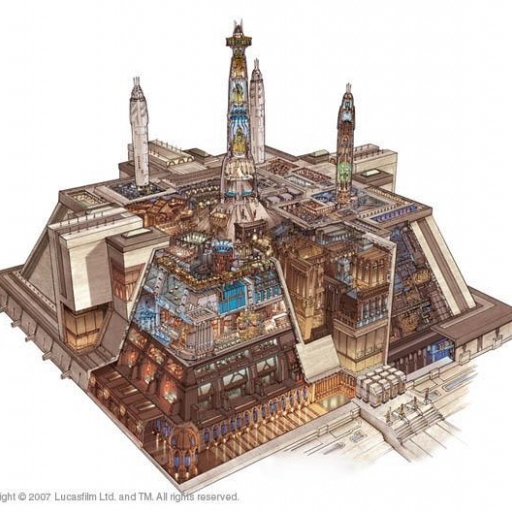
Around 3500 BBY, the Jedi Temple on Coruscant entered another major phase of construction and expansion. The site already had deep history: Jedi had occupied the sacred spire area after the Great Hyperspace War, and the destruction of Ossus in 3996 BBY had increased Coruscant's importance. Later rebuilding after the Sith sack of 3653 BBY restored the complex again. The c. 3500 BBY additions therefore belonged to a long sequence of architectural change rather than one founding moment.
The Temple is an architectural palimpsest
A mature Jedi Temple can look like a single monument, but its history is layered. Earlier sacred sites, Republic grants, post-Ossus construction, wartime destruction, and later renovations all occupy the same institutional landscape.
The building therefore acts like an archive in stone.
Coruscant becomes more central after Ossus
The destruction of the Ossus library world in 3996 BBY removed one of the Order's greatest intellectual centers. Coruscant grew in importance as the Jedi redistributed training, governance, and collections.
Centralization made the Order easier to coordinate, but it also concentrated people and knowledge in one highly visible political capital.
The 3653 BBY sack did not end the site
The Sith assault devastated the Temple during the Sacking of Coruscant. The Jedi later rebuilt, showing that sacred institutional space could survive even spectacular military defeat.
By c. 3500 BBY, expansion represented not merely repair but renewed confidence in a permanent Coruscant presence.
Later generations mistake accumulated history for permanence
By the final centuries of the Republic, the Temple could appear timeless. In reality it had repeatedly changed.
That illusion of permanence is politically useful: institutions often present a rebuilt headquarters as proof that they themselves are continuous and enduring.
Event sequence
Jedi gain a Coruscant site associated with the sacred spire.
Ossus's devastation increases Coruscant's importance.
Sith forces devastate the Temple during the Sacking of Coruscant.
The Order rebuilds.
A major phase of additions expands the Temple complex.
Further archives, towers, and ceremonial spaces are completed or rebuilt.
Explore this entry
Was the Jedi Temple built in 3500 BBY?
No. 3500 BBY marks a major expansion phase in a site whose Jedi history began much earlier.
Why does rebuilding matter politically?
Restoring a destroyed headquarters says the institution intends to remain in the capital and claims continuity despite defeat.
Did the later Temple preserve earlier structures?
Its long construction history incorporated older foundations, spaces, and traditions, although specific physical survival varies by source.
Anthropological assessment
Monumental institutions often hide construction histories behind a single name. Calling something 'the Jedi Temple' compresses thousands of years of rebuilding, appropriation, and changing political priorities.
That compression produces authority. A complex assembled in stages can be experienced as ancient and timeless, strengthening the belief that the institution it houses is equally permanent.
Sources and further reading
- The Essential Guide to Warfare and Jedi Temple reference material.
- Jedi Temple/Legends — Wookieepedia.
- The Old Republic era sources for the post-Sacking Temple.
3500 BBY · Legends · Evidence and political anthropology
Coruscant Temple expansion: what the historical record supports
Source-constrained historical account
Legends reference histories place a major rebuilding and expansion of the Coruscant Jedi Temple around 3500 BBY, long after the Sith attack on Coruscant. This is a construction phase, not the final completion of every room. The Jedi Archives underwent later development, and the Temple's spires were rebuilt still later. Those stages should remain separate chronological entries.
Institutions, beliefs and material life
Temple architecture organizes work, training, authority, archives and public ceremony. A rebuilt monumental complex can demonstrate institutional continuity after devastation, but architecture by itself does not establish that all Jedi held identical political views. The date is approximate in the reference sequence and should not be confused with a single construction contract.
Chronology and evidence limitations
Dates in this early Legends era are from fictional reference chronologies, sometimes approximate. A later person's accomplishments cannot be read into a record of their birth. IDS distinguishes events recorded in original books or reference titles from analysis of their social implications. A source illustration or cover may portray an era rather than the precise dated event.
The original published narrative and reference bibliography are recorded below; secondary online reference links are research aids and not interchangeable with primary novel pages or guide citations.
Test your historical judgment
Answer both questions. Your result explains the source-based distinction, including any corrections.