
Continuity notice: This is the Legends Expanded Universe, separate from the modern Canon chronology. Events with similar names must not be combined into a single factual history.
A commander after the Empire's collapse
Thrawn emerged as a formidable leader among surviving Imperial fleets. Unlike rival warlords who relied primarily on terror, he brought careful planning and a systematic interest in opponents' strengths. His campaign threatened a New Republic still working to establish trusted institutions.
The puzzle of lost military resources
Thrawn pursued advantages including the lost Katana fleet and access to special technologies, while the unstable dark Jedi Joruus C'baoth complicated his plans. The New Republic faced dangers created by military intelligence as well as by warships.
Art and dangerous generalizations
Thrawn sought to interpret a culture through its artistic works. The ability could be useful in his fictional strategy, but it is not evidence that all individuals in a species possess one unchanging set of mental habits. Political and social variations matter.
The defenders must cooperate
Luke Skywalker, Leia Organa Solo, Han Solo, Mara Jade and others acted amid rival political interests. Thrawn's ability to exploit divisions made trust and coordinated investigation important to the Republic's survival.
Anthropological assessment
Heir to the Empire shows how the interpretation of cultural information can become part of military power and how easily careful study can slide into stereotyping.
Interactive historical research
Was the original Heir to the Empire a Disney+ show released in 2026?
No. It was published as a Legends novel in 1991.
Choose a perspective:
Published evidence and limits
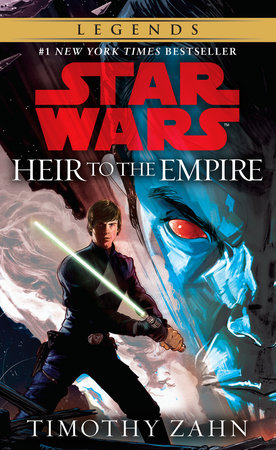
Heir to the Empire begins the Legends Thrawn trilogy and depicts an Imperial campaign roughly five years after Endor, within the 9 ABY setting. Later outcomes of Thrawn's war require Dark Force Rising and The Last Command. His fictional use of cultural art should not be presented as a valid real-world anthropological technique for predicting how entire societies behave.
Original published work: Heir to the Empire at Penguin Random House. The publisher synopsis identifies the book and story but does not replace direct inspection of each chapter.
Legends · Original publication analysis · 6–45 ABY
A coordinated Imperial campaign against a still-fragile Republic
The novel Heir to the Empire begins with a New Republic that has won control of major institutions but has not eliminated every Imperial fleet. Grand Admiral Thrawn assembles scattered military resources and challenges leaders whose administrative responsibilities differ from those of an underground rebellion. The publisher's 20th-anniversary edition description locates the novel five years after Endor and confirms the campaign against the New Republic. It also establishes a narrative baseline for the pregnancy of Leia Organa Solo and the efforts of Luke Skywalker to restore Jedi life. This is distinct from the modern Canon account of Thrawn's eventual return from Peridea.
The campaign continues across Dark Force Rising and The Last Command, including struggles over an abandoned fleet, Imperial cloning resources and cooperation among enemies of the Empire. Thrawn's tactical reading of artwork appears in the fiction as a technique for predicting particular opponents. Readers should not mistake a character's strategy for a defensible real-world anthropological claim that every person belonging to a species shares fixed motives. The novel's political conflicts are better understood in terms of the Republic's institutions, resources and competing loyalties than in terms of biologically predetermined cultural behavior.
IDS focuses on the vulnerability of a postwar government when institutional capacity is still being built. War can resume even after the occupation of a capital because military assets, officers and supply routes survive elsewhere. The Coruscant takeover provides the earlier political backdrop. The Dark Empire is a later Legends crisis, not a direct continuation of the same Thrawn command structure.
Test the evidence: Is the Thrawn of this 9 ABY novel the same event as the Canon return from Peridea?
Source judgment: No. The character appears in both continuities, but Zahn's original post-Endor trilogy is a Legends story with a separate political chronology. Shared names do not make the two timelines interchangeable.
Primary-work publisher record: Timothy Zahn, Heir to the Empire; related issue, volume or series description. The source links establish published books, the narrative premise and specified supporting claims; they do not replace close reading of every novel chapter or comic panel. Historical and institutional conclusions are original IDS interpretation, not additional Legends dialogue.
Source and verification
Timothy Zahn, Heir to the Empire; Dark Force Rising; The Last Command. View source and Legends chronology →.