
Legends reference chronology places the first recorded discovery of the rare alloy madilon around 10,000 BBY; neither its exact discovery location nor its discoverer is securely identified. Kumauri engineers pioneered its use in hyperdrive construction, allowing smaller and more efficient engines and extending the distance ships could travel through the hyperspace-beacon network. The material remained important long after the Kumauri Empire disappeared.
A scarce strategic material
Madilon improved hyperdrive engineering but was difficult to obtain.
Scarcity made access to the alloy economically and strategically important.
Longer jumps and smaller engines
Madilon enabled more compact hyperdrive systems and longer jumps when ships relied on beacon networks.
Improvements in propulsion changed which routes, ships, and missions were practical.
A technology outlives its inventors
The Republic adopted Kumauri innovations after defeating the empire.
Madilon remained a valued hyperdrive component for thousands of years.
Anthropological assessment
Madilon demonstrates that technological change depends on materials as well as ideas. An invention can spread only as far as supply chains permit.
Its association with the Kumauri also shows that frontier societies could generate innovations later adopted by the Republic center.
Ductavis Era · around 10,000 BBY · Legends
A rare metal changes the scale of hyperdrive engineering
Madilon was a naturally occurring alloy with unusually useful strength and flexibility under the stresses associated with hyperspace travel. Its discovery around 10,000 BBY made a more compact class of hyperdrives possible, because comparatively small amounts of the substance could improve designs that otherwise required much larger components. Legends sources credit Kumauri engineers with pioneering military uses of the alloy. The finding belonged to a wider technical history in which ship range, supply networks and the ability to deploy fleets were all shaped by the materials available to engineers.
Scarcity mattered as much as the alloy's performance. If madilon could not be synthesized economically and occurred at only certain deposits, control over mining and distribution became part of strategic planning. The later discovery of deposits at Nyriaan was a separate event, millennia after the original technological breakthrough. The source's claim that the material could help build much smaller hyperdrives should not be converted into a blanket claim that every galactic ship immediately received one or that scientists in 10,000 BBY knew every later application.
Efficiency is a political advantage
Smaller machinery can change which hulls can use a long-range drive and how much internal space remains for other systems. Those changes affect trading possibilities as well as military logistics. The technical advantage is distributed through the institutions able to purchase the material.
A discovery is not a universal supply
Rare materials create chokepoints. Access to a few deposits can determine which fleets and firms benefit from an improvement. The history of madilon is therefore also a history of economic inequality among technologically sophisticated societies.
Did engineers manufacture unlimited madilon in laboratories?
No. The Legends source describes it as a scarce naturally occurring alloy whose properties scientists could not reliably reproduce through synthesis.
Published evidence: Galaxy of Intrigue; The Essential Guide to Warfare (Kumauri uses of madilon). Legends only. Date estimates and indirect material-culture interpretations are not presented as eyewitness accounts.
c. 10,000 BBY · Legends · Evidence and interpretation
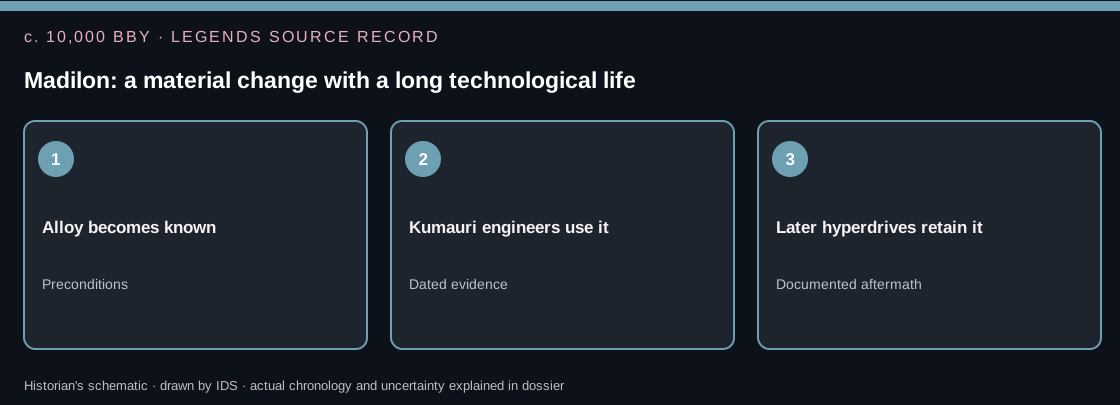
Madilon: a material change with a long technological life
What the record establishes
The alloy madilon entered recorded technical history around 10,000 BBY. Kumauri engineers used it to reduce the size and improve the effectiveness of hyperdrive components. The material later appeared in technologies far removed from Kumauri's short-lived state, including those associated with other civilizations and eras.
Anthropological analysis
A material's historical importance can outlast the government that first commercialized it. Mining, metalworking knowledge and propulsion manufacture passed into wider networks, separating a valuable process from the ruler initially linked to its adoption. This is also why a picture of Kumauri's battleship alone does not explain the alloy's properties.
Dating and source limitations
Legends sources do not securely identify the original mine, discoverer, composition or laboratory date. Circa 10,000 BBY is a broad chronology placement, not the year that every galactic hyperdrive adopted madilon.
Check the evidence: Does 'discovered in 10,000 BBY' identify madilon's first named chemist?
Correction and explanation: No. It marks an approximate technological milestone; the original discovery site and discoverer remain unknown.
Source trail: Galaxy of Intrigue (2010); The Essential Guide to Warfare (2012). Source history and bibliography →. Printed-page collation remains open.
Sources and further reading
- Rodney Thompson, Gary Astleford, and Eric Cagle, Galaxy of Intrigue, 2010.
- Jason Fry with Paul R. Urquhart, The Essential Guide to Warfare, Del Rey, 2012.
- Madilon, Wookieepedia