
Sometime after 10,000 BBY, the Tenth Alsakan Conflict began. The Republic and Alsakan again fought over political power, but military technology had changed. The Republic Navy now possessed capital ships incorporating mass-driver weapons derived from the defeated Kumauri Empire, giving fleets the ability to devastate planetary surfaces from orbit.
The old rivalry returns again
The Pius Dea crisis had temporarily transformed the Coruscant-Alsakan struggle into an alliance against theocracy, but the older political rivalry survived.
By the Tenth Conflict, competition had returned to direct warfare.
Kumauri weapons enter Republic service
Republic battleships used mass-driver cannons capable of accelerating asteroids into planetary targets.
Orbital bombardment expanded the destructive scale of the Alsakan wars.
The Eighth and Ninth Conflicts remain largely blank
Later numbering establishes that two conflicts existed between the Seventh and Tenth wars, but published chronology provides little usable detail.
IDS does not invent dates or campaigns for them merely to fill the numerical gap.
The Tenth Conflict ends in a draw
The war ended sometime before the 9400s BBY without resolving the larger rivalry.
Coruscant and Alsakan would continue periodic conflict for thousands of years.
Anthropological assessment
The Tenth Conflict shows that alliances formed against a common threat do not necessarily erase older structural disputes.
Its weaponry also shows technological diffusion through war: the Republic defeated Kumauri and then adopted the defeated enemy's methods.
Ductavis Era · around 10,000 BBY · Legends
The Alsakan rivalry enters the age of orbital terror
The Tenth Alsakan Conflict began after approximately 10,000 BBY, continuing an old political rivalry between Alsakan and the Galactic Republic's capital on Coruscant. Both sides had already survived the very different crisis of Pius Dea rule. Their return to war shows that participation in a coalition against one form of power did not settle the longer question of political influence within the Republic. The ordinal name also refers to a series whose Eighth and Ninth conflicts are only poorly documented, making any attempt to present an unbroken exact calendar misleading.
What had changed was the technology of capital-ship warfare. The Republic could employ mass-driver weapons influenced by the Kumauri designs captured or studied after an earlier war. The Osara Mundicide appears in this context. Such weapons created new incentives to develop strong planetary shields and guns capable of threatening warships from the ground. The conflict's end is described as a draw before the 9400s BBY rather than a single decisive defeat of either political center.
Old competition, new technology
Institutions can return to familiar disputes using tools their predecessors lacked. The capital-world rivalry remained a political problem, but the destructive costs of fighting it rose as fleets gained capabilities to threaten whole planets.
Avoid a false exact start
The source record supports a period after about 10,000 BBY, not a declaration issued on that precise year. The timeline should keep its approximate placement separate from the securely stated relationships among the wars.
Did the Tenth Alsakan Conflict end immediately in 10,000 BBY?
No. The conflict began after that approximate date and continued until before the 9400s BBY, ending without a decisive overall victory.
Published evidence: The Essential Guide to Warfare; Alsakan Conflict reference chronology. Legends only. Date estimates and indirect material-culture interpretations are not presented as eyewitness accounts.
After 10,000 BBY; before the 9400s · Legends · Evidence and interpretation
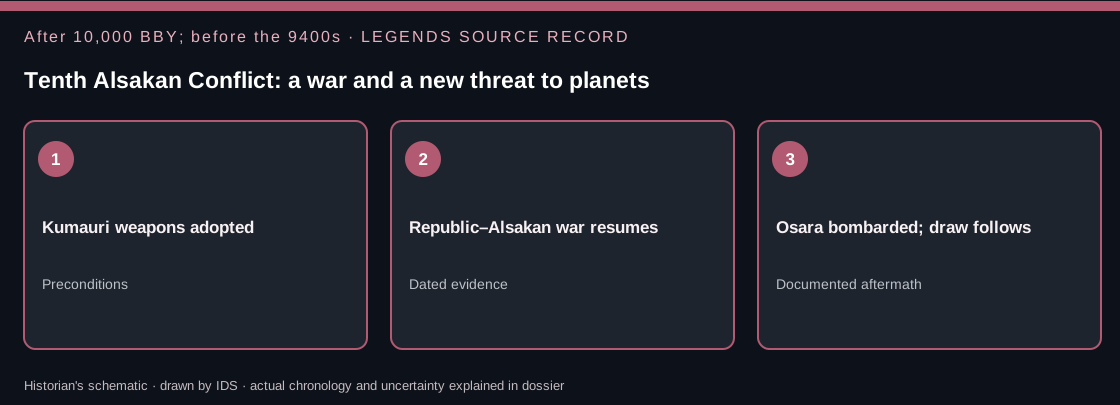
Tenth Alsakan Conflict: a war and a new threat to planets
What the record establishes
The Tenth Alsakan Conflict resumed the political struggle between Coruscant's Republic and rival Alsakan sometime after 10,000 BBY. Republic capital ships used mass-driver weapons descended from designs employed during the Kumauri war. The campaign included the Osara Mundicide, an episode of devastating planetary bombardment. Reference chronology places the war's inconclusive conclusion before the 9400s BBY.
Anthropological analysis
The ability to attack a world from orbit brought the location of civilian life within reach of fleet operations. This made planetary shields and ground defenses politically important; a society's bargaining position depended partly on the capacity to protect settlements, not merely on ship counts. An indecisive war could still transform military doctrine.
Dating and source limitations
The sources do not name a single exact start date or provide a detailed battlefield sequence. The war is recorded as a draw, so the Osara atrocity should not be described as an event that conclusively won it for either side.
Check the evidence: Did the Osara bombardment mean the Republic definitively won the Tenth Conflict?
Correction and explanation: No. The war's recorded outcome was a draw; an atrocity does not establish strategic victory.
Source trail: The Essential Guide to Warfare (2012), Capital Ships and Planetary Defenses. Source history and bibliography →. Printed-page collation remains open.
Sources and further reading
- Jason Fry with Paul R. Urquhart, The Essential Guide to Warfare, Del Rey, 2012.
- Tenth Alsakan Conflict, Wookieepedia