
During the Tenth Alsakan Conflict, no earlier than about 10,000 BBY, Republic orbital bombardment devastated a world in the Osara system in an event remembered as the Osara Mundicide. The attack used the new class of planetary bombardment technology inherited from the Kumauri war and became a symbol of the destructive escalation of the ancient Alsakan conflicts.
Planetary destruction from orbit
Mass drivers allowed capital ships to accelerate asteroids into a planetary surface.
The tactic bypassed the older assumption that atmospheres and distance made inhabited worlds relatively safe from sustained fleet attack.
A defensive arms race begins
Worlds now had reason to invest in shields strong enough to absorb orbital attacks.
Planetary turbolasers later gave defenders the ability to threaten attacking capital ships from the surface.
Why the word 'mundicide' matters
The name frames the event as violence against a world, not merely a fleet or army.
That linguistic scale preserves the attack as an atrocity even though detailed casualty records are absent.
Anthropological assessment
The Osara Mundicide shows how a new military technology can transform civilian vulnerability. A weapon designed at the frontier became a tool for devastation in an internal Republic war.
The response was technological as well as political. Fear of bombardment accelerated planetary shields and surface-to-space weapons.
Ductavis Era · around 10,000 BBY · Legends
Orbital bombardment becomes an Alsakan-era atrocity
The Osara Mundicide occurred during the Tenth Alsakan Conflict, sometime no earlier than approximately 10,000 BBY. The preserved account identifies a devastating orbital attack associated with the technology that followed the Republic's victory over Vall Kumauri. That inherited military capability made sustained bombardment from space possible on a scale unfamiliar to earlier generations. The destruction of a world demonstrates why these weapons had political consequences beyond the fleets carrying them.
The reference record does not securely identify a precise day, name every affected inhabitant or provide a reliable complete casualty total. It also does not justify inventing an eyewitness account of the final minutes. What is established is the relationship between the Alsakan rivalry, the use of increasingly destructive orbital methods and the accelerating interest in planet-based defenses. Planetary shields and heavy surface weapons became plausible responses to a danger that no local government could ignore once capital ships could threaten the whole surface.
Why the term mundicide matters
A label denoting the devastation of a world conveys a scale of harm not captured by the language of an ordinary naval battle. Such events affect civilians, ecosystems, buildings and future political possibilities. The label should not be used as an invitation to invent unrecorded casualty figures.
The defensive arms race
When the threat changes, defensive systems must change as well. The effort to develop effective shields and planet-based turbolasers belongs to a later response, not necessarily to the exact moment of the Osara attack. Technological escalation often proceeds through several connected conflicts.
Can the Osara Mundicide be assigned a precise day in 10,000 BBY?
No. The cited Legends chronology places it during the Tenth Alsakan Conflict and no earlier than around 10,000 BBY; the exact date is not preserved.
Published evidence: The Essential Guide to Warfare (2012); Tenth Alsakan Conflict chronology. Legends only. Date estimates and indirect material-culture interpretations are not presented as eyewitness accounts.
After c. 10,000 BBY; before 9400s BBY · Legends · Evidence and interpretation
Osara Mundicide: planetary harm cannot be reduced to a battle result
What the record establishes
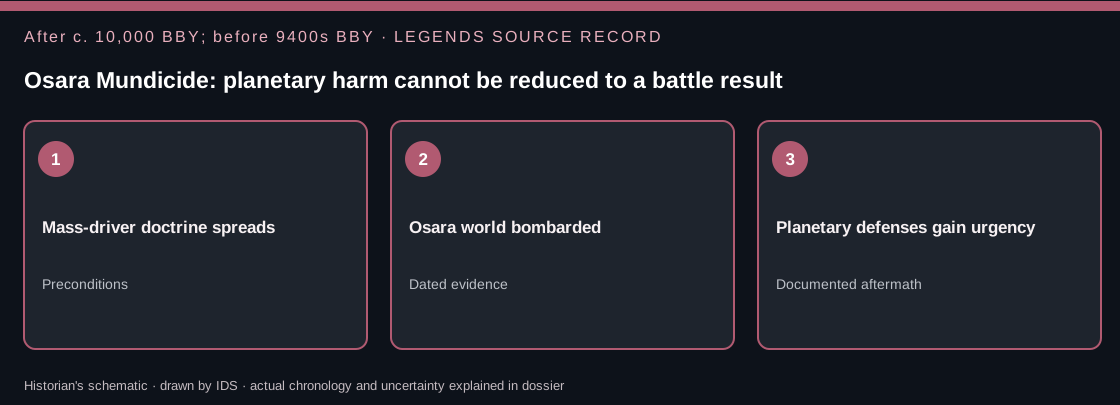
During the Tenth Alsakan Conflict, the Republic used mass-driver-equipped capital ships to bombard a world in the Osara system. Legends names the devastation the Osara Mundicide. Kumauri-era technology was among the precursors for this capacity to direct asteroids or large kinetic projectiles from orbit against settlements.
Anthropological analysis
Mundicide is an ethical description of destruction at planetary scale. The archival category directs attention to people and environments far beyond uniformed combatants. Later demand for planetary shields also reflects how populations tried to reduce their exposure to an imbalance between orbiting warships and fixed settlements.
Dating and source limitations
The dates are bounded by the Tenth Alsakan Conflict: later than circa 10,000 BBY and before the 9400s. The source does not securely report an exact population killed, the planet's pre-attack government, a named officer who ordered the attack or a complete aftermath map.
Check the evidence: Does the source give an exact 10,000 BBY calendar date and casualty count?
Correction and explanation: No. It gives the conflict context and catastrophic character of the attack, with important details unresolved.
Source trail: The Essential Guide to Warfare (2012), Planetary Defenses and Capital Ships. Source history and bibliography →. Printed-page collation remains open.
Sources and further reading
- Jason Fry with Paul R. Urquhart, The Essential Guide to Warfare, Del Rey, 2012.
- Osara Mundicide, Wookieepedia