
Around 10,000 BBY, Republic explorers discovered Ord Gimmel. The surviving chronological reference is brief, but the event belongs to the long process by which the Republic converted unknown or poorly connected systems into mapped political geography.
Exploration as state infrastructure
Republic scouts did more than find coordinates. Surveying made worlds legible to navigators, administrators, merchants, and military planners.
A mapped world could enter route systems and eventually political institutions.
The Ord tradition
Many worlds carrying the Ord designation were associated with Ordnance/Regional Depot functions in Republic history.
The source establishes discovery here more clearly than the exact date or form of any later military development.
Anthropological assessment
Ord Gimmel demonstrates how maps create administrative reality. A planet becomes easier for a state to govern once it can be named, routed, measured, and entered into institutional records.
The sparse surviving account also illustrates archive bias: discovery is remembered, while the local experience of first contact is not.
c. 10,000 BBY · Legends · Evidence lab
Ord Gimmel: what a discovery record cannot tell us
What the record establishes
Legends chronology records that Republic explorers discovered Ord Gimmel at approximately 10,000 BBY. The source describes an encounter entered into Republic historical knowledge. It does not specify an explorer's name, a first landing, the planet's earlier population or a military construction schedule. The Ord prefix is associated with Republic depot designations elsewhere, but that broader usage does not prove when infrastructure was established on this particular world.
Anthropological assessment
Survey records are instruments of institutional knowledge. They let officials and travelers name, locate and compare distant places. Yet an official discovery is not necessarily the first discovery by all societies, and appearing on a Republic chart is not synonymous with voluntary political incorporation. The contrast between a remembered date and absent local testimony shows how archival survival privileges the actions of state surveyors. Interpreting such a brief record requires care with both its evidence and its gaps.
Evidence limits
The date remains approximate. No reliable source cited here supplies a Jedi captain, a garrison, civilian population counts or an early building plan. The graphic is conceptual and must not be treated as an actual chart or timeline of construction.
Check your historical judgment: Does the Ord prefix establish a depot in 10,000 BBY?
Correction: No. The discovery date and the date of any military facility are different factual questions.
Source trail: Suns of Fortune; Legends chronology of 10,000 BBY. Bibliography and reference history ↗. Printed page verification remains open.
Artwork provenance and interpretation
Discovery, naming and occupation are different kinds of claim
An early record of Republic explorers reaching Ord Gimmel does not, by itself, establish the founding date of a military depot. The word Ord in later galactic geography evokes Republic logistical sites, but a named discovery date cannot substitute for a documented construction or military-garrison record.
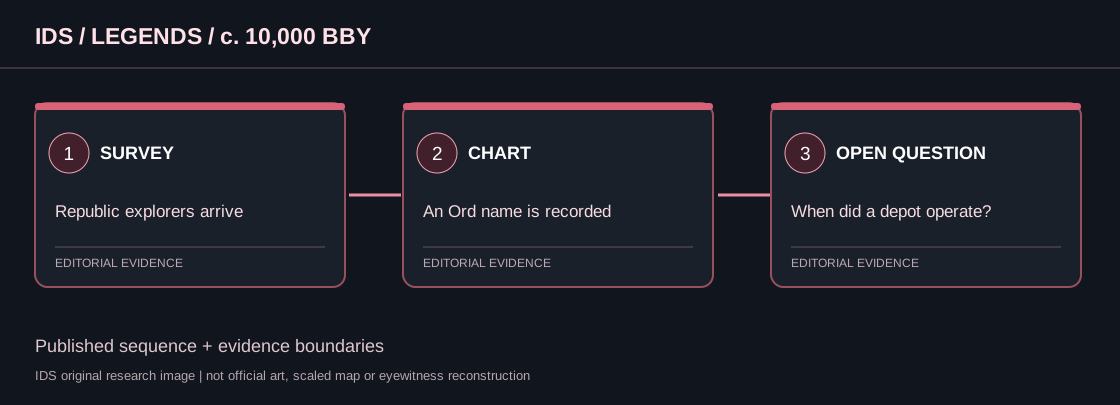
This distinction matters when assessing the Republic's early frontier. Charts and surveys extend knowledge; installations and settlements require further work; a new political claim may still be contested by inhabitants. The original IDS diagram identifies these stages as separate evidence questions. The image in the body is therefore retained, while an unrelated remote hero image is replaced by the site's own labeled analytical illustration.
The page's original IDS image represents an evidence sequence, not official artwork, a historical scene, or a verified reconstruction of a ship, city or planet.
Sources and further reading
- Suns of Fortune, Fantasy Flight Games.
- 10,000 BBY, Wookieepedia