
Image verified by editorial review: official video-game image related to this specific event, replacing an unrelated or less relevant image.
Official Star Wars Battlefront II portrayal of Inferno Squad commander Iden Versio, from StarWars.com's Operation Cinder feature. This is a character-focused image tied to the operation, not a depiction of an individual targeted planet.
StarWars.com's official Operation Cinder feature. → Editorial source identification does not grant permission to redistribute the original artwork; this page references the publisher-hosted image.
A contingency directed against civilian worlds
What triggers the Contingency's attacks?
Do not confuse the depicted event with the fate of every world or person.
Palpatine's instructions survive him
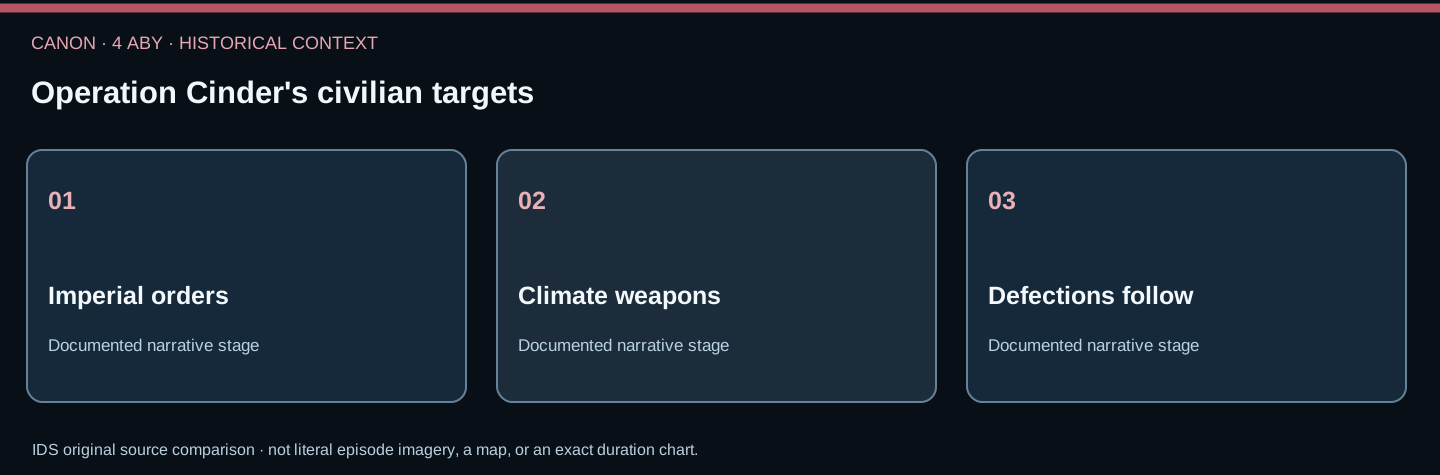
After Endor, designated Imperial commanders received orders from Sentinel droids as part of the Emperor's Contingency. The instructions demanded attacks against worlds that had supported both the Empire and its enemies. The strategic purpose was punishment and destruction if the Emperor could no longer rule.
Climate disruption becomes a weapon
Imperial forces deployed climate disruption arrays and used bombardment to produce dangerous weather systems and other devastation. Worlds including Naboo, Vardos and Burnin Konn became targets of destruction that was unrelated to the actual threat posed by their civilian inhabitants.
Some Imperial personnel reject the orders
The severity of the attacks caused defections. Iden Versio and Del Meeko, once committed Imperial operatives, turned against the regime after seeing it deliberately threaten the populations it claimed to protect.
Anthropological assessment
Operation Cinder illustrates a state system treated as the property of one ruler. Administrative commands remained capable of inflicting mass violence after the ruler's death, showing the importance of the institutions that carried out his designs.
Interactive evidence lab
Did Operation Cinder target only Rebel military bases?
No. It targeted populated worlds, including worlds that had previously supported the Empire.
Compare the event from three perspectives:
A contingency directed against civilian worlds
Operation Cinder is part of Palpatine's posthumous Contingency. Imperial commanders receive orders to attack designated planets, including places previously loyal to the Empire. Lucasfilm identifies climate disruption arrays, bombardment and other methods. Some worlds are spared the worst effects while others, including Vardos, suffer catastrophic damage.
The attacks challenge the idea that the Empire's military was simply defending Imperial populations. Cinder deliberately turns state force against societies the regime purported to govern and protect. The severity varies by location; the page should not imply that every named target became uninhabitable. The policy also prompts defections and strengthens opposition to remaining Imperial authorities.
Evidence and dating: The chronology gives a year, not a specific day. Source publication year must not be confused with the fictional year. Lucasfilm's Operation Cinder explainer.
Test your historical judgment
Get a score and individual corrections after answering.
Canon · 4 ABY · Source-critical reading
Operation Cinder's civilian targets
The destruction ordered by Palpatine's posthumous contingency did not distinguish reliably between loyal Imperial worlds and rebel-held territory. Lucasfilm's Operation Cinder history lists Vardos, Naboo, Burnin Konn and other worlds targeted through extreme climate disruption, bombardment or related measures. A weapon used against a planetary atmosphere makes civilians vulnerable far beyond the immediate location of a military unit.
The mechanism also explains political consequences. Some Imperials who had rationalized earlier violence could no longer reconcile their service with orders directed against their own populations, while others followed the chain of command. That contrast demonstrates that obedience and dissent can coexist within a powerful institution. The official source describes varied outcomes for particular worlds; it does not mean every target was destroyed or every loyal officer defected.
Research judgment: Was Operation Cinder aimed exclusively at worlds that had openly supported the Rebellion?
Explanation: No. Some affected planets had been Imperial strongholds; the plan punished even former loyalists.
Continue related history → · Post-Endor history route →
Source context: Official Lucasfilm game, Databank or author commentary. Political interpretation is identified separately from the source; exact casualty numbers, invented dates and undocumented firsthand accounts are not supplied.
Canon · post-Endor source review · 12 October 2026
How the Contingency worked across different worlds
Operation Cinder should be investigated as an Imperial command system, not as one battle with a single outcome. The source history distinguishes the orders delivered after Endor from the varied tools used to execute them. Climate disruption arrays could turn a planet's weather into an instrument of mass harm. Other attacks involved bombardment or explosives. Naboo resisted a catastrophic atmospheric assault, while Vardos suffered severe environmental damage. Listing targets without distinguishing these outcomes would misstate the evidence. StarWars.com's retrospective also notes that the complete list of attacked planets and overall death toll have not been established.
The chain of responsibility is part of the event. Palpatine designed the Contingency; surviving military institutions had to receive, interpret and execute it. Sentinel messengers communicated orders, but officers and crews still made consequential choices. This is why the defection of Iden Versio and Del Meeko matters: the operation exposed a division between Imperial loyalty as a political identity and obedience to a particular command. The record does not support the claim that all Imperial officers dissented, or that every targeted community was already in open rebellion.
From an anthropological perspective, the relevant questions concern institutional obedience, collective punishment and the difference between a ruler's interests and those of civilians governed in his name. This interpretation uses documented plot events but does not claim that Star Wars directly presents a formal theory of state power. The follow-on Vardos dossier examines one refusal; the Jakku dossier follows a later stage of the Contingency.
Evidence register: Lucasfilm's Operation Cinder history. Distinguish original story material from later publisher commentary and IDS interpretation. No exact scene timestamp, unverified casualty count, or new image license is claimed.
Sources and interpretation
StarWars.com, What Is Operation: Cinder?; Battlefront II (2017). Read background →. Images may represent later appearances, as disclosed above.