
Interactive research file · 4–5 ABY · Canon
After Endor: violence, liberation and the problem of peace
From Palpatine's Contingency to the Galactic Concordance, follow how the New Republic won the last major battle while confronting occupation, internal dissent and an incomplete peace.
The Emperor's orders outlive him
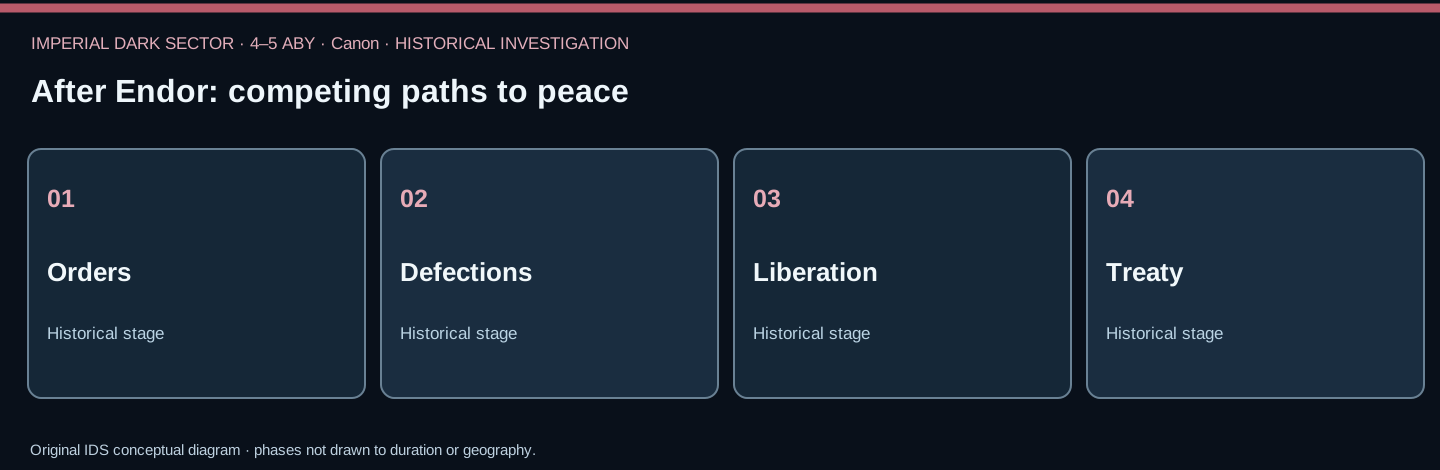
Operation Cinder shows how an authoritarian system can remain dangerous after its leader dies. Commands, weapons and obedient institutions survived Palpatine and could still destroy civilian infrastructure. Official Lucasfilm history documents climate-disruption attacks on a mix of planets, including places that had supported the Empire. This fact prevents the campaign from being described as an ordinary last defense of Imperial territory.
Iden Versio's break on Vardos is not evidence that the Empire's earlier actions were harmless until that moment. Instead it records a crisis within an officer's loyalty when a system she had served attacked her home population. Defection demonstrates that political identities can change through confrontation with particular acts of state violence. The experiences of individual officers, civilians and damaged communities must not be folded into one uniform response.
Liberation and local political agency
Kashyyyk's liberation in the Aftermath story places Han and Chewbacca alongside Wookiee resistance and other allies. It is easy for a character-driven chronology to reduce the episode to the exploits of visitors. But occupation was experienced by the inhabitants of Kashyyyk, whose social ties and institutions had been threatened under Imperial rule. Ending occupation allowed people to rebuild relationships, not simply change the flag over a military station.
The story also illustrates the limits of a New Republic centered on its most visible heroes. Local knowledge and resident political commitments were critical even when broader allies supplied ships or support. A source-conscious account must distinguish the freeing of Kashyyyk from the final main fleet encounter at Jakku, because the two confrontations involved different institutions and different communities.
A last stand and a formal agreement
At Jakku, the New Republic defeated the Empire's large remaining force. The resulting wrecks became part of the desert world's later lived environment and salvage economy. The official author account of Aftermath: Empire's End distinguishes Gallius Rax's plan, Rae Sloane's competing position and the separate motives of other characters. The battle therefore should not be narrated as a universally accepted end to Imperial ideology.
The subsequent Galactic Concordance provided a treaty with Imperial remnants, allowing the New Republic to revive representative institutions and radically reduce its military. Lucasfilm's Databank presents those policies as elements of a postwar political settlement. They were consequential choices, not a guarantee that every survivor would accept peace. The future rise of the First Order is one reason that a historian must distinguish a signed agreement from complete demobilization.
Follow the interconnected events
Operation Cinder
Orders target civilian worlds, including Imperial strongholds
Examine this dossier →Iden Versio breaks ranks
An Imperial officer rejects the attacks on Vardos
Examine this dossier →Kashyyyk is liberated
Wookiee residents and allies resist occupation
Examine this dossier →The Battle of Jakku
An Imperial military defeat leaves a landscape of wrecks
Examine this dossier →The Galactic Concordance
A treaty formalizes peace without dissolving every remnant
Examine this dossier →Test the historical interpretation
Did the Concordance erase every Imperial military and political remnant?
Explanation: No. It ended the major civil war formally, while surviving networks continued to matter.
Did every Imperial on Vardos agree to carry out Operation Cinder?
Explanation: No. Iden Versio and Del Meeko were among those who broke with the program.
Sources and further reading
This research route follows Canon stories only. The original film, game or novel provides the narrative events; Lucasfilm's Databank entries and publisher/author articles offer verifiable interpretation and publication context. Concepts such as political legitimacy, kinship and labor are IDS's historical analysis, not attributed quotations from characters.
Lucasfilm: What is Operation Cinder? →
Lucasfilm coverage of Aftermath: Life Debt →
Author interview: Aftermath: Empire's End →
Lucasfilm New Republic Databank →
Image provenance: All diagrams here are original IDS educational illustrations. They are not film stills, licensed character pictures, maps, or exact visual reconstructions. External social preview support for SVG requires separate live-platform testing.