
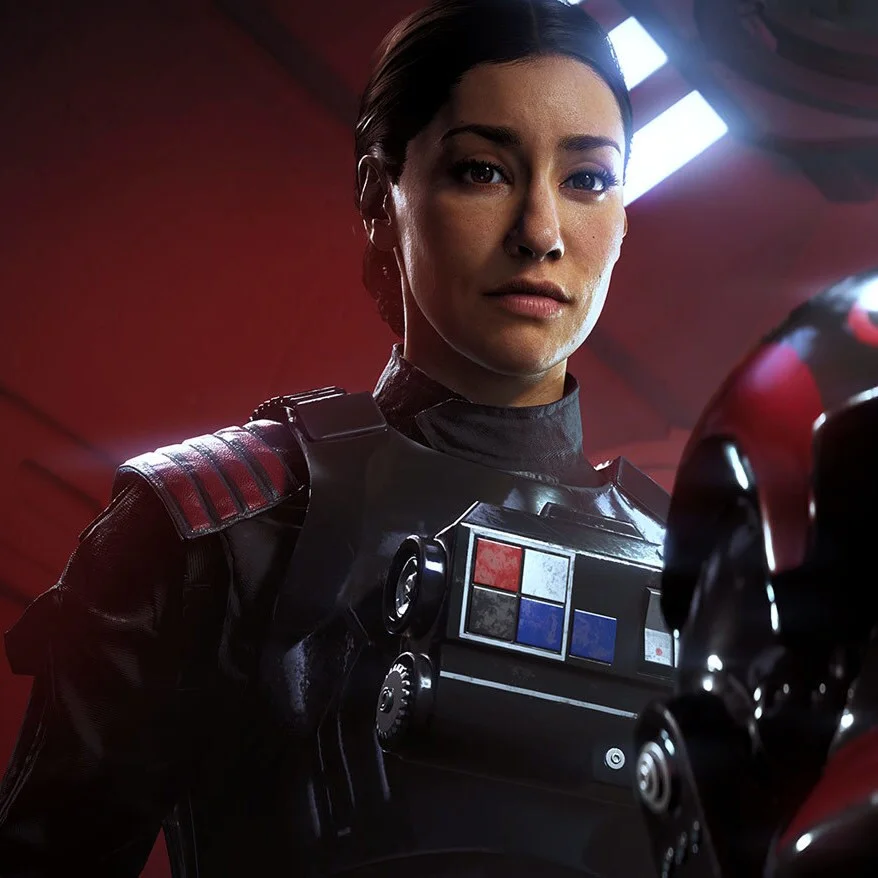
INFERNO SQUAD · THE EMPIRE AFTER ENDOR
Inside the Iden Versio file
Training, loyalty and defection
From Imperial Vardos to the First Order conflict, Iden's life is a study in how professional loyalty changes under evidence and institutional pressure.
Vardos: a childhood inside Imperial authority
Iden Versio is born on Vardos, a world where the Empire's rule is woven into formal education, civic pride and military ambition. Her father, Garrick Versio, helped place Vardos under Imperial control after the Clone Wars. The planet's capital, Kestro, houses Imperial institutions and the Future Imperial Leaders Military Preparatory School. Iden studies there and learns to treat Imperial service as a profession and a marker of belonging. Her convictions are not presented as an unexamined disguise. She begins her story believing that the state which trained her protects order.
Her father is not simply a private parent with a separate job. Garrick is a naval officer whose influence joins family expectations to the Empire's command hierarchy. Growing up as his daughter offers Iden advantages, including access to advanced education and career possibilities, while also exposing her to intense pressure to succeed within the same system. The official StarWars.com Databank identifies her proficiency in flight and combat and notes that her unconventional methods sometimes test the limits of rigid Imperial protocol.
Iden's biography therefore begins before the player takes control of her. She is skilled because she is trained, trusted because she has demonstrated results, and loyal because her formative institutions present Imperial order as legitimate. None of those facts predetermines every later decision. An anthropological account must explain how belonging was produced without assuming that childhood completely removes adult moral responsibility.
The making of Inferno Squad
The destruction of the first Death Star demonstrates that the Empire's enormous military apparatus is vulnerable to intelligence leaks, infiltration and unconventional Rebel tactics. Admiral Garrick Versio responds by forming Inferno Squad, an elite special-operations unit designed to discover threats and protect Imperial secrets. Iden is chosen to command it. Gideon Hask, a longtime associate from her formative years, and Del Meeko, an adaptable specialist with experience in combat and engineering, become core members.
The prequel novel Star Wars Battlefront II: Inferno Squad, written by Christie Golden, explores the unit's earlier mission against remnants of Saw Gerrera's Partisans. Its account matters because covert work is not merely the action of winning a blaster fight. It involves deceptive appearances, carefully managed identities, clandestine relationships and the uncertain reliability of information. An agent's competence can be difficult to separate from the institution that defines their mission.
Within the squad Iden has practical authority, yet she still answers to officers and an Emperor far beyond the immediate team. Her relationship with Hask includes a history of professional rivalry and trust. Del contributes technical judgment and concern for consequences. Their distinct personalities are significant because the squad eventually splits under pressure even though its members share training, operational experience and a mission history.
Imperial equipment makes the unit's status conspicuous. The distinctive black armor, ID10 seeker droid and the Corvus, a Raider II-class corvette, combine surveillance, mobility and force. The official Databank describes the Corvus as Inferno Squad's home as well as its transport. This overlap matters: long deployments turn a warship into a social environment where relationships are maintained and the chain of command becomes part of everyday life.
Endor: victory, defeat and a crisis of legitimacy
Battlefront II opens with Iden in Imperial service before the Battle of Endor. The player briefly controls her during an infiltration and escape from a Rebel vessel, establishing that she is not a Rebel disguised as an Imperial officer. She returns to her squad as the Empire prepares for its decisive confrontation. When the second Death Star is destroyed, Iden witnesses a defeat severe enough to change the strategic and political order of the galaxy.
The Emperor's death does not immediately erase the military and administrative machinery built in his name. Imperial officers continue to issue orders. Surviving commanders attempt to maintain the chain of authority, and soldiers have to decide whether an instruction remains legitimate simply because it is transmitted through familiar channels. Iden initially follows the Empire's effort to retaliate against the victorious Rebellion.
The question becomes concrete with Operation: Cinder, a posthumous Imperial plan that subjects worlds to destructive attacks. Vardos is among the affected planets. The assault reveals a contradiction between the Empire's advertised duty to defend its citizens and its willingness to punish those same populations. For Iden, who has personal ties to Vardos, the order is not a remote policy dispute. It threatens the home and civilians whom Imperial leaders had taught her to value.
Iden and Del reject the attack and disobey Imperial commands. Hask does not. This is the central divide in the story: officers with a shared professional education judge the meaning of loyalty differently. Iden's choice is significant precisely because she has served the Empire competently. Describing her as having always been secretly loyal to the Rebellion would flatten the documented change.
Defection and a different military institution
Iden's decision creates an immediate practical problem. She and Del become targets of the organization that supplied their identities, credentials, weapons and training. Their ability to operate against that institution depends partly on the same specialized competence it previously valued. They leave Imperial service and work with the Rebel Alliance, taking missions against remaining Imperial forces.
The campaign includes encounters with major figures of the post-Endor period, but Iden's story should not be recast as merely a sequence of celebrity appearances. Her contribution is to show the war from a professional Imperial officer's perspective before, during and after defection. The player's knowledge of Imperial tactics is carried into Rebel operations, where information formerly used for suppression can now help challenge a surviving regime.
Her relationship with Garrick Versio becomes difficult to separate from institutional conflict. His dedication to Imperial authority survives its military disasters; hers does not. Their disagreement asks whether family obedience and military obedience should have identical force. The story does not require the reader to agree with every later decision Iden makes. It does require recognizing that private kinship cannot resolve the political disagreement for her.
Through operations that culminate around the Battle of Jakku, Iden witnesses the Empire's final major military collapse. The transition from Empire to New Republic is not instant or clean. The same worlds, technologies and trained personnel persist while political authority changes. Her personal transition is thus connected to a wider question: how do people who served an authoritarian state participate in what follows?
Del, Zay and a life beyond the original war
After the Empire's defeat, Iden and Del establish a shared life and raise their daughter, Zay Versio. The household is shaped by experiences the child did not choose: both parents were once Imperial operatives and later rejected Imperial rule. That history becomes part of the family's background without determining the daughter's eventual ideology. Zay learns practical skills, especially piloting, from a mother who has survived multiple political and military transformations.
The family connection adds a new kind of obligation to Iden's story. She is no longer solely a commander responsible for her squad or an officer changing allegiance. She is a parent whose daughter can inherit both the knowledge and the risks of earlier conflicts. Their interactions in Battlefront II: Resurrection show familiarity and training, not a simple replacement of professional competence with domestic life.
An archival mistake would be to treat these decades only as a gap between game missions. The long interval reveals that the consequences of leaving the Empire extend beyond the decisive moment of defection. Iden remains alive, works with Del and raises a family while the postwar political order develops. That sustained life is crucial to understanding why the First Order's later activities strike at both public institutions and private relationships.
Resurrection: the conflict returns
The Resurrection expansion begins after the Corvus is discovered abandoned on Pillio. Iden and Zay investigate with Shriv, a Duros veteran associated with the Rebellion and Resistance. The story connects the abandoned ship and Del's disappearance to Project Resurrection, a First Order operation involving the coercive recruitment of children. The threat is not a literal return of the dead Emperor. It is the attempt to reproduce a militarized political organization through abducted young people.
Iden learns that Del has been captured, interrogated by Kylo Ren and killed by their former teammate Gideon Hask, now a First Order officer. This brings an unresolved division within Inferno Squad back into direct conflict with the next generation. Hask regards the successors of the Empire as the continuation of his political home; Del and Iden built a family outside its control.
The final confrontation aboard the First Order vessel Retribution kills Hask but leaves Iden mortally wounded. She dies with Zay, while the surviving companions carry intelligence to the Resistance. The result is personal loss, not the disappearance of the larger threat. Iden's career began in an institution that promised protection through absolute loyalty and ends while she resists a successor institution attempting to manufacture loyalty through abduction.
Zay's survival gives the narrative a generational dimension. The daughter is not required to repeat her mother's exact military career. She carries testimony, skills and a responsibility to decide what to do with information inherited from a past conflict. The campaign leaves readers with a concrete distinction between continuing someone's work and reproducing the institution that once defined them.

Story chronology
These narrative milestones follow the published novel and game campaign. They are not invented mission levels or exhaustive battle records.
Imperial childhood
Grows up on Vardos, attends its military preparatory school and becomes a talented pilot and combatant.
Founding Inferno Squad
After the first Death Star's loss, Admiral Versio forms the special-forces unit and Iden assumes command.
Inferno Squad novel
Undercover operations against Partisan survivors deepen the unit's internal relationships and secrecy.
Endor
Imperial defeat and the Emperor's death place the surviving command hierarchy under strain.
Operation: Cinder
Iden and Del refuse the destructive orders applied to Vardos and leave Imperial service; Hask stays loyal.
Battle of Jakku
Participates in the campaign surrounding the Empire's last large military defeat.
Family and postwar life
Builds a life with Del Meeko and raises their daughter Zay.
Resurrection
Investigates the abandoned Corvus and Project Resurrection, learns Del's fate and dies in the fight against Hask.
Gleb directed the Imperial preparatory school associated with Iden and Hask, then led Jinata Security through the events surrounding Project Resurrection. Explore the Gleb dossier →
People and institutions
Sort the relationships to distinguish family, teammates and opposing claims of authority.
Del Meeko ↗
Fellow Inferno operative, defector and partner; together they raise Zay.
CREWZay Versio ↗
Daughter and pilot who participates in the Resurrection investigation.
CREWShriv Suurgav ↗
Rebellion and Resistance ally who assists during the postwar struggle.
POWERGideon Hask ↗
Former teammate who remains committed to Imperial successor regimes.
POWERAdmiral Garrick Versio ↗
Father, superior officer and formative model of Imperial authority.
Anthropological assessment
These research lenses interpret established narrative events. They are not diagnoses of a fictional person or descriptions of game abilities.
Political anthropology
Vardos links education, family prestige and government authority. Iden's change demonstrates how institutions can lose allegiance when lived evidence contradicts their claims.
Operation: Cinder evidence lab
How should an independent historian evaluate Iden's decision to defy the attack on Vardos? Choose a method. These are analytical exercises, not in-game dialogue options.
Select an approach
Compare how the explanation fits the known story.
Test the evidence
Was Iden secretly a Rebel at the beginning?
No. The game portrays her as a successful Imperial officer. Her rejection of Operation: Cinder is a change within the story rather than the unveiling of a long-standing undercover affiliation.
Does the game let the player prevent her defection?
No. Battlefront II tells an authored single-player story. Its multiplayer abilities and player tactics do not give the player control over this major narrative turn.
What does Resurrection add?
The three-chapter expansion follows Iden decades later, linking Del's disappearance and the abandoned Corvus to the rise of the First Order and the fate of her family.
View the Iden Versio collecting page: reviewed cards, figures, Funko and other formats
Collecting this character
Iden Versio appears in the licensed novel Star Wars Battlefront II: Inferno Squad, which documents the squad's early relationships. The game itself provides her central on-screen story. IDS does not claim a specific numbered Topps card, LEGO figure or collectible variant here without verifying its release. Any trading-card photograph will require the collection owner's supplied image.
Find the Inferno Squad book on Amazon ↗
Sponsored links may earn IDS a commission on qualifying purchases.
As an Amazon Associate I earn from qualifying purchases. Check the exact item and publisher before ordering.
Research sources
- Official Star Wars Databank: Commander Iden Versio ↗
- Official Star Wars Databank: Inferno Squad ↗
- Official Star Wars Databank: Vardos ↗
- Official Star Wars Databank: Corvus ↗
- StarWars.com interview: Christie Golden on Inferno Squad ↗
- Electronic Arts: Battlefront II Resurrection ↗
Lucasfilm's Databank establishes Iden's formation, family, squad and homeworld. The novel, 2017 campaign and Resurrection expansion supply narrative events. The anthropology sections and interactive exercises are original editorial interpretation, not additional canon.