
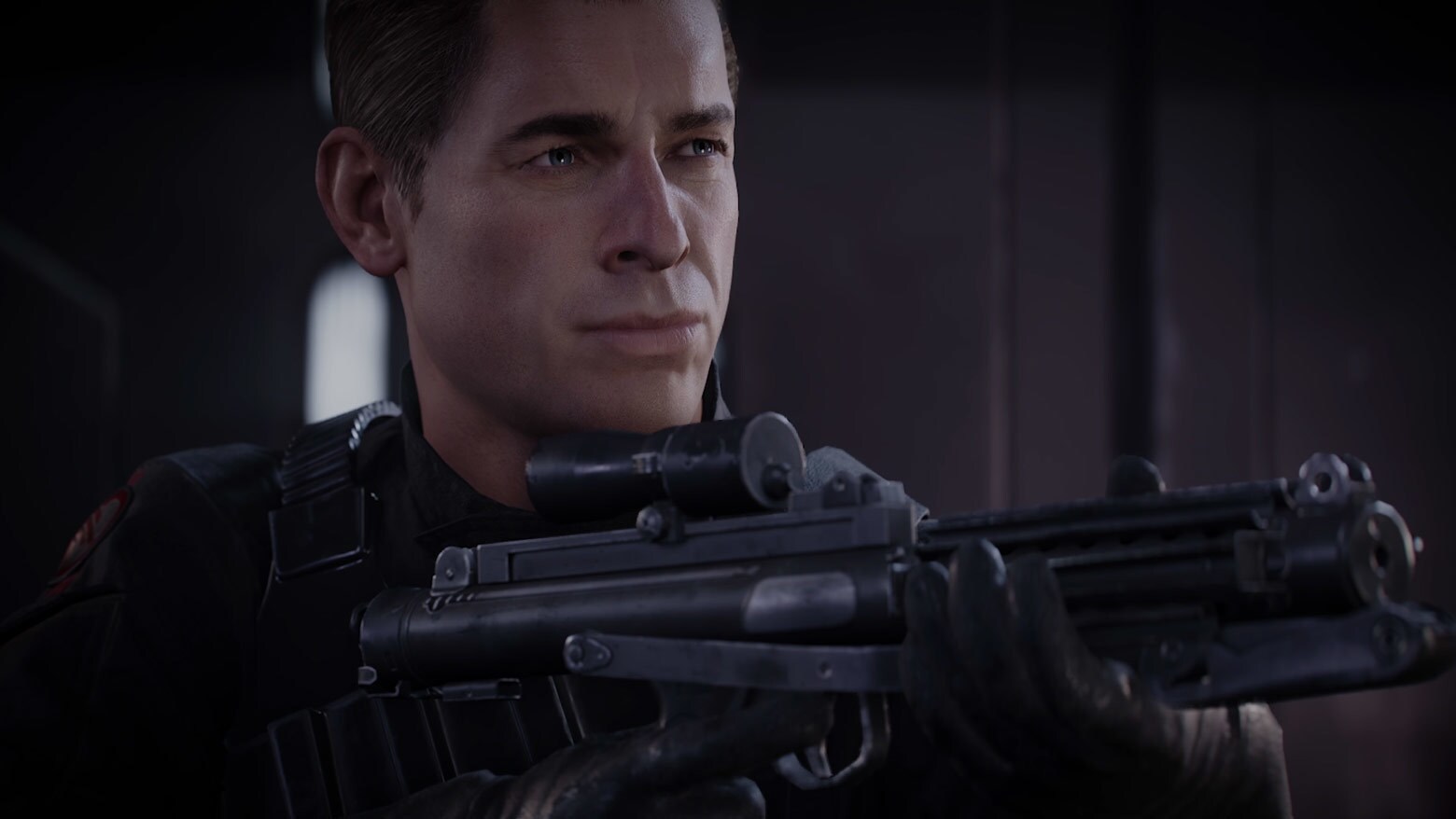
Official Star Wars Battlefront II portrait of Gideon Hask
Lucasfilm / StarWars.com Databank, official Battlefront II character portrait. Official source ↗

THE LOYALIST · INFERNO SQUAD · CANON

Gideon Hask

An orphan who found a family in the Empire, then defended its successors against the comrades who refused Operation: Cinder.

CANONINFERNO SQUADMAJOR STORY SPOILERS

CANON · INFILTRATION · IDENTITY

Inside the Inferno Squad dossier

History and institutions

An orphan who found a family in the Empire, then defended its successors against the comrades who refused Operation: Cinder.

CONTINUITYCanon
GAMEBattlefront II (2017)
BOOKInferno Squad (2017)

The Empire as a surrogate family

Gideon Hask begins as a child whose personal history becomes inseparable from the Imperial state. The official Databank identifies him as an orphan from Kuat, a major world associated with shipbuilding and Imperial power. The Empire offers him structure, a profession and a replacement for lost relationships. His later conduct cannot be explained simply as generic villainy. The authority he defends is also the institution through which he understands security, belonging and achievement.

The novel Battlefront II: Inferno Squad expands that formation. Hask trains on Vardos, the strongly Imperial world where the Versio family exercises influence. He knows Iden Versio from their youth. Christie Golden, discussing the novel with StarWars.com, describes them as competitive but not merely hostile: Hask respects Iden's ability even when her achievements leave him in second place. The history matters because their eventual break is not between strangers or naturally opposed factions. It is a rupture inside a close professional and personal world.

His loyalty has both emotional and political dimensions. The Empire takes a child with limited family connections and gives him a place in its hierarchy. That does not excuse the regime's violence. It helps explain why he treats disloyalty as a threat to the only stable order he knows. A careful reading separates the source's biography from this anthropological interpretation. The story shows Hask's actions. It does not provide a single psychological diagnosis for every decision.

Inferno Squad: elite service, restricted information

After the first Death Star is destroyed, Admiral Garrick Versio creates Inferno Squad to protect Imperial secrets and prevent further humiliating losses. Iden commands the unit, with Hask and Del Meeko among its central operatives. The official publisher describes a team trained for infiltration, intelligence and direct combat. Hask specializes in forceful execution of missions and trusts the Imperial chain of command. Del is a more reflective technician; Iden is their decisive commander.

The squad's close relationships can obscure the institution's purpose. Inferno does not act as an independent humanitarian force. It serves a government capable of overwhelming violence and information control. Operations may require agents to eliminate threats, conceal crimes or recover sensitive material. In this structure, comradeship makes personnel more effective while also increasing pressure to accept collective missions without public scrutiny.

The contrast between Hask and Del should not be reduced to an easy choice between courage and cowardice. Both have combat experience and demonstrate commitment to their teammates. Their separation becomes visible when they are asked to distinguish loyalty to fellow citizens from obedience to an Emperor whose death has not ended the consequences of his commands. Their similar training generates sharply different responses when those duties conflict.

Endor and the surviving orders

In the Battlefront II campaign, Inferno Squad survives the fighting around Endor and witnesses the destruction of the second Death Star. The event is a military catastrophe but also a crisis of political legitimacy. The Emperor's authority appears suddenly absent, while Imperial officers continue to claim the right to command entire worlds. Hask remains determined to obey the successor chain of command and defeat the Rebellion.

Operation: Cinder turns the division inside the squad into an irreversible confrontation. Imperial forces deploy satellites and weapons against planetary populations, including the loyal Imperial world of Vardos. The attack destroys the comfortable distinction between protecting Imperial subjects and protecting the Empire itself. Iden and Del resist orders that would abandon civilians to this destruction; Hask accepts the regime's demands and reports their defection.

Vardos is important because all three principal characters have a personal stake in the planet and the larger Imperial system. It is where the Empire once taught its future leaders that obedience meant civilization and stability. Under Cinder, the same state attacks the world that helped shape its officers. Hask interprets resistance as betrayal. Iden and Del identify continued obedience as the greater violation. The divergence is shown through their choices, not through an abstract loyalty meter.

His immediate story continues through the collapse of Imperial military power, including the confrontation around Jakku. Hask survives the war's final campaign and remains associated with forces that will become part of the First Order. Survival does not produce reconciliation. The later expansion presents him as a commander who carries the old Imperial conflict into a new generation.

Resurrection: rule through fear

Battlefront II: Resurrection reveals Hask operating within the First Order. The storyline connects him to Project Resurrection, a clandestine program involving the abduction of children for the First Order's military system. The word resurrection is politically charged: it promises continuity and renewal to a defeated organization, but the means involve coercing younger people into future service. This is a clear example of institutional reproduction through control of children rather than consent.

Del Meeko, formerly Hask's comrade, has built a life outside the Empire with Iden and their daughter Zay. Hask's later confrontation with Del is therefore not a neutral battlefield encounter. It attacks the very possibility that an Imperial officer could leave the organization, form a family and refuse further service. In the Resurrection narrative Hask kills Del after the First Order's interrogation of him.

Iden's pursuit of Hask becomes both a personal reckoning and an effort to stop the First Order. Their final confrontation aboard the Retribution brings the old Inferno story to a close. Hask dies in the clash, while Iden is mortally wounded. Zay and Shriv survive with intelligence concerning the First Order. The end of Hask's life does not end the social system he helps enforce, which is why the story's consequences matter beyond the fate of one antagonist.

Military material life and visible authority

Hask's black Inferno armor, blasters and advanced spacecraft show how status is made visible. A special-forces uniform signals privileged access, demanding training and direct proximity to the state's coercive powers. His equipment is not merely decorative. It lets a relatively small organization conduct operations with an influence far beyond its size, often hidden from the people affected.

The Corvus is the unit's shared working environment. This Raider II-class corvette carries command personnel into missions where secrecy, movement and coordination are decisive. The same vessel becomes part of a changing political history when members of the squad abandon the Empire. Equipment can endure while the authority claimed over it changes. In Hask's perspective, departing officers appear to have taken an institutional resource out of its proper hierarchy.

The First Order period shifts his visible identity from an Imperial operative to an officer of a successor regime. Uniforms and ships advertise a claim of continuity, but the organizations are not identical. The new regime attempts to recreate the personnel and fear that sustained the old one. Hask's career connects those two systems without making every Imperial soldier's later political choices inevitable.

Story chronology

Chronology follows the prequel novel, the 2017 campaign and its Resurrection continuation. No unsupported birth date or numerical character attribute is asserted.

RECORD 01

Before Inferno Squad

Orphaned on Kuat, Hask finds a new institutional family in the Empire and trains on Vardos alongside Iden Versio.

RECORD 02

After the Battle of Yavin

Admiral Garrick Versio recruits Hask into the newly formed Inferno Squad.

RECORD 03

Battle of Endor

Inferno Squad survives the destruction of the second Death Star and receives new Imperial orders.

RECORD 04

Operation: Cinder

Hask stays loyal when Iden and Del refuse to cooperate with the Empire's attack on its own civilians.

RECORD 05

Battle of Jakku

Hask remains an opponent of his former teammates as the Empire's military position collapses.

RECORD 06

First Order era

Hask participates in Project Resurrection and murders Del after his interrogation.

RECORD 07

Resurrection finale

Hask dies confronting Iden aboard the Retribution, while surviving allies carry intelligence to the Resistance.

Return to the Battlefront II game hub →

Gleb, a former Imperial educator on Vardos, later leads Jinata Security for the First Order. Hask kills her when Project Resurrection is exposed. Open Gleb’s full dossier →

Relationships and authority

Filter the network to see how colleagues, family and political superiors shape this story.

Anthropological assessment

The categories below are scholarly perspectives applied to a fictional story. They do not claim to be character dialogue, in-game combat mechanics or psychological diagnoses.

Institutions

The Empire replaces lost family ties with career, rank and belonging. Institutional attachment helps explain obedience without justifying violence.

Field note: biography versus explanationUse the official Databank and documented story events to establish what happened. Use anthropological theory to explain relationships, power and identity. Interpretation should never be passed off as a new fact from the game.

Interactive evidence lab

After Cinder, what most clearly separates Hask from the defectors? Select an evidence test. This is IDS analysis, not an in-game choice.

IDS CASE STUDY

Choose an interpretation

Compare explanations against the known story.

Evidence questions

Is Hask the player character?

No. The Battlefront II single-player story primarily follows Iden Versio; Hask is a major supporting character who becomes an antagonist. Multiplayer systems should not be mistaken for his story biography.

Does Project Resurrection mean reviving dead Imperials?

No. The expansion presents coercive recruitment and abductions associated with building First Order forces. Its name is ideological rather than literal resurrection.

Is this a Legends character?

No. The 2017 Battlefront II story and Christie Golden's Inferno Squad novel are part of current Star Wars Canon.

Collecting this character

The confirmed, character-relevant physical source is Christie Golden's Star Wars Battlefront II: Inferno Squad novel, which develops the squad's relationships before the game's campaign. IDS does not claim an individual Topps card, minifigure or action figure for this character without a verified product record. No third-party trading-card images are reproduced here.

Find the Inferno Squad novel on Amazon (sponsored) ↗

Sponsored: IDS may earn a commission through qualifying purchases.

Research sources

The official Databank anchors early biography, Imperial service and affiliations. EA's campaign coverage and the published game establish the later events. Christie Golden's interview describes the characters' backgrounds and relationships in the prequel novel.

IDS editorial interpretation is distinct from Canon events. Interactive selections here are interpretive teaching tools, not playable dialogue choices or guaranteed combat tactics.