Danger Squadron to Resistance
His humor gets the attention, but his career explains why the Rebellion can trust someone to help former enemies become allies.
CONTINUITYCanon
SPECIESDuros
FIRST GAMEBattlefront II (2017)
A Rebel officer before Inferno Squad
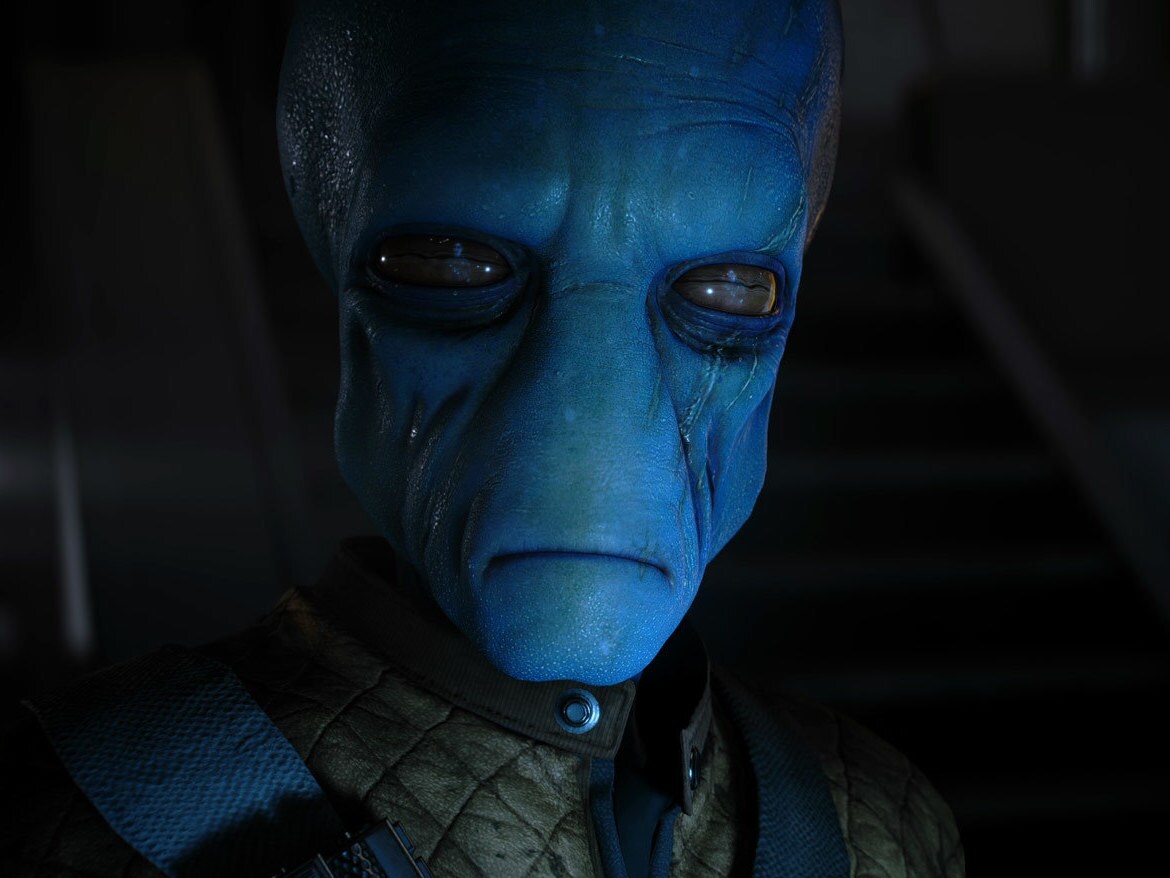
Shriv Suurgav is a Duros officer who serves the Rebel Alliance long before the Empire's defeat becomes inevitable. Official StarWars.com reference material identifies him as the commander of Danger Squadron, a reliable officer associated with the Liberation of Sullust, the Battle of Endor, and other important Rebel operations. His biography therefore begins with an established military career rather than with his later friendship with Imperial defectors. When the 2017 Battlefront II campaign introduces him, he already knows the political risk of opposing a government with far greater resources.
The Duros are one of the galaxy's many species represented in interstellar navigation and commerce, but Shriv should not be reduced to a generic cultural representative. His blue skin, pronounced facial features and dark eyes visibly distinguish him from the game's mostly human main cast, while the narrative defines him primarily through competence, loyalty and his combative sense of humor. Neither his birthplace nor a detailed Duros family history is established by the core official profile. IDS does not invent either to fill a biographical gap.
His professional position matters. Danger Squadron is a military organization with leadership responsibilities and personal relationships, not just a name printed on a starfighter. Shriv leads others into dangerous circumstances while the Rebellion is still trying to survive. His capacity to operate within a coalition becomes especially important after Endor, when a victorious insurgency must begin protecting worlds and making decisions that resemble those of a government.
Lando Calrissian, Endor, and wartime judgment
The Databank identifies Shriv as a longtime friend of Lando Calrissian and an ally of Leia Organa. Those relationships place him within a network of Rebel leaders, pilots and commanders, while allowing him a personality distinct from the better-known figures around him. He is not presented as an officer who always speaks in patriotic slogans. His sarcastic remarks question assumptions, acknowledge danger and sometimes frustrate companions even when he continues working beside them.
In Battlefront II, his scenes with Lando illustrate what a professional relationship can look like when two people handle risk differently. Lando uses charm, confidence and improvisation. Shriv is more openly skeptical. Their exchanges create comedy, but the larger function is to show operational trust without requiring uniform temperaments. Two people can disagree about tone or approach while acting together against the Empire.
Official material connects Shriv to the Battle of Endor and the Liberation of Sullust. The game does not supply a full personal log of every sortie or pilot under his command, so this article avoids turning historical participation into a fabricated series of heroic missions. What matters for the documented story is that Shriv has the standing to speak for Rebel military interests and the experience to assess people who offer to defect.
His unusual humor can also be examined without confusing sarcasm with a lack of commitment. The contrast between his pessimistic words and reliable actions is part of his characterization. He complains, but he returns to dangerous work. Evaluating the officer solely by what he says would ignore the operational evidence of what he chooses to do.
Operation: Cinder and the former Imperial officers
Shriv becomes essential to the game's central transformation when Iden Versio and Del Meeko abandon the Empire during Operation: Cinder. Both had belonged to the elite Inferno Squad, a unit trained to locate and destroy threats to Imperial power. A newly defecting soldier with classified knowledge can be a valuable ally, but the same person also represents a serious intelligence risk. Shriv's Rebel position puts him close to the practical problem of whether former enemies can be trusted.
The official StarWars.com overview of Resistance Reborn states that Shriv is instrumental in Iden and Del's defection and incorporates the two pilots into Danger Squadron to stop Operation: Cinder at Naboo. That account matters because it identifies more than a single friendly gesture. Shriv helps convert a political break with the Empire into a place within a different military chain of command. Their expertise can now serve people the Empire is attacking.
Naboo is a useful test of this change. Imperial forces threaten a populated world through an operation intended to continue the dead Emperor's punishment of perceived enemies and former subjects. Officers who refuse those orders have to act, not simply profess private doubt. Cooperation among Iden, Del and Shriv is therefore consequential. It concerns real command responsibilities, the risk of betrayal and the protection of civilians.
Yet Shriv does not simply erase the defectors' previous actions. They trained inside the enemy institution, and the narrative's turn matters because their history remains part of who they are. An evidence-based reading distinguishes the circumstances that produced their loyalty from the later decisions that changed it. Shriv offers an example of how an opposing organization can accept defectors through observed cooperation instead of treating political origin as permanent destiny.
Jakku and the New Republic's Inferno Squad
As the Rebel Alliance becomes the New Republic, Shriv's role continues. The StarWars.com account describes him joining Iden and Del in a new Inferno Squad that sees action at the Battle of Jakku. The name is deliberately significant. A designation once associated with Imperial surveillance and special operations becomes attached to soldiers fighting the Empire's remnants. Institutional names, like ships and equipment, can acquire different political meanings as their members and missions change.
Shriv serves as a connection between the original Rebel command culture and the former Imperial officers. He already belongs to the anti-Imperial movement. Iden and Del bring different tactical knowledge and painful experience with the system they have rejected. Their cooperation brings unlike military traditions into a shared organization. It also forces the story to confront the question of how a postwar government should treat people who have recently changed sides.
The Battle of Jakku marks the decline of the Empire's main military force, but it does not settle every question about Imperial ideas, resources or surviving personnel. Shriv's later appearances demonstrate that continuity. The officer who once fought a powerful centralized state eventually faces a successor seeking to reproduce aspects of that system. His career spans more than a single victory celebration or campaign endpoint.
For the reader, the shift from Danger Squadron to a revised Inferno Squad is a useful reminder that the title of a unit does not fully define its ethical position. Investigating who gives orders, whom a mission affects and how soldiers respond provides better evidence than assuming a particular badge always signifies the same goals.
Resurrection and responsibility for Zay
Decades later, the First Order has grown into a serious threat. Battlefront II: Resurrection brings Shriv back into the narrative when Iden is contacted about the abandoned Corvus on Pillio. Del Meeko's disappearance and the investigation into Project Resurrection draw Iden, Shriv and Iden's daughter Zay into a new conflict. EA's official expansion announcement confirms that Shriv returns, and StarWars.com's later coverage supplies the connection among the principal characters.
Project Resurrection concerns the First Order's effort to build its forces through the abduction and coercive recruitment of children. The title does not mean that fallen Imperial soldiers are literally revived. Shriv helps the Versio family pursue evidence of this operation. His earlier experience working with former Imperials now gives him context for evaluating how a successor regime acquires people, equipment and legitimacy.
The later campaign culminates in a confrontation aboard a First Order Star Destroyer. Shriv and Zay survive after Iden dies, carrying intelligence relevant to the Resistance. This event changes the meaning of Shriv's support. He is no longer merely the sarcastic officer who helped two adult defectors. He becomes a surviving comrade who continues working with their daughter after the loss of both parents.
The official Resistance Reborn feature says Shriv and Zay leave on a mission to find allies shortly before the First Order reaches D'Qar. The story thereby links an individual military relationship to the wider Resistance network. Shriv's continuing role is grounded in his choices: he remains with the young pilot, protects the information they recovered and participates in the effort to organize a response to the First Order.
Resistance Reborn, evidence and a longer military life
Shriv and Zay also appear in the canon novel Resistance Reborn, which connects the events of the Battlefront II story to the Resistance's struggle after The Last Jedi. The official article about the novel explicitly names both characters and explains the importance of their earlier operations. This cross-media appearance is significant because it confirms that the game's surviving allies continue to exist within the larger published narrative rather than vanishing after the last playable chapter.
Shriv is a supporting protagonist, not the primary playable character in the Battlefront II story. The main campaign centers on Iden, while the Resurrection continuation includes her, Zay and others. Different multiplayer classes, fan modifications and custom skins should not be treated as evidence that Shriv has a canonical special ability tree or a personal equipment loadout. In-game representation and narrative biography answer different research questions.
The evidence is also limited. The published sources offer his species, allegiance, important campaigns, command position and several relationships, but do not establish every aspect of his personal life. There is no basis here to assign him an invented homeworld, a childhood military academy or an exact birth year. A detailed biography can still be worthwhile when it focuses on the documented changes in his social and military roles.
Shriv's continuing significance lies partly in that sequence. He begins as a Rebel commander, helps incorporate defectors into another chain of command, participates in the transition to the New Republic and eventually supports the next generation of Resistance fighters. His dark humor is memorable, but his documented institutional and interpersonal continuity makes him important to the story.