
Image verified by editorial review: published novel cover related to this specific event, replacing an unrelated or less relevant image.
Published cover of Chuck Wendig's Aftermath: Empire's End (Random House Worlds, ISBN 9780593972779), which narrates the Battle of Jakku. Cover illustration is a publisher depiction, not a documentary screenshot or an individual named ship identification.
Publisher listing for the Battle of Jakku novel. → Editorial source identification does not grant permission to redistribute the original artwork; this page references the publisher-hosted image.
The final large battle is not a universal surrender
Who brings Imperial forces together at Jakku?
Do not confuse the depicted event with the fate of every world or person.
A final concentration of Imperial forces
In 5 ABY, Gallius Rax gathered major remaining Imperial fleets around Jakku. Many officers believed they were making a last stand to restore Imperial rule. His concealed orders, however, followed the late Emperor's plan to punish and eliminate a failed Empire.
A destructive battle in space and on land
New Republic forces attacked Imperial vessels and ground installations. Star Destroyers and other warships crashed into the desert, leaving debris fields that would shape the planet's landscape and later scavenging economy.
Sloane prevents a wider catastrophe
Rax intended to destroy Jakku with a planetary device. Rae Sloane confronted and killed him, averting the final detonation. She then departed toward the Unknown Regions with other Imperial survivors who would form part of a new remnant.
Anthropological assessment
Jakku's wreckage shows how the material remains of war influence subsequent societies. Debris became a source of wealth and danger for scavengers, even after the political conflict that created it had ended.
Interactive evidence lab
Did every Imperial survivor die at Jakku?
No. Survivors escaped, including people who later helped build new Imperial-descended organizations.
Compare the event from three perspectives:
The final large battle is not a universal surrender
In Aftermath: Empire's End and related Canon history, Gallius Rax brings major Imperial forces to Jakku. Many participants believe they are fighting to restore the Empire, but Rax has a concealed purpose connected to Palpatine's Contingency. New Republic forces prevail in a battle that leaves immense wreckage across the desert world.
Jakku signals the defeat of the principal remaining Imperial military concentration, not the extinction of every former Imperial officer or belief. The war's conclusion involves soldiers, civilians, political negotiators and later splinter groups. The remains of starships also become part of Jakku's material landscape, showing how a military event can shape later livelihoods and memory.
Evidence and dating: The chronology gives a year, not a specific day. Source publication year must not be confused with the fictional year. Lucasfilm's Palpatine Contingency explanation.
Test your historical judgment
Get a score and individual corrections after answering.
Canon · 5 ABY · Source-critical reading
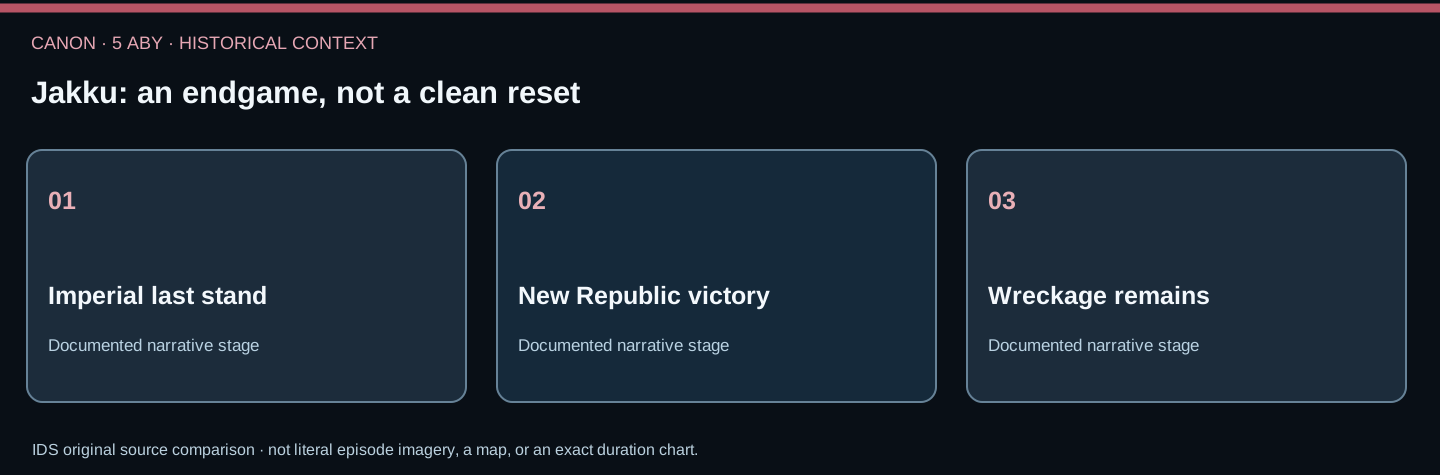
Jakku: an endgame, not a clean reset
The Battle of Jakku brought a large Imperial force and the New Republic into an enormous confrontation after the Emperor's death. Lucasfilm's Jakku Databank records the military wreckage that remained on the planet, while Chuck Wendig's author interview for Aftermath: Empire's End connects the battle to Gallius Rax's plans and to the continuing story of Sloane and other Imperial survivors.
A strategic victory has a different scale from its environmental and civilian consequences. The remains of wrecked ships became part of Jakku's later economy as people scavenged components, even though the battle had already entered Republic history as an ending. The imperial military collapse also did not make every extremist faction disappear immediately. The Galactic Concordance followed as a political settlement, and the First Order would later emerge from surviving Imperial networks.
Research judgment: Did winning the Battle of Jakku automatically eliminate every Imperial remnant or all future threats?
Explanation: No. It ended the major military confrontation, but remnants and later successor movements continued.
Continue related history → · Post-Endor history route →
Source context: Official Lucasfilm game, Databank or author commentary. Political interpretation is identified separately from the source; exact casualty numbers, invented dates and undocumented firsthand accounts are not supplied.
Canon · post-Endor source review · 12 October 2026
Battlefield victory and the surviving Imperial network
The Battle of Jakku brings together two stories that must not be collapsed into one. To many Imperial combatants, it was a final effort to defeat the New Republic. To Gallius Rax, it was connected to a concealed part of Palpatine's Contingency. The Aftermath: Empire's End narrative reveals why the commander had gathered forces at a remote world and why Rae Sloane's conflict with him matters. Treating all Imperial personnel at Jakku as knowing the concealed plan would falsely assign them the same motives. The novel and the official Lucasfilm discussion provide stronger evidence than a later image of the planet's wrecks can offer.
New Republic victory destroyed the Empire's major fleet concentration but did not amount to the death or surrender of every Imperial survivor. Other Canon accounts, including Alphabet Squadron and Battlefront II, approach the same period through different participants. These perspectives should be read as overlapping accounts, not as permission to invent a single precise sequence for every vessel or unit. The visible wreckage later used by Jakku's scavengers shows the continuing material consequences of the campaign, but cannot by itself establish who commanded each lost ship.
The political aftermath requires its own article. A battle determines control of forces and territory; the Galactic Concordance sets out a formal settlement. This distinction helps explain why the New Republic could celebrate an end to the large war while still confronting former Imperial networks. See the earlier Contingency attacks for the connected post-Endor history. The cultural interpretation here concerns how veterans, scavengers and displaced residents experience an event differently from the governments that name it a victory.
Evidence register: Lucasfilm interview with the Empire's End author. Distinguish original story material from later publisher commentary and IDS interpretation. No exact scene timestamp, unverified casualty count, or new image license is claimed.
Sources and interpretation
Aftermath: Empire's End; StarWars.com Palpatine's Contingency. Read background →. Images may represent later appearances, as disclosed above.