
In 5000 BBY, the Manderon Period ended and the Post-Manderon period began. The transition coincided with the Great Hyperspace War, the destruction of the old Sith Empire, and the beginning of a millennium that would eventually lead into the Old Sith Wars.
A period boundary shaped by war
The Great Hyperspace War marks the political rupture between the two eras.
The old Sith Empire would not survive the opening year of the period.
A millennium before the Great Sith War
The period includes Republic recovery, hidden Sith survival, the Gank Massacres, the Beast Wars, and numerous regional conflicts.
By 4000 BBY, Sith-related warfare again dominates the chronology.
Anthropological assessment
Historical eras are retrospective categories that make long timelines easier to interpret.
Here the boundary is useful because 5000 BBY genuinely changed relations among the Republic, Jedi, and Sith, even though daily life on most worlds did not reset at once.
Legends · Post-Manderon source research
A thousand-year historical chapter, not a single declaration
The Post-Manderon period is a later Legends historical label covering approximately 5000–4000 BBY. Its opening coincides with the Great Hyperspace War and the collapse of the older Sith Empire, events that changed the relationship between Sith rulers, Jedi and the Galactic Republic. No surviving source describes a Senate law formally renaming the next thousand years on the day the war ended. The label is a tool that later historians and reference guides use to group changes that unfolded at different speeds in different parts of the galaxy.
The period included recovery from the Great Hyperspace War, new struggles over Sith knowledge, regional expansions and conflicts, the Gank Massacres, a series of Mandalorian operations, and the beginnings of the Beast Wars on Onderon. Some of these events were independent of one another. Readers should not assume that everyone alive in the period experienced one continuous war or that every local conflict resulted from the collapse of Sith power in 5000 BBY. Later at the boundary around 4000 BBY, the histories of Freedon Nadd, the Krath and the Great Sith War create another cluster used to mark a new era.
Historical labels summarize rather than cause events
Periodization enables readers to navigate centuries of material, but its categories do not replace the motives and institutions operating in each locality. A millennium can contain long periods of ordinary trade and education alongside wars remembered for their dramatic scale.
The end of one empire leaves multiple legacies
The old Sith state lost its central position, yet knowledge, artifacts and survivors persisted in different locations. Subsequent movements reused this material in different ways. Institutional continuity must be demonstrated from sources rather than inferred from an inherited name.
Did the Republic officially proclaim the Post-Manderon period in 5000 BBY?
No. Post-Manderon is a retrospective Legends reference label, not a dated contemporary declaration. The Great Hyperspace War is one reason later historians use the boundary.
Evidence: The Essential Atlas; The Complete Star Wars Encyclopedia; Old Sith Wars chronology. Source reference and bibliography →. Distinguishes contemporary evidence, later historical summaries and IDS interpretation.
Historical interpretation · 5000 BBY · Legends
What the surviving story establishes
The Post-Manderon period is a retrospective category used to organize an interval of Legends history. It should not be mistaken for a decree proclaimed by a Galactic Senate or an announcement made on one world.
The boundary is placed near the Great Hyperspace War, a turning point that changed Republic knowledge of the Sith and the balance of power between regions. Other communities would have experienced this period division differently, if at all.
Period labels can help visitors compare episodes separated by centuries, but they are interpretive tools. This page belongs beside event dossiers rather than being described as a battle or an action taken by one historical actor.
Did the people of the Republic necessarily use the phrase 'Post-Manderon period' in 5000 BBY?
No evidence is provided for that. The phrase is used here as a later historical classification, not a quotation from a contemporary Republic announcement.
Original story or reference: Legends chronological reference classification; Great Hyperspace War source corpus. View the cited source listing →
5000 BBY · Legends · Evidence lab
Post-Manderon: an era label and its limits
What the record establishes
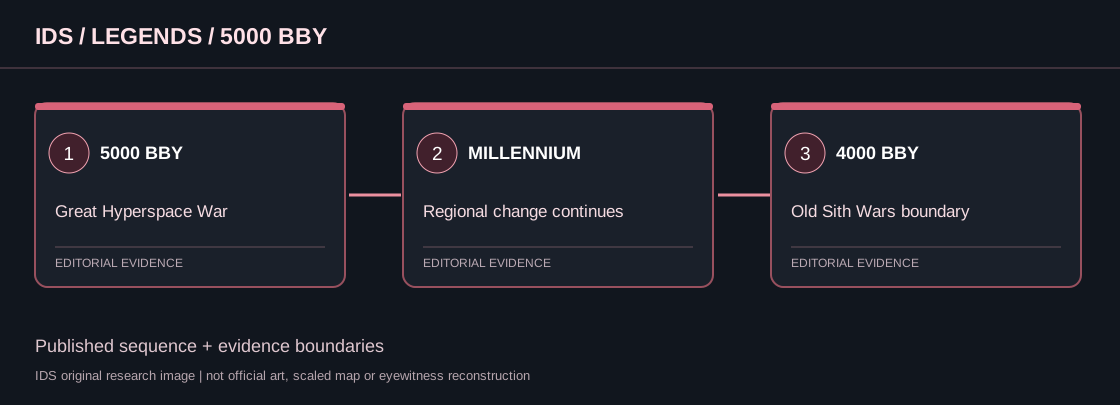
The Post-Manderon period is a Legends reference classification covering roughly 5000–4000 BBY. It begins as the Manderon period ends around the Great Hyperspace War and the Koros Unification Wars, and precedes the Old Sith Wars. Histories of the surviving Sith, the Gank Massacres, the Beast Wars and many smaller regional conflicts fit within this long interval. The phrase is a historian's category, not a known Republic government proclamation.
Anthropological assessment
A period boundary helps compare changes over centuries but does not mean everyone lived through a uniform turning point. Different worlds experienced very different social and political changes. Republic officials, the hidden Sith and societies beyond their direct control used different institutions and remembered different events. Periodization works best when the name gives structure without erasing those differences.
Evidence limits
The exact start and end years are conventionally presented in Legends chronology. The term is not established as a current Canon era or as a calendar that every character was required to use.
Check your historical judgment: Did Republic citizens everywhere proclaim a new Post-Manderon age in 5000 BBY?
Correction: No. The term is a retrospective reference-period label, not a documented collective public declaration.
Source trail: The Essential Atlas; Post-Manderon period chronology. Bibliography and reference history ↗. Printed page verification remains open.
Sources and further reading
- The Essential Atlas.
- Post-Manderon period, Wookieepedia