
- World
- Sraato / later 244Core
- Earlier disaster
- c. 3809 BBY meteor storm
- Instability duration
- ~500 years
- Milestone
- Environmental chaos ends
- Region
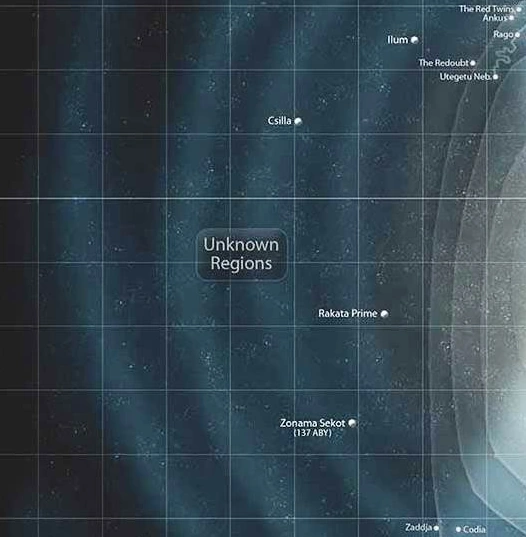
- Unknown Regions
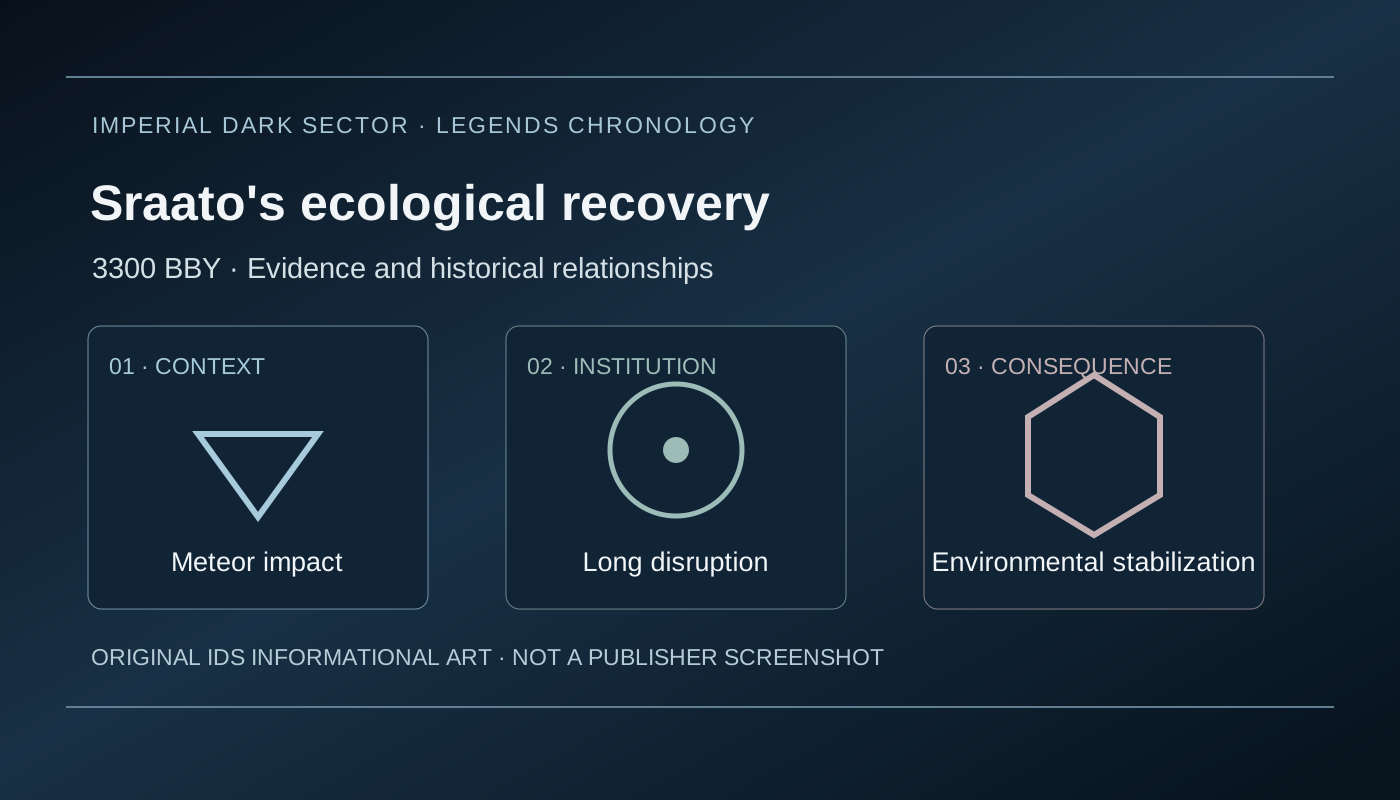
Around 3300 BBY, the environmental chaos created by Sraato's catastrophic meteor storm finally subsided. Roughly five centuries earlier, repeated impacts had pulverized large areas of the southern hemisphere and wiped out the Systino Crime Syndicate's mining operation along with hundreds of enslaved workers. Dust, debris, and continuing instability then made the resource-rich world commercially impractical for generations.
The earlier mining economy had depended on coerced labor
The Systino Crime Syndicate extracted valuable resources using hundreds of enslaved workers. When the meteor storm struck, the destruction erased both infrastructure and the labor population sustaining it.
Later treasure stories can romanticize 'lost wealth.' A social history has to remember who was forced to produce that wealth.
Environmental recovery is slower than political change
A crime syndicate can collapse in a day; planetary dust cycles, unstable terrain, and atmospheric disruption can persist for centuries.
The c. 3300 milestone is therefore an ecological event rather than a new regime or battle.
The world remains attractive because danger does not erase value
Sraato was still rich in resources. That encouraged later treasure hunters to test whether the old catastrophe had made extraction permanently impossible.
Risk and value became linked in the planet's reputation.
The planet will later be renamed 244Core
Thousands of years later, new claimants rediscovered the world and renamed it amid competing ownership claims.
The change of name shows how later economic actors can overwrite older geography even when the planet's physical landscape preserves the earlier disaster.
Event sequence
A massive meteor storm devastates Sraato and destroys the Systino operation.
Dust, debris, impacts, and ecological instability make the world exceptionally dangerous.
The long period of environmental chaos finally ends.
Treasure seekers return intermittently, but no immediate stable industrial revival follows.
The world is rediscovered and becomes known as 244Core.
Explore this entry
Did people recolonize Sraato in 3300 BBY?
Not according to the surviving source. The date marks environmental stabilization, not a new mass settlement.
Why did anyone keep returning?
Because the same geological history that made the planet dangerous also left it extremely rich in valuable resources.
What happened to the enslaved mining population?
The earlier meteor catastrophe destroyed the mining operation and killed the workers. Their fate is part of the event, not merely background to a treasure legend.
Anthropological assessment
Sraato separates environmental time from political time. Governments, syndicates, and mining contracts can change rapidly, while damaged planetary systems may require centuries to stabilize.
The world also illustrates how narratives of 'lost treasure' can conceal labor history. Valuable ruins exist because people once worked there, including people whose labor was coerced and whose lives were destroyed by the catastrophe.
Sources and further reading
- The Unknown Regions.
- Sraato — Wookieepedia.
- 244Core — Wookieepedia.
3300 BBY · Legends · Evidence and political anthropology
Sraato's ecological recovery: what the historical record supports
Source-constrained historical account
Legends references describe a major ancient meteor storm on Sraato and an extended aftermath of atmospheric and environmental instability. The later date is attached to the end of that disruption. There is no secure warrant to assign a specific meteor count, map of impacts or fixed number of displaced inhabitants when such measurements do not appear in the available account.
Institutions, beliefs and material life
Environmental history has a different evidentiary pattern from wars. Geological change can shape the possibility of settlement and transport over centuries without leaving records of individual political decisions. This article should distinguish planetary processes from the experiences of inhabitants who may not be individually named in surviving material.
Chronology and evidence limitations
Dates in this early Legends era are from fictional reference chronologies, sometimes approximate. A later person's accomplishments cannot be read into a record of their birth. IDS distinguishes events recorded in original books or reference titles from analysis of their social implications. A source illustration or cover may portray an era rather than the precise dated event.
The original published narrative and reference bibliography are recorded below; secondary online reference links are research aids and not interchangeable with primary novel pages or guide citations.
Test your historical judgment
Answer both questions. Your result explains the source-based distinction, including any corrections.