

- System
- Yavin
- Survey method
- Probe droids
- Date
- c. 3200 BBY
- Republic classification
- Uninhabitable
- Major ancient site
- Yavin 4 Massassi temples
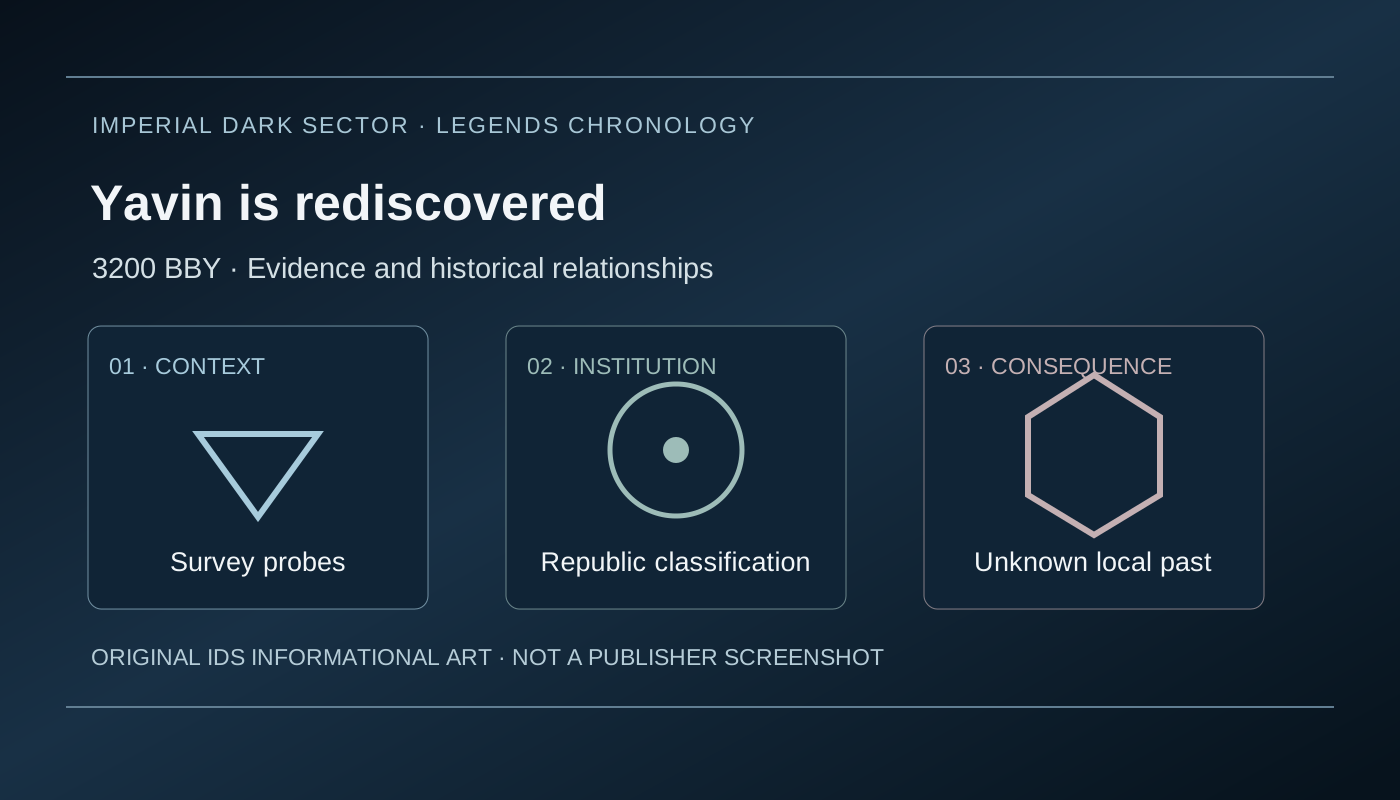
Around 3200 BBY, probe droids exploring spurs of the Perlemian Trade Route rediscovered the Yavin system. The survey classified the system as uninhabitable. That bureaucratic label is striking because Yavin 4 contained monumental ruins from Naga Sadow, the Massassi, and Exar Kun. The classification tells us more about the survey's criteria and recognized contemporary population than about the full history of the moon.
Rediscovery happens through machines rather than settlers
Probe droids extended navigational knowledge beyond frequently traveled routes. Their mission was practical: identify systems and assess their usefulness for further travel or settlement.
That purpose shapes what information gets recorded. A probe optimized for habitability may not perform the work of an archaeologist.
'Uninhabitable' is an administrative category, not a complete ecological description
Yavin 4's biosphere makes a literal claim of biological uninhabitability untenable. The more cautious reading is that surveyors detected no recognized contemporary civilization or acceptable settlement conditions under their criteria.
Historical databases often turn complex assessments into short labels that later readers can over-literalize.
The Massassi ruins survive outside active political memory
Thousands of years earlier, Yavin 4 had been home to Massassi communities and Sith regimes. By the time of the probe survey, those societies were gone.
Architecture therefore outlasted the political knowledge necessary to explain it.
Yavin will be rediscovered again and again
Later Sith, archaeologists, rebels, Imperials, and Jedi would all reinterpret the moon's ruins for new purposes.
A place can repeatedly become 'new' to different institutions even while remaining physically continuous.
Event sequence
Sith and Massassi history transforms Yavin 4.
Exar Kun's regime collapses; the moon becomes increasingly isolated.
Republic probe droids rediscover the Yavin system.
The system is cataloged as uninhabitable.
New groups repeatedly return and reinterpret the ancient ruins.
Explore this entry
How can a jungle moon be called uninhabitable?
The safest interpretation is that the survey classification meant unsuitable for recognized settlement or lacking a detected contemporary population, not that no life could exist there.
Did the probes identify Exar Kun's temples?
The surviving chronology does not establish a detailed archaeological assessment, so IDS does not claim they did.
Why does 'rediscovery' matter?
It shows that galactic knowledge is not cumulative in a perfect straight line. Routes, systems, and histories can fall out of active archives and later be found again.
Anthropological assessment
The Yavin survey is a lesson in bureaucratic knowledge. Administrative categories are built for particular tasks and can flatten the complexity of places that exceed those tasks.
It also challenges the idea of a single galactic memory. The ruins persisted materially while institutional knowledge of their builders fragmented, demonstrating that landscapes can remember more than archives do.
Sources and further reading
- The Essential Atlas / Legends astrographic chronology.
- Yavin system/Legends — Wookieepedia.
- Great Temple/Legends — Wookieepedia.
3200 BBY · Legends · Evidence and political anthropology
Yavin is rediscovered: what the historical record supports
Source-constrained historical account
The Legends chronology describes Republic probes locating the Yavin system again around 3200 BBY and recording it as uninhabitable. The important distinction is between a survey classification and the system's longer archaeological history. Automated instruments can be effective for navigation while missing cultural remains, ecological niches or complex questions of past habitation.
Institutions, beliefs and material life
State databases turn an observation into official knowledge. Once a survey label enters a chart, later travelers may rely on it without revisiting the circumstances in which it was produced. That social effect should not be treated as proof that survey technicians knowingly concealed ruins or falsified reports.
Chronology and evidence limitations
Dates in this early Legends era are from fictional reference chronologies, sometimes approximate. A later person's accomplishments cannot be read into a record of their birth. IDS distinguishes events recorded in original books or reference titles from analysis of their social implications. A source illustration or cover may portray an era rather than the precise dated event.
The original published narrative and reference bibliography are recorded below; secondary online reference links are research aids and not interchangeable with primary novel pages or guide citations.
Test your historical judgment
Answer both questions. Your result explains the source-based distinction, including any corrections.