

- Polity
- Hapes Consortium
- Date
- c. 3100 BBY
- Policy
- Borders sealed
- Defensive force
- Hapan Royal Navy
- Isolation ends
- 8 ABY
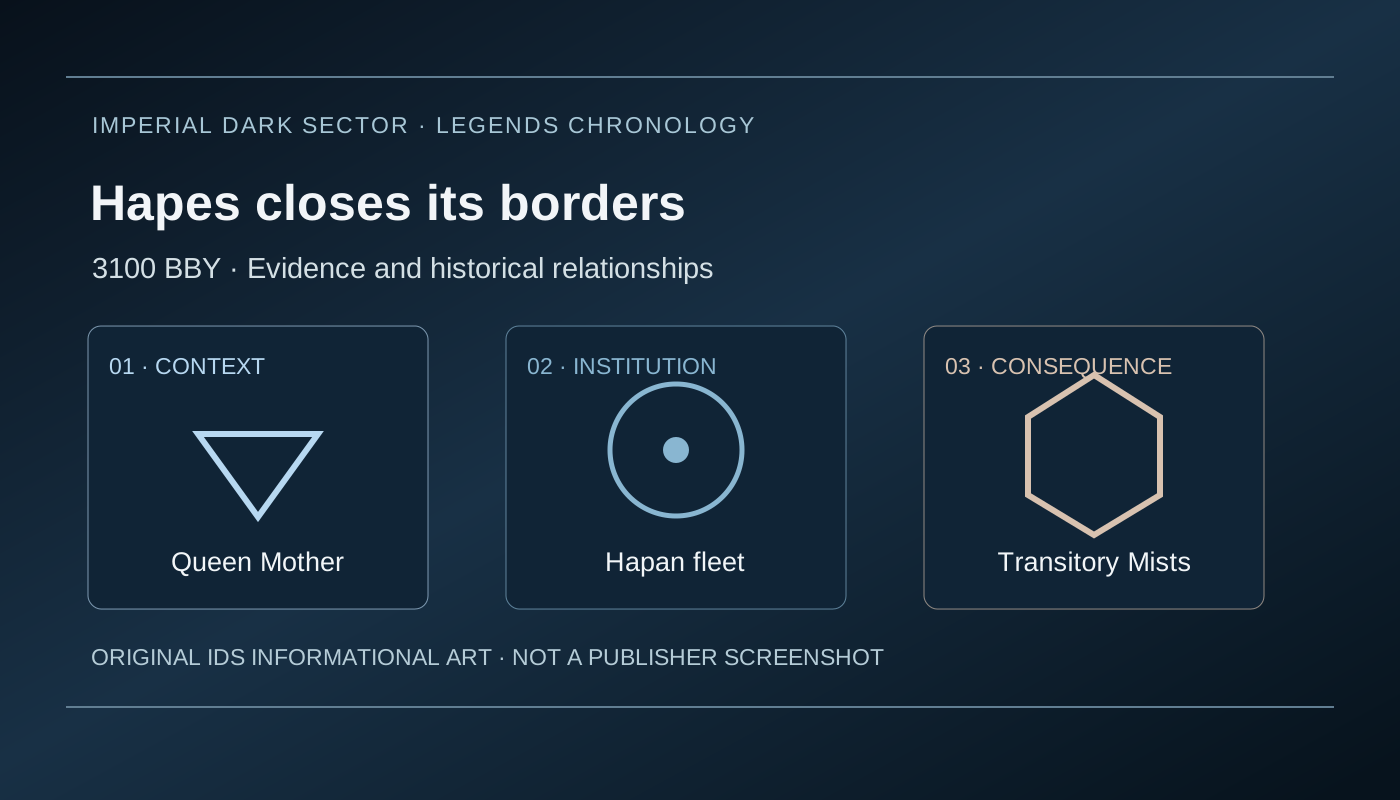
Around 3100 BBY, the Queen Mother of the Hapes Consortium sealed the Cluster's borders to the outside galaxy. The decision transformed a region already protected by the hazardous Transitory Mists into a deliberately guarded political enclave. The Royal Navy increasingly focused on preventing smugglers, pirates, and uninvited outsiders from crossing the frontier, while the Consortium continued expanding and consolidating internally.
Isolation was built on geography
The Transitory Mists already made the Cluster difficult for outsiders to enter safely. Hapan rulers could therefore enforce border controls more effectively than a state in open space.
Geography did not determine isolation, but it made the political choice materially possible.
The Royal Navy becomes a border institution
A navy can exist to fight wars abroad or to control movement at home. Hapan naval priorities increasingly emphasized the latter.
Smugglers and intruders became political problems because crossing the frontier challenged the Queen Mother's authority to decide who could enter.
Internal expansion continues despite external closure
Sealing the border did not mean the Consortium stopped changing. Hapan forces and settlers continued consolidating and colonizing worlds inside the Cluster.
Isolation from outsiders can coexist with intense internal mobility.
The closure lasts for millennia
The border policy endured until the New Republic era, when Hapes reentered wider galactic diplomacy in 8 ABY.
Such longevity made isolation more than policy; it became part of Hapan identity and expectations about outsiders.
Event sequence
Jedi destroy the Lorell Raiders; descendants of captives reshape Hapan society.
A matriarchal monarchy and regional political institutions consolidate.
The Queen Mother seals the borders.
The Royal Navy protects controlled access through the Transitory Mists.
Hapes formally reenters wider galactic diplomacy.
Explore this entry
Did Hapes become isolated because the Mists made travel impossible?
No. Travel was difficult but possible. Isolation was a political decision enforced through geography and naval power.
Did Hapan civilization begin in 3100 BBY?
No. This date marks border closure, not founding.
What does a closed border change culturally?
It limits routine outside contact, allowing internal institutions and ideas about outsiders to develop with less everyday external challenge.
Anthropological assessment
Hapes demonstrates that borders are social technologies built on material landscapes. The Mists provided obstacles, but law, patrols, dynastic authority, and shared expectations turned those obstacles into a political frontier.
Long isolation also produces feedback: the longer outsiders are restricted, the more foreignness itself can become culturally meaningful, which in turn makes continued restriction seem natural.
Sources and further reading
- The Essential Atlas.
- Hapes Consortium/Legends — Wookieepedia.
- Hapan political-history reference material.
3100 BBY · Legends · Evidence and political anthropology
Hapes closes its borders: what the historical record supports
Source-constrained historical account
The Hapes Consortium's ancient isolation policy is placed approximately in the early third millennium BBY in Legends chronology. The decision limited external travel through the Hapes Cluster, supported by navigation difficulties and naval patrols. It should be interpreted as a policy with a long history, not a claim that a literal border remained uniformly impermeable on every day afterward.
Institutions, beliefs and material life
A political boundary depends on enforcement, geography and recognized authority. Hapan isolation could help preserve court institutions while constraining the movement of outsiders. Its effect on everyday residents, smugglers and local trade may have varied, so broad claims of complete economic separation require specific support.
Chronology and evidence limitations
Dates in this early Legends era are from fictional reference chronologies, sometimes approximate. A later person's accomplishments cannot be read into a record of their birth. IDS distinguishes events recorded in original books or reference titles from analysis of their social implications. A source illustration or cover may portray an era rather than the precise dated event.
The original published narrative and reference bibliography are recorded below; secondary online reference links are research aids and not interchangeable with primary novel pages or guide citations.
Test your historical judgment
Answer both questions. Your result explains the source-based distinction, including any corrections.