
Image verified by editorial review: screen frame related to this specific event, replacing an unrelated or less relevant image.
Return of the Jedi (1983): Anakin's final conversation with Luke after choosing to save him. The frame depicts the aftermath of his decision, not the instant he throws the Emperor. Lucasfilm still, displayed from its original image host.
Lucasfilm's Darth Vader biography confirms the sequence and his sacrifice. → Editorial source identification does not grant permission to redistribute the original artwork; this page references the publisher-hosted image.
An individual decision changes a regime's leadership
Who saves Luke from Palpatine's attack?
Do not confuse the depicted event with the fate of every world or person.
- Year
- 4 ABY
- Continuity
- Canon
- Place
- Throne room, Death Star II
An attempt to turn Luke against his father
Darth Vader took Luke Skywalker to the Emperor's throne room. Palpatine sought to provoke anger as the Rebel fleet fought outside. Luke dueled his father and disarmed him but refused to execute the defeated Sith, rejecting the succession role Palpatine offered.
Palpatine attacks the young Jedi
Enraged by Luke's refusal, Palpatine struck him with Force lightning. Vader watched his son's suffering and turned against his master, lifting the Emperor and throwing him into the station's reactor shaft.
A final exchange between father and son
The Emperor's attack fatally wounded Vader. Luke removed his father's mask, allowing Anakin to look at him directly before dying. The event did not undo his decades of violence, but it ended the immediate Sith master–apprentice relationship.
Anthropological analysis
The throne-room confrontation is about the uses of kinship within authoritarian power. Palpatine tried to make family loyalty a means of reproducing Sith hierarchy, while Luke refused to treat shared ancestry as an obligation to serve evil.
Interactive evidence lab
Did Luke choose to become Palpatine's apprentice?
No. He rejected the Emperor, and Vader saved him.
Switch lenses to see how the event connects to power and culture.
An individual decision changes a regime's leadership
Luke refuses to kill his disarmed father or submit to the Emperor. Palpatine then attacks Luke with Force lightning. Vader intervenes to save his son and turns against Palpatine, suffering fatal injuries in the process. This is the throne-room climax of Return of the Jedi, occurring during the battle raging outside the second Death Star.
The family relationship matters to the story, but Vader's action does not physically destroy every Imperial institution. The death of Palpatine and Vader destabilizes the political center while a fleet still fights and remnants remain afterward. Describing the moment as both an ethical decision and an institutional crisis preserves the distinction between personal redemption and the later struggle to end Imperial rule.
Evidence and dating: The chronology gives a year, not a specific day. Source publication year must not be confused with the fictional year. Lucasfilm Death Star II Databank.
Test your historical judgment
Get a score and individual corrections after answering.
Canon · original evidence analysis
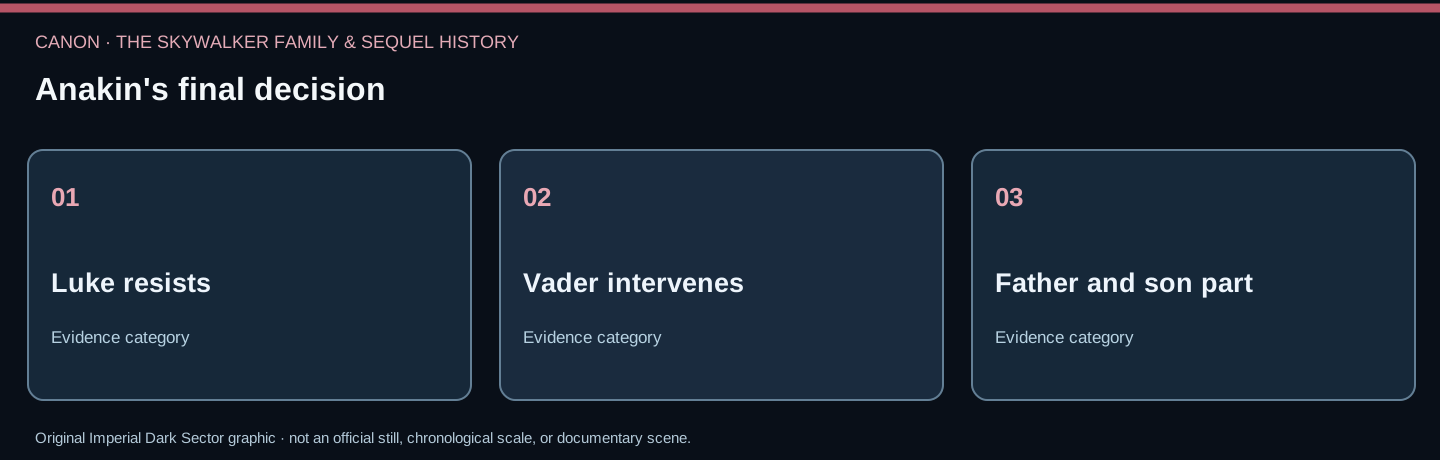
Anakin's final decision
During the second Death Star confrontation, Darth Sidious tried to destroy Luke after Luke refused the power offered by the Emperor. Vader then acted against his master to protect his son. The decision broke the pattern of obedience that had sustained his role in the Empire, even though it came after decades of injury and harm he had caused to others. The account does not imply that a single final act canceled the suffering of his victims or dismantled all Imperial institutions immediately.
Luke's refusal to kill his father and Anakin's subsequent choice are different decisions with different ethical consequences. The film's intimate final exchange is also distinct from the wider space battle outside the Death Star. An anthropological reading may explore kinship, moral change and obligations, but it should avoid implying that every family bond necessarily overcomes coercive power. The new image separates resistance, intervention and farewell without recreating a frame from Return of the Jedi.
Check your interpretation: Did Anakin's final act instantaneously undo every consequence of Vader's previous actions?
Explanation: No. It saved Luke and defeated the Emperor in that encounter, but earlier harms and the surviving Empire required separate reckoning.
Compare a related history → · Skywalker and sequel-era research guide →
Source reference: Anakin's final decision — official Lucasfilm or publisher source. Individual motive, source perspective, exact dating and offscreen outcomes are discussed as interpretations, not quoted eyewitness evidence.
Sources and interpretation
Return of the Jedi; StarWars.com Emperor's Throne Room databank. Check original source background →. Interpretive commentary is separated from the narrative facts.