
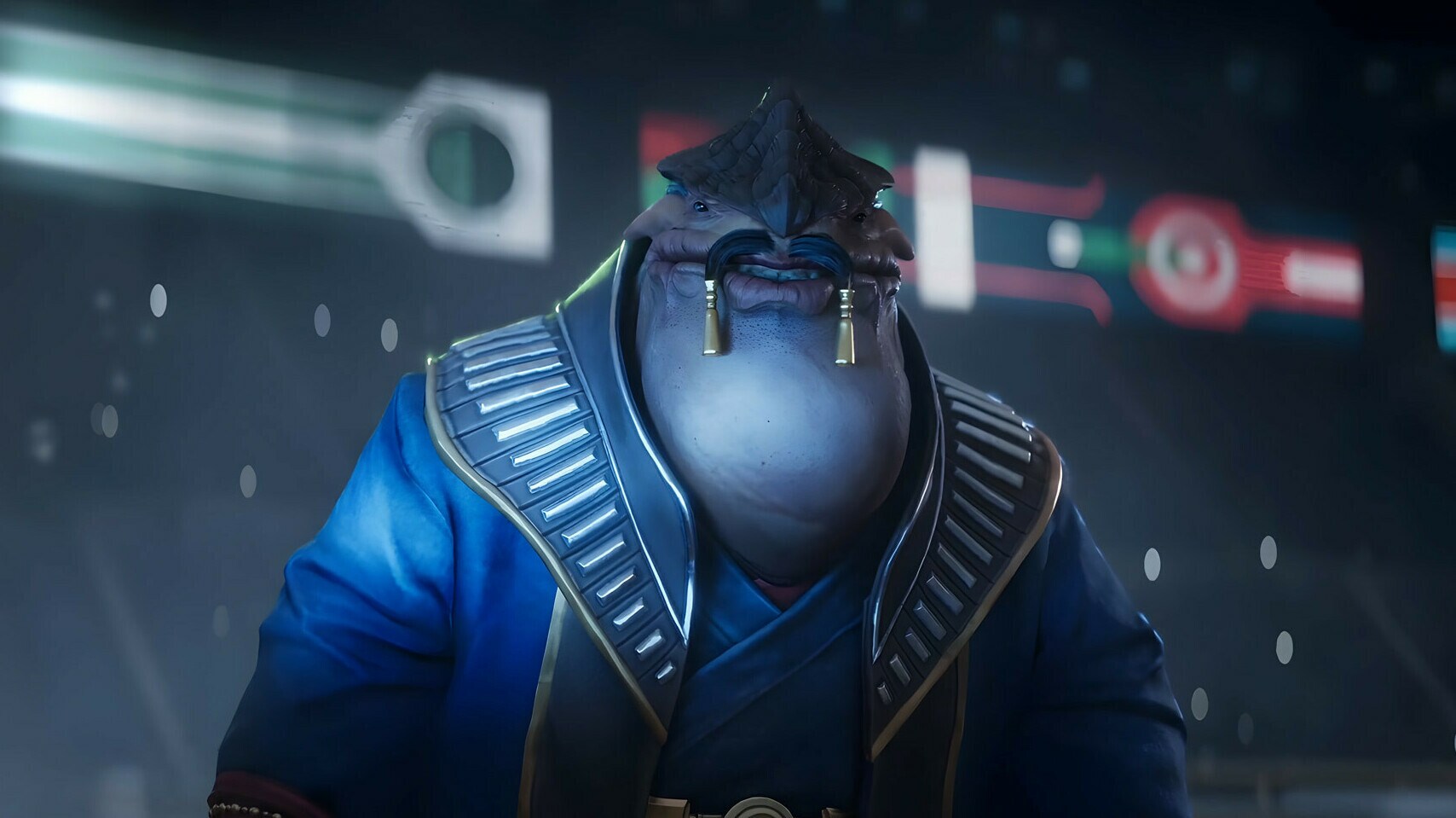
GALACTIC RACER / LEAGUE FOUNDER / CANON
He founded a league. Then lost control.
Darius Pax helped professional racing survive the Empire, but his dream of rebuilding the sport became dependent on a powerful family whose champion refuses to play fair.
Darius Pax is the Besalisk founder of the Galactic League and a major story organizer in Star Wars: Galactic Racer. His experience reaches back to the era of Hutt-sponsored races, when he repaired vehicles and eventually managed racers for Jabba. He worked in luxury vehicle customization after the Empire pushed the racing circuit underground. When the New Republic emerged, he invested his own savings in a new competition.
The project succeeded but attracted the wealth and influence of Kestar Bool. The League grew, its tracks moved toward Bool-controlled worlds and the champion's power increased. Pax now wants to recover the legitimacy of the sport he loves. His predicament is not just one racer breaking the rules. It is a governance problem: what happens when an institution needs a sponsor more than it can constrain that sponsor?
01 / VERIFIED ORIGINS
A mechanic for Jabba's racers.
Lucasfilm describes Darius Pax as a Besalisk whose fascination with motorsport began long before the Galactic Empire. He entered the racing world as a mechanic for the Hutts and rose to manage the stable of racers associated with Jabba the Hutt. That history distinguishes him from a wealthy outsider who decided to purchase a league only after discovering a commercial trend.
The practical work of managing racers connects maintenance, talent and organization. A mechanic is responsible for how a machine survives use. A team manager must also coordinate people who may compete for attention, opportunities and resources. Pax's ascent gives him experience of racing as both performance and labor.
Working for Jabba's racing operation placed Pax within a Hutt-controlled commercial environment. The source does not establish his legal status, his precise wages, or any secret personal allegiance to Jabba's later criminal projects. Employment history is enough to demonstrate proximity to Hutt sponsorship, not personal responsibility for everything done by the Hutts.
The official account emphasizes his craft and his love of the sport. Pax is not introduced as a Force user, elite racer or New Republic official. He is a skilled vehicle specialist and organizer with a sense of history. That matters because the plot asks him to recognize how his own institution is changing even as its audiences expand.
In Galactic Racer, Pax speaks for the promise of a league where competition could again become a public activity. His ambition is deeply personal: he wants racing to bring fans and pilots together, without the intimidation and cheating that increasingly accompany Kestar Bool's dominance.
02 / REGIME CHANGE
Racing pushed underground.
The Empire's rule reshaped the conditions of racing. According to the Star Wars Databank, the Imperial government forced the competition underground. Pax's ability to tailor complex vehicles to demanding customers enabled a professional transition from racing machines to luxury vehicles. His technical competence remained useful, but the industry in which it was valued changed.
The contrast between a legitimate racing circuit and an underground one is not simply a change of scenery. Laws and enforcement alter which organizations can gather publicly, advertise and receive investment. Pushed into less visible settings, a sport may rely more heavily on networks of private patrons and criminal intermediaries. The Galactic League inherits that difficult history even after the Empire disappears.
Pax's work with luxury vehicles is an example of occupational adaptation. A mechanic who once worked on machines designed to win races can apply related skills to products purchased for prestige and private enjoyment. The labor remains technical, but its institutional setting and intended customers are different.
The source does not claim that Pax never repaired a racing engine again, or that every part of the sport vanished. It establishes the general pressure created by Imperial policy and his specific response. That limited but grounded sequence is more useful than inventing arrests, raids or a particular clandestine championship.
When the New Republic begins, Pax recognizes the chance to organize racing openly again. That hope is not the same thing as legal authorization. Lucasfilm describes the League as an unsanctioned competition in an Outer Rim where the legality of racing remains unsettled. His ambition to gain recognition should not be confused with proof that the New Republic already endorses the League.
03 / FOUNDING THE INSTITUTION
The cost of a new beginning.
Pax invests all of his own credits to establish the Galactic League, an optimistic name for a difficult project. The early years are modest, but the competition attracts committed spectators and talented racers. The League creates a tour across planets in the Outer Rim, combining the spectacle of speed with the practical difficulty of staging an event in politically uncertain territory.
The official organization profile makes the underlying structure explicit. Entrants need backing and a vehicle, and they race through a string of planetary events before the championship challenge. Sponsors may be enthusiasts, pirates or syndicates. This means that access to competition already depends on someone else's resources, even before the Bool family's special influence is considered.
Pax also introduces skim speeders to the League. StarWars.com's vehicle guide describes them as machines with a history in smuggling, adapted to a formal racing setting. That detail expresses a founder's ability to change the boundaries of a sport. Vehicle classes and rules are not just technological categories; someone decides which machines count as legitimate participants.
The sporting institution has a geographical structure. Each planet offers a different race environment, local infrastructure and network of participants. Its competitive geography shapes where crowds gather, where money flows and which groups benefit from commercial attention. The later movement of tracks toward Bool-affiliated planets is therefore a major shift in institutional control.
Pax's dream is to make the League an inclusive celebration of racing, but the financing model makes that ideal vulnerable. An organizer who requires outside money must determine whether investor demands are compatible with impartial rules. The League grows only while those conflicts remain unresolved.
04 / KESTAR BOOL & CORRUPTION
Success created a rival authority.
Kestar Bool, the youngest son of Kedron Bool, joins the racing circuit after Pax encourages him to compete. Pax sees the Bool family's wealth as an opportunity to accelerate the League's development. The immediate benefits are substantial: expanded activity, more attention and increased viewership. But family resources give Kestar influence over the competition that is supposed to judge him.
Lucasfilm explains that League tracks move to Bool-affiliated planets as Kestar's influence increases. Those venues are not neutral background. Control over where a competition occurs affects economic opportunity, local prestige and potentially the treatment of rivals. It also gives a powerful entrant advantages unrelated to driving skill.
Kestar relies on ringers and cheating while seeking public admiration and his father's approval. Pax increasingly regards those methods as unacceptable. A champion who participates in the race and also shapes the institution can weaken the very standards that make a title meaningful.
The dilemma is sharpened by Pax's own responsibility. He did not merely inherit Bool's control; he encouraged Kestar to join partly because of the resources it would bring. Recognizing the damage now requires acknowledging that the path to rapid expansion helped create the problem. Pax's goals and the League's dependence no longer align.
This history is part of why Shade matters to Pax. The gameplay reveal establishes that he recruits the masked newcomer to challenge Kestar. Shade's grievance against the Bool family overlaps with Pax's institutional objective, although those motivations are not identical. A personal rivalry can become a mechanism for changing a wider organization without turning the racer into an official regulator.
Pax's desire to remove Bool's corruption may invite readers to view him as simply virtuous. The record instead supports a more interesting position. He wants the sport to succeed, and some of his earlier decisions made the threat possible. Ambition, compromise and regret coexist within the same biography.
05 / INTERACTIVE LEAGUE LEDGER
Who makes the rules when money enters?
Switch among institutions shaping Pax's League. The analysis describes known relationships; it does not manufacture financial data or claim these buttons are actual game mechanics.
The League begins with its founder's credits
Pax finances the initial project himself. That preserves an early degree of creative control, but limits the speed and scale of growth.
Institutional question: Whose priorities decide the rules?
06 / HISTORICAL SEQUENCE
Rise, compromise, resistance.
BEFORE THE EMPIRE
Pax begins as a mechanic for Hutt-associated racers.
JABBA'S OPERATIONS
Rises to manage Jabba's group of racers.
IMPERIAL PERIOD
Racing is driven underground; Pax works on customized luxury vehicles.
NEW REPUBLIC EMERGES
He finances his own racing circuit and gives it the name Galactic League.
EARLY TOURS
Committed racers and fans build an audience for the competition.
BOOL INVESTMENT
Kestar joins; his family resources help expand the League and influence its venues.
THE CHAMPION'S GRIP
Pax grows alarmed by cheating, ringers and Kestar's institutional power.
SHADE ENTERS THE CIRCUIT
Pax recruits a challenger whose conflict with the Bool family may help change the League.
For the actual sequence of challenges, events and campaign missions, open the three-act campaign guide. Dates and outcomes not established in primary sources are not invented here.
07 / RELATIONSHIP & AUTHORITY MAP
A circuit with too many bosses.
Filter the League's power network to distinguish competitors from sponsors and public institutions. A person may occupy more than one role.
Hibi Esuufa
Mechanic and engineer on Shade's crew, working inside the League's paddocks.
Related archive →Kestar Bool
Champion, beneficiary of family resources and growing source of institutional conflict.
Related archive →Hutt racing networks
Pax's earlier professional world involved Jabba's racing operation.
Related archive →New Republic
The post-Imperial government whose hoped-for support differs from actual sanction.
Related archive →08 / IDS DECISION SIMULATION
The League's first integrity hearing.
Hypothetical scenario: an influential investor is linked to allegations of cheating. Removing the backer could threaten half the tour's planned venues. What is Pax's first obligation?
This is original IDS institutional analysis, not a canonical dialogue tree or a game ending predictor.
Choose a course above
Evaluate fairness, financial dependence and legitimacy before making a judgment.
09 / IDS ANTHROPOLOGICAL ASSESSMENT
Who owns fair competition?
Darius Pax is a useful case for studying institutions because his biography contains more than a familiar conflict between good sportsmanship and cheating. He creates the organization, finances it, attracts members, and then sees an influential competitor gain power over its operation. The problem is not simply a bad actor inside a good structure. The financing and geography of that structure help determine how much influence a wealthy participant can exercise.
His earlier career also traces changes in political economy across different regimes. Under the Hutts, he learned racing as a service profession tied to wealthy patrons. Under the Empire, the suppression of racing redirected his skills toward private luxury vehicles. Under the New Republic, he tried to revive public competition, but entered a market where sponsors and underworld contacts still shaped access.
That sequence demonstrates how occupational expertise survives political rupture without becoming politically neutral. Pax modifies vehicles in several eras, but the institutions controlling demand, investment and legality change around him. His knowledge remains constant enough to be portable. The organizational value and public consequences of that knowledge depend on where he works.
The League's reliance on backers establishes an inequality among racers. Opportunity is not produced by talent alone when participants need money, vehicles and access to routes. A sport can celebrate merit while still distributing entry through unequal social networks. The Bool family's influence intensifies that contradiction because the champion's private resources alter the institution's settings.
Moving races onto Bool-affiliated worlds is an especially important detail. Location determines who may conveniently attend, who can profit from the event and which authorities or patrons are near the competition. A map of tracks is therefore also a map of political and commercial influence. League expansion cannot be evaluated solely by the size of its audience.
Pax remains sympathetic because he recognizes that his project has departed from his intention. Yet his part in bringing Kestar aboard matters. Institutional responsibility includes earlier choices made for seemingly practical reasons. If the solution is to remove a corrupt champion, the deeper challenge is to create rules strong enough that another influential racer cannot simply take the same place.
Finally, the story concerns legitimacy: the difference between having an audience, possessing money and earning justified authority. A league may be popular and financially successful while failing its own competition standards. Pax's dilemma asks whether the sport can exist as a fair association of racers and fans, rather than as the prestige project of whoever pays most.
10 / COLLECTING THIS CHARACTER
Character-specific evidence first.
A licensed Darius Pax Topps card, figure or LEGO minifigure is not established by the official references consulted for this dossier. No generic Besalisk or Jabba collectible is presented as a Darius item.
The game's PlayStation 5, Xbox Series X|S and PC editions and Lucasfilm's official promotional portrait are verifiable starting points for documenting this character's first appearance. Any future collectible entry should identify a specific product and source; trading-card art will only be shown when supplied by the collector.
11 / OFFICIAL RECORD
Sources and boundaries.
The Databank establishes the life history. Lucasfilm's League entry explains the circuit's funding and uncertain legal status; the game trailer establishes Pax's recruiting role. The ledger and integrity hearing are clearly labeled original IDS interpretation.
RELATED PERSONNEL & GUIDES