
ZERO COMPANY / INFINITE COIL / COMBAT REPORT
A cult commander who sometimes shows mercy.
Visser is one of Kundri Fathom's most trusted lieutenants, commanding her fighters in battle while maintaining a personal code of honor that complicates easy assumptions about the Coil.
The Star Wars Databank states that Visser is a formidable tactician and combatant. It also confirms he has at times spared or released prisoners when other Coil leaders would not. This is a documented exception within a dangerous organization, not a declaration that his faction's actions are benevolent or justified.
A major game confrontation places Visser at the end of a demanding sequence at Mordant Citadel on Luunata. Mission accounts describe escort units, evasion mechanics and plague-related hazards. These provide practical guidance for players but should be kept separate from the official personal biography, which does not supply a numeric boss kit.
This dossier examines his position between collective ideology and personal rules. Readers can filter his command relationships, open source-confidence records, compare approaches to the boss encounter and test a hypothetical prisoner decision. His unknown homeworld, species and early history remain unfilled rather than dressed up as certainty.
01 / OFFICIAL RECORD
The field officer behind the plague.
Lucasfilm identifies Visser as one of Kundri Fathom's trusted subordinates and an officer who often leads the Infinite Coil into direct battle. He is regarded as a skilled tactician and fighter rather than a remote theorist. His place in the hierarchy connects strategic decisions with the violent activity of the Coil's ground forces.
Unlike Fathom, whose story centers on charismatic leadership and the plague, Visser is given a specific personal limit. The Databank says he maintains a code of honor and has sometimes allowed prisoners to live or go free. The distinction is meaningful because it describes behavior even under an organization committed to coercive expansion.
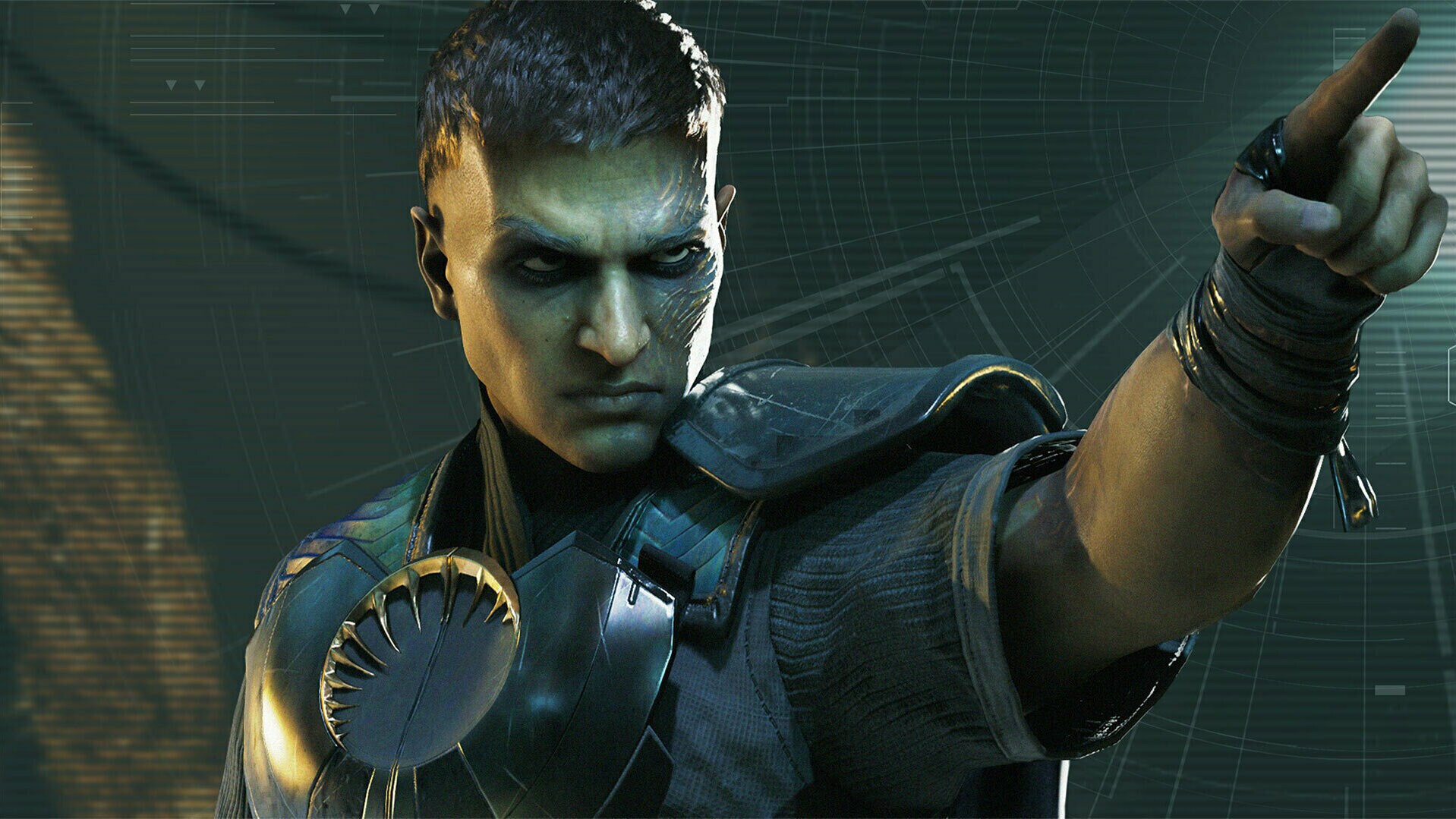
The official profile does not identify his species, birthplace, childhood, civilian employment or rank insignia. The portrait shows a stern humanoid with cropped dark hair, textured clothing, shoulder armor and a pointing gesture. Appearance should not be transformed into proof that he is biologically human or belongs to a named regional culture.
Visser's code does not come with a written charter in Lucasfilm's published biography. Readers do not know its full boundaries, whether it applies equally to enemies and civilians, or how frequently he disobeys another leader to follow it. An archive can identify mercy as documented without constructing a heroic personal philosophy that the narrative never supplies.
The name and visual image are enough to distinguish Visser from the faceless followers who constitute much of the Coil's force. A field commander acts within a hierarchy but can also become a figure soldiers recognize and fear. The specific psychological bond between Visser and individual followers, however, is not established by the Databank.
Lucasfilm's cast announcement credits Dylan Kenin as the voice of Visser. The performance makes the command role a distinct character voice rather than a generic enemy unit. The official materials frame him as an antagonist, though they permit ethical complexity in his conduct.
02 / CULTIC AUTHORITY AND PERSONAL RULES
Loyalty without total moral sameness.
The Infinite Coil is a Separatist-aligned paramilitary cult led by Kundri Fathom. Its members carry the Shadow Plague, and official descriptions portray the organization as spreading through vulnerable populations. Visser holds a senior position in that structure. His actions therefore occur in a collective context with consequences beyond his own conduct.
A leader can grant a lieutenant tactical authority while expecting ideological loyalty. Visser's reputation for battlefield skill helps make him an effective intermediary between the leader's intentions and the soldiers who execute them. In institutional terms, that is a position of delegated power: he does not need to be the supreme leader to affect prisoners, civilians and rival combatants.
The documented episodes of sparing prisoners matter because they show a difference between the behavior of individual commanders within the same faction. The organization may be violent and coercive even when one officer resists certain acts. Conversely, one merciful decision does not erase responsibility for leading a unit involved in military attacks.
A code of honor is not identical to a human-rights framework or a neutral law of war. It may protect only selected people or circumstances. The official biography does not specify which prisoners Visser freed or what rules guided his decision. Calling him honorable should therefore remain a description of his stated conduct, not an independent acquittal.
Visser can be read alongside Typhon, another principal named antagonist. The droid specializes in precision warfare and is reported to have an abnormal fixation on the plague. Visser is characterized through a social rule about prisoners. The contrast shows that commanders inside the Coil's wider network cannot be understood through one uniform personality model.
Zero Company's history also introduces displaced individuals such as Jae Mordant, who lost her mining citadel to the Coil. Such consequences situate Visser's command in territorial politics. His code of honor is ethically significant precisely because it operates within an organization causing displacement and military danger.
03 / TACTICS AND COMMAND
What a lieutenant controls.
Visser often leads his forces in person rather than remaining only a name in intercepted documents. An officer commanding from the battlefield can respond to local information quickly but may also be exposed to the same hazards as subordinate troops. The Databank establishes his direct combat role; it does not reveal every deployment he supervised.
The Luunata mission sequence in the shipped game brings that identity into practical focus. Community walkthroughs describe his role as the climactic boss of the effort to retake Mordant Citadel. The location links his presence directly to Jae's effort to recover control of a mining site seized by the Coil.
Encounter reports describe a fight with supporting enemies and disruptive abilities, including Plague Miasma and a high-evasion field. Individual sources emphasize different counters: one recommends dealing with escorts and using a push to open space, while another reports that area effects can strip the evasion field. Both are game-guide observations, not attributes claimed in the brief Lucasfilm biography.
The encounter also requires stamina. Clearing one room of enemies can leave the squad with fewer healing items and fewer safe tactical options for the boss. A player who understands the mission sequence should preserve resources for the final engagement rather than judge success only by whether the previous phase was completed.
Managing prisoners is part of the story identity but is not the same as defeating Visser in combat. Choosing an efficient way to neutralize his boss abilities does not answer whether his personal treatment of captives demonstrates genuine restraint, reputation management or another motive. Those possibilities are not interchangeable with verified actions.
The contrast is useful because game systems tend to create simple objectives such as defeat the boss and eliminate hostile units. The biography tells us that the antagonist has at least one category of conduct beyond combat. An anthropological archive should preserve that additional social information instead of allowing the boss fight to become the entire person.
04 / PLAYER GUIDE / MAJOR SPOILERS
Boss: Visser at Mordant Citadel.
Mission context: Behind Enemy Lines / Retake Mordant Citadel on Luunata, the former mining stronghold associated with Jae Mordant. The mission builds through multiple stages and culminates in a Visser fight. Verify objectives in your live mission log; sources name the mission phases differently.
Plan for a long operation
Do not enter with all utility slots devoted to damage. Save medical supplies and at least one reliable area or knockback effect for later phases.
Clear the earlier objectives
At the citadel, follow the guns and control-room objectives. When the mission permits an exit, take it instead of insisting on clearing every optional enemy.
Manage Visser's escort
Coil units and reinforcements remain dangerous even when the boss is visible. Prioritize enemies that can pin or interrupt vulnerable operators.
Watch for Plague Miasma
Reported plague effects can punish standing in affected ground. Use the threat display and move operators out before committing attacks.
Counter the evasion field
Player accounts describe stripping Visser's high evasion with area effects such as concussion grenades or Electro-Web, then using concentrated fire.
Finish the entire encounter
Several walkthroughs report that defeating Visser does not itself end the battle; clear remaining required Coil forces and wait for objective completion.
This section synthesizes multiple player walkthroughs. Difficulty settings and subsequent patches may alter exact mechanics and safe routes.
INTERACTIVE BATTLEFIELD ANALYSIS / NO INVENTED STATS
Fight the commander. Not the interface.
Compare three different causes of the citadel fight's difficulty; use the live tactical indicators to choose your response.
Avoid entering the dangerous area
Plague Miasma can make apparently useful ground unsafe. Check its footprint and duration, then reposition before committing the squad to attack lanes.
Question: Can every operator leave the threatened tiles safely?
05 / KNOWN SEQUENCE
Fathom's lieutenant enters the field.
INFINITE COIL
Visser becomes a trusted lieutenant under Kundri Fathom.
FIELD COMMAND
He frequently leads the Coil in direct battle and acquires a reputation as a formidable fighter.
RECORDED MERCY
Lucasfilm states that Visser has sometimes released or spared captives where other leaders would not.
LUUNATA CRISIS
The Coil's takeover of the planet and Mordant Citadel makes the command structure a direct threat to Jae Mordant.
CITADEL OPERATION
Zero Company advances through the mining stronghold toward Visser's boss engagement.
BOSS DEFEAT
A reported campaign route culminates in defeating Visser and required Coil escorts; outcomes are gameplay spoilers, not a claim that every player uses the same tactics.
Exact early-life dates, a birthplace and a full record of prisoner releases have not been published in the official Databank.
06 / POWER AND OPPOSITION NETWORK
The commander between two orders.
Kundri Fathom
The cult's leader and Visser's superior within the Infinite Coil.
Open related archive →Typhon
Another major Coil-aligned antagonist, a super tactical droid with an unusual interest in the plague.
Open related archive →Infinite Coil
The infected force whose battlefield actions Visser often coordinates.
Open related archive →Jae Mordant
Ore-Baroness dispossessed when the Coil seized her mining citadel on Luunata.
Open related archive →Bennic Halloren
Republic Intelligence officer whose assessment prompts the contract with Zero Company.
Open related archive →Mordant Citadel / Luunata
Industrial stronghold that serves as the setting for the major boss encounter.
Open related archive →07 / OPEN THE EVIDENCE FILE
Honor: assertion, action or inference?
Visser is a trusted Coil lieutenant
The Databank explicitly assigns him a field-command role under Kundri Fathom.
The source does not name every troop formation or set a comprehensive rank hierarchy.
Visser sometimes spares prisoners
The official biography states he has kept a code of honor and acted mercifully toward some captives.
It does not identify all captives, how many were freed, or whether his conduct reflects an international legal standard.
Visser uses difficult boss defenses
Mission reports discuss a high-evasion field, plague hazards and supporting forces.
Specific counters should be tested against current patches and difficulty settings.
Species, home and full moral conversion
The published character biography does not establish Visser's species, homeworld or a complete ideological break with the Coil.
Restraint during one type of encounter does not negate the broader consequences of commanding a violent faction.
INTERACTIVE IDS DECISION SIMULATION / HYPOTHETICAL
What makes mercy credible?
Hypothetical situation: a captured opponent is defenseless. A commanding officer believes the faction's purpose is just, but the officer's personal code prohibits harming this prisoner.
This case study is not a hidden ending, canonical conversation, or guaranteed combat strategy.
Choose a course above
Reveal an institutional and tactical interpretation of your choice.
08 / IDS ANTHROPOLOGICAL ASSESSMENT
A code of honor inside a coercive institution.
Visser illustrates why membership in a violent organization does not make every member's conduct identical. The Coil is described as a plague-bearing paramilitary cult that preys on vulnerable populations. Within that structure, Lucasfilm identifies an officer who sometimes refuses the harshest treatment of captives. The exception is meaningful because the wider institutional pattern remains threatening.
Anthropologists of armed groups often distinguish formal rules, informal expectations and personal codes. A commander's private concept of honor may coexist with an organization that uses coercion. It can also conflict with orders. The Databank identifies Visser's rule through observed acts of mercy without publishing its complete contents.
Mercy is relational rather than merely an interior feeling. It involves a person who holds power over another and chooses not to exercise it in a particular way. Releasing or sparing a prisoner changes an immediate social relation, but it does not itself resolve the larger war or establish whether the detention was lawful.
This distinction prevents a common biographical shortcut: the officer who once did a generous thing must secretly be a hero. Visser remains a leader of the Infinite Coil. His responsibility for the organization cannot be erased by one class of behavior. At the same time, refusing to acknowledge restraint would conceal a documented fact.
Honor itself is a cultural category, not an automatic synonym for justice. A code might protect peers while excluding outsiders, apply only after surrender or depend on status. Without detailed scenes, the archive should not select a particular interpretation and call it canon.
The citadel encounter adds another dimension: the difference between how a game asks players to act and how a character is described. Players are directed to defeat a hostile boss and protect their squad. The story also gives that opponent a history of sometimes protecting prisoners. These are not contradictory descriptions of the same action; they belong to different kinds of narrative evidence.
Jae Mordant's connection to the citadel highlights who is missing from simple ruler-versus-invader stories. Mining settlements are inhabited by workers and depend on material infrastructure. A fight over its control affects more people than the named Ore-Baroness and field commander. The human consequences of occupation cannot be measured only by the outcome of a boss battle.
The Shadow Plague intensifies the problem of agency and responsibility. The Coil's members are described as infected, but an infection does not by itself demonstrate that everyone acts through identical degrees of choice or control. Visser's individual code cannot settle the complex relationship between disease, loyalty and the orders of his superiors.
Finally, Visser demonstrates the value of a careful character archive. A factual dossier can recognize a frightening commander, the specific actions that complicate his reputation, and the unknown limits of his code without celebrating the Coil or manufacturing a redemption storyline.
09 / COLLECTING THIS CHARACTER
Proof before product claims.
Lucasfilm provides an official Visser portrait and identifies his appearance in Star Wars: Zero Company. The cited sources do not establish a licensed Visser-exclusive Topps trading card, LEGO minifigure or action figure.
A generic dark-armored Star Wars figure is not evidence of a Visser release. Products can be added after checking an official character name, manufacturer and edition. Star Wars trading-card images must come from collector-supplied photos only.
10 / SOURCE LOG AND GAME EVIDENCE
Verify the officer behind the story.
Visser's direct field role and honor code come from the Lucasfilm Databank. EA confirms the character's antagonist placement and Lucasfilm credits Dylan Kenin. Boss strategy is compiled from clearly attributed game walkthroughs, not presented as official biography.
CONNECTED CHARACTER FILES