

CLASSIFIED LORE FILE / ZERO COMPANY / CANON
The infection that became a movement.
The Shadow Plague defines the Infinite Coil, but its real nature is less certain than its terrifying reputation.
In Star Wars: Zero Company, the Shadow Plague is the mysterious disease carried by every member of Kundri Fathom's Infinite Coil. The group expands across Republic worlds during the last phase of the Clone Wars. According to Lucasfilm, its infected members are rumored to display exceptional endurance and dangerous abilities. A campaign narrative turns that threat into the reason an unconventional team of mercenaries is called into service.
The plague sits at the intersection of three different problems. There is an illness whose origin and physical operation have not been fully explained in the short official Databank entries. There is an armed organization that recruits vulnerable people and gains territory. And there is a tactical game system that gives infected combatants particular battlefield interactions. These are related elements of the story, not interchangeable kinds of evidence.
This file approaches them separately. The evidence console lets you inspect a claim's status; the Resonance simulator demonstrates a specific game rule without inventing a transmission mechanism; and an ethical case study explores what happens when a government confuses infection with active enemy membership. The article also connects directly to Fathom, Typhon, Visser, the Infinite Coil organization dossier and the Zero Company walkthrough.
01 / INTERACTIVE EVIDENCE CONSOLE
Facts. Rumors. Unknowns.
Examine each claim before accepting it as canon.
Every Infinite Coil member is infected.
The official Databank explicitly states that every member of the group, including Kundri Fathom, carries the Shadow Plague.
This confirms a faction characteristic, not the medical status of every civilian in a Coil-controlled district.
VIEW SUPPORTING SOURCE →The point of the console is not to assign truth by majority vote. A statement from an official character reference, a piece of in-universe rumor, and a reproducible gameplay effect support different claims. Research becomes misleading when these categories are silently combined.
Source limits matter most when the subject is mysterious by design. An archive can say that every named Coil member is described as infected without asserting what microscope evidence would show, or which procedure an in-universe doctor would use to confirm an infection.
02 / LUCASFILM CANON
The plague that connects bodies and power.
Lucasfilm's description of the Infinite Coil uses the Shadow Plague to define its membership. The organization is a Separatist-aligned paramilitary cult, and the mysterious infection is a common condition among its followers. Kundri Fathom herself is explicitly included. This gives the plague unusual organizational importance: it marks the group at the same time that it poses a threat in its own right.
The same short description attributes rumored unnatural resilience and deadly powers to those infected. The word rumored must be retained. It communicates the uncertainty built into the story's public knowledge and cannot be translated into a confirmed list of symptoms or an explanation of biological action. Players may encounter combat abilities that resemble those rumors, but such abilities remain different evidence from a biological description.
A storyteller can present a frightening disease without documenting the agent that causes it. The Databank does not name a bacterium, virus or organism; it does not provide a genome, an incubation interval or a known pathway of transmission. Nor does it identify a universally available cure or preventive measure. These blanks should stay visible in a serious reference work.
The plague also has a political effect through fear. A soldier facing an unusually durable opponent may describe the enemy as unnatural, while a population facing territorial conquest may circulate warnings far beyond the actual battlefield. Those are plausible readings of the narrative environment, not confirmed accounts of specific characters spreading misinformation.
Separating observable effect from proposed cause prevents a common problem in speculative-fiction encyclopedias. A text might depict an infected fighter shrugging off danger, yet the observer does not necessarily know whether that result derives from changed biology, outside assistance, concealed technology or a supernatural influence. The page therefore avoids presenting a single speculative mechanism as established fact.
The game's conflict is not a medical manual. Its plague is a fictional device used to drive a Clone Wars story and distinguish the Infinite Coil's troops from standard military forces. Discussion of those imaginary conditions should not be used as guidance for real symptoms, contagious disease or care.

The face of an infection cannot tell us its mechanism.
A stylized physical appearance can communicate character and menace. Without a story source, it cannot establish a diagnosis, transmission route or Force ability.
KUNDRI FATHOM'S COMPLETE BIOGRAPHY →03 / KUNDRI FATHOM
A leader whose alleged powers remain contested.
Kundri Fathom commands the Infinite Coil and inspires loyalty strong enough for Lucasfilm to emphasize it directly in the Databank. The organization is not simply a population of people who happen to share a disease. It has a named political and military leader, an ideological identity, and a program of territorial expansion.
The official Fathom biography introduces uncertainty about the supernatural character of her authority. Some say she possesses the Force. Others argue she is exceptionally persuasive and misleading. A careful dossier records the disagreement without making the final judgment on evidence the source does not supply.
This distinction complicates the social history of allegiance. People may obey a commander because they believe a claim about sacred power, because their circumstances leave few alternatives, because a military organization controls their environment or because they accept the commander's program. The official materials do not map each individual follower to one of those motives.
Visser gives the faction another recognizable form of authority. He leads troops in combat and is noted for occasionally sparing captives under a personal code. Typhon, a super tactical droid, uses precision strikes and is said by Republic Intelligence to have a puzzling interest in Fathom and the plague. The different descriptions show the value of separating personal leadership, military command and mechanical strategy.
Typhon's relation to the plague is particularly easy to misstate. The official account reports interest in it, not a medically verified infection of a machine. Describing a droid as fascinated with an illness does not demonstrate that a biological agent has altered its processors or that the droid shares the subjective condition of organic followers.
Fathom's importance in the larger narrative is clear even while these smaller questions remain uncertain: Zero Company is contracted to locate and stop her and the faction she leads before the Shadow Plague spreads further through the galaxy.
04 / TERRITORY AND RECRUITMENT
As worlds fall, the danger grows.
The Infinite Coil Databank describes the organization preying on vulnerable people across Republic worlds. It adds that with each conquered world, the plague spreads and the movement expands. That is a narrative connection between conquest and increased infected membership. It does not disclose an infection probability, a universal method of spread or a complete record of the world's population before and after occupation.
The geographical consequences are more visible through story locations. On Luunata, the Coil seizes the mining citadel once controlled by Jae Mordant. Her loss helps create the political pressures behind hiring Zero Company. The inhabitants and laborers of a mining settlement would have interests that do not reduce to the claim of either ruling elite or occupying force, but the available short biographies do not tell us their specific views.
A different place serves the protagonist: The Den, a converted freighter on the Ring of Kafrene. It belongs to Hawks' operational network and should not be mislabeled as a Coil laboratory or capital. Confusing the home base of the investigators with the territory of the investigated faction would distort the fictional geography.
Moving through multiple worlds also changes the problem of knowledge. Reports may come from military patrols, fleeing residents, local contacts or captured records. Each source has a limited vantage point. Bennic Halloren's story begins with the recognition that the Coil is more dangerous than his superiors appreciate, illustrating how a small or poorly understood faction can be misjudged amid a large war.
An archive concerned with ordinary life should ask what people lose under an armed takeover: predictable movement, access to work, residence and the capacity to make collective decisions. These questions matter even where published material does not describe specific events. They should not become invented statistics of casualties, missing persons or named settlements.
Separatist alignment does not make every Separatist sympathetic to the Coil. Runa Blask, an operator and adviser who retains pro-Separatist convictions, works against the organization. That is evidence from the game's character network against treating broad political labels as proof of individual behavior.
05 / INTERACTIVE GAMEPLAY SIMULATION
Kill one enemy. Empower another?
See why the order of defeating infected enemies changes the turn.
Independent post-release guides report that Resonance stacks pass to the nearest surviving infected enemy after a defeat. Reaching three stacks can trigger a Plague Surge.
Which infected target falls first?
Select a target. The board will illustrate where its current Resonance would go under the stated nearest-neighbor assumption.
Teaching model only: the live game uses a full battlefield with actual distances, abilities and positioning.
This is a fixed illustrative exercise, not a full combat calculator. The nearest-survivor relationships and stacks are stipulated for teaching. Community guides disagree on some situational priorities; use actual distances, upgrades and unit tooltips in your current game. View the secondary gameplay reference ↗
06 / FIELD GUIDE / IMAGE EVIDENCE
Two ways to see the same threat.
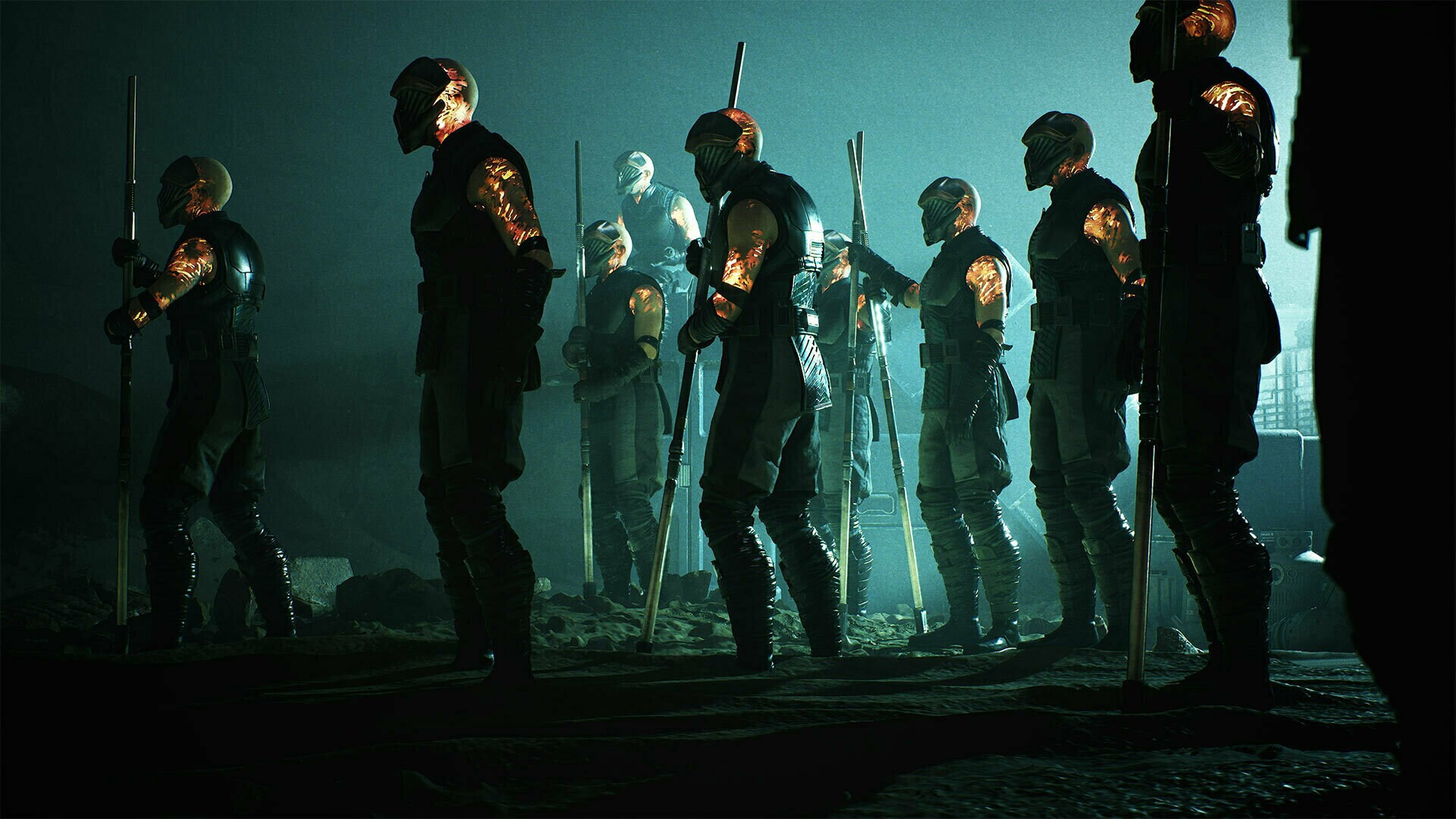

The fiction and the interface emphasize different aspects of the plague. In a cinematic scene, ranks of uniformed followers communicate organization, threat and the atmosphere surrounding the Coil. On the battle map, individual enemies present positions, combat abilities, health and status information that the player must interpret immediately.
According to developer commentary, Coil troops differ from Separatist droids and Outlaws because their distinct abilities affect target priority. That statement is stronger support for tactical ordering than an unsupported assertion that all infected fighters possess the same attack. A careful player identifies which unit can disrupt a plan, which might Surge, and whether a particular objective must be completed before every hostile has fallen.
Post-release gameplay guides describe an additional rule: a dead infected unit may pass Resonance to the nearest surviving infected unit, and sufficient stacks trigger a Surge with increased danger. This gameplay system should not be copied into fictional epidemiology as though a status counter were a medical model. It describes how the game challenges players, not necessarily what an in-universe clinician would observe.
For practical preparation, see the game's current enemy tooltips and mission objectives, preserve enough actions to respond to an unexpected Surge, and use displacement only after verifying where another infected enemy will move. The detailed Visser and Typhon boss dossiers cover their separate mechanics, which should not be generalized to all Coil units.
The puzzle emphasizes tactical responsibility as well as dramatic action. Eliminating a weak opponent is not automatically a safe move if that opponent's defeat changes another unit's abilities. The player is asked to reason about relationships among enemies, not merely reduce health bars as fast as possible.
07 / OCCUPATION AND THE EVERYDAY
When being ill becomes a political label.
The Shadow Plague story invites investigation of how institutions classify people. A commander may describe an occupied district as infected. A medical worker may identify individual conditions. An intelligence officer may ask which armed groups are present. These classifications serve different purposes and can have different consequences for those who live under them.
In the fiction, Lucasfilm identifies infected membership within the Coil. It does not follow that every person living in Coil-controlled territory is a combatant or a willing supporter. This distinction is crucial because territorial conquest, disease and political loyalty can overlap without becoming equivalent.
The statement that the movement preys on vulnerable populations points toward unequal conditions of recruitment. People who lack security, access to resources or freedom of movement may face pressures that are absent for those far from the war. A serious account should examine the social circumstances of membership rather than assuming that every recruit made the same independent choice.
Fear of contagion can also shape how outsiders speak about a population. A collective label may permit authorities to treat everyone as a single undifferentiated threat, despite differences of age, health, occupation and agency. In the Star Wars narrative, the risk is heightened because the fictional pathogen is associated with a violent political faction.
An anthropological reading does not excuse coercive or violent actions by infected fighters. It insists on asking what a particular individual is doing, what authority they are subject to, and what evidence supports a judgment about their conduct. Those questions help distinguish the responsibility of a field commander from the situation of an inhabitant trapped inside territory that commander controls.
Evidence about occupied populations is incomplete in the official synopsis. No confirmed census, detailed social history of Luunata's miners or standardized medical assessment is supplied. Listing those absences openly is more accurate than inventing suffering in order to give the article emotional force.
08 / DOCUMENTED STORY SEQUENCE
From obscure threat to galactic emergency.
Clone Wars
A galactic conflict leaves local communities exposed to insecurity and competing authorities.
An infected movement grows
The Infinite Coil expands among vulnerable Republic populations. Its members carry the Shadow Plague.
Fathom commands loyalty
Kundri Fathom becomes the named center of the group; claims of Force ability circulate.
Intelligence escalates
Bennic Halloren judges the Coil a larger danger than his superiors recognize.
Zero Company intervenes
Hawks and the team begin investigating and fighting the Coil.
Luunata and beyond
The Coil's conquest affects Jae Mordant's mining citadel and leads to major confrontations.
The final operation
The released game contains a concluding battle against the Coil. Detailed outcomes are covered in spoilers below.
Reveal the campaign ending's Shadow Plague implication (major spoilers)
Independent post-release mission and ending accounts describe the defeat of Kundri Fathom as also ending the plague's threat, with a parasite-like entity separating from her in the final sequence. This interpretation is grounded in reports of the released game's closing scenes, not in the short Lucasfilm Databank entry.
The ending invites new questions about causal dependence on Fathom, but the cutscene alone does not provide a complete biological model that could be applied across every infected world. For the exact sequence, consult a verified playthrough. Avoid using a single account of the ending to invent earlier origins, universal transmission rules or a previously unmentioned treatment.
Read a secondary ending account ↗No unsupported BBY dates or invented founding year are assigned to these stages.
09 / IDS DECISION SIMULATION
A district is infected. Who is an enemy?
Hypothetical scenario: a Republic analyst receives a report of armed Coil forces in a settlement with residents who may also carry the Shadow Plague. The original source has not yet been corroborated.
This fictional exercise explores responsibility and evidence. It is not a canonical mission, medical advice or an instruction for conducting real military action.
Choose an approach
The analysis will identify which assumptions your choice makes about disease, affiliation and coercion.
10 / FOUR-FIELDS ANTHROPOLOGICAL READING
One plague, several forms of knowledge.
Cultural anthropology asks how people understand an illness, classify danger and relate their experiences to political power. The Infinite Coil brings those questions together because infection is both a bodily condition and a marker associated with membership. The response of outsiders can depend as much on what they believe about the disease as on anything its carriers have done.
Archaeology would attend to the spaces and objects through which a movement becomes visible. Weapons, uniforms, occupied workplaces and the reuse of facilities all show how organized force changes material life. The game's imagery provides clues about its military presentation, but not a complete excavation record of the faction's origins or the everyday experiences of occupied settlements.
Biological anthropology highlights the need to distinguish observable bodily variation from unsupported evolutionary or medical explanation. Lucasfilm supplies a fictional disease and rumors of unusual capacities, but does not provide enough biological evidence to justify a real clinical model. Any comparison to actual infectious diseases should respect that difference rather than using real-world terminology to create false certainty.
Linguistic anthropology examines the words used to categorize people and events: plague, cult, infected, carrier, loyalist and enemy. A change of label can alter how a population is treated. The category enemy describes a role in a conflict. The category infected describes a condition. When those words are fused, individuals who have not chosen to fight may be reclassified as threats.
Social identity within the Coil cannot be reduced to infection alone. Fathom commands loyalty, Visser exercises delegated battlefield authority and sometimes shows restraint toward prisoners, while Typhon is a droid strategist interested in the plague. These different roles demonstrate why a group should be studied as an organization with internal distinctions rather than a mass of biologically identical fighters.
Fear and rumor also produce political consequences. Fathom's possible Force abilities are disputed in the official reference, which means characters' beliefs about her may matter even if the supernatural explanation is not resolved. Rumors can change patterns of deference, hesitation and resistance without needing to be scientifically confirmed.
Playing Zero Company adds a second evidentiary layer. The user interface treats Resonance as a quantitative status, presenting stacks and threshold effects that can be manipulated through movement and target order. This system produces meaningful gameplay choices, but the status icon is not a statement about cellular biology. Rules for a tactical encounter are designed for player legibility and risk.
War also shifts who has authority to interpret evidence. Bennic Halloren sees danger that senior colleagues initially minimize, while Hawks' mixed team includes people who distrust the Republic for other reasons. The narrative thereby separates competence and access to knowledge from formal rank and political allegiance.
Finally, the short official Databank records deliberately leave key facts unaddressed. Naming an unknown is not a failure of research. It is the proper boundary between an evidence-based account and speculative continuation. The Shadow Plague's importance lies as much in the social and institutional responses it provokes as in a cure, cause or final scene that a writer might wish to invent.
11 / SOURCE TRAIL & CONTINUITY
Evidence with defined limits.
Canon-level claims rely on primary Lucasfilm and EA material. Mechanics and ending observations from independent guides are clearly marked as secondary. Anthropological explanations and hypothetical simulations are original IDS interpretation, not concealed story scenes.