Authority, cargo and political economy
CONTINUITYCanon
BASEKhepi system
ROLEPirate band
A crew with a code, not merely a criminal boss
The Rokana Raiders are a band of space pirates operating around the Khepi system during Star Wars Outlaws: A Pirate's Fortune. Their captain, Stinger Tash, has directed them toward ancient artifacts concealed inside the Khepi Tomb. Ubisoft's official discussion describes the raiders as an unusually collective operation. Rather than promising obedience to a hereditary chief, the members are meant to vote on consequential decisions under rules known as the Rokana Code.
This arrangement makes the Raiders an institution, not just a sequence of hostile starfighters. A code defines who can participate in decisions, how shares are distributed and the consequences of violating group loyalty. It also gives members a basis for challenging a captain who has ceased to follow the standards on which that authority depends. The written rule and actual practice need to be examined separately: a captain can technically permit a vote while shaping the information and pressures surrounding it.
The game's setting places these rules inside a group that raids settlements and civilian freighters. Describing their voting procedures does not imply that the people they attack are protected by those procedures. The right to participate belongs to recognized crew members. Outsiders are still subject to threats and violence. Political equality within a predatory organization is not the same thing as universal equality.
The Rokana Code: votes, spoils and exclusions
The in-game Rokana Code says that crew members may propose a vote on important matters, including the selection or replacement of the captain. Once the decision is reached, members are supposed to accept it. The code also explains the distribution of plunder. The captain receives an ordinary share rather than an automatic royal entitlement. Veteran pirates receive two shares, while someone seriously injured on a raid receives a share and a half.
The text reveals a significant exclusion. Droids receive neither voting rights nor shares of the plunder, even if they perform work for the group. The apparent promise that every raider has a voice is therefore conditional on recognized membership. This is a documented feature of the fictional rules, not an inference that all pirate crews or all Star Wars societies treat droids identically.
The Code also establishes an especially severe punishment for selling out or stealing from the crew: marooning with only limited air. Such rules communicate how seriously the group treats loyalty, even while the threat of death may discourage genuine disagreement. A person can have a formal right to call a vote and still fear what a powerful captain will do in response.
An annotated version discovered in the story undercuts the rulebook's appearance of straightforward democracy. It suggests that Stinger's personal dominance has made independent voting hazardous. The distinction between the official constitution and the unofficial instructions learned by recruits becomes the most important institutional tension in the Raiders' story.
Stinger Tash's rise and pursuit of the Khepi Tomb
Stinger Tash rises through the Raiders with a reputation for ambition and persuasion. Ubisoft describes her as a leader who gives others opportunities to express themselves while usually getting the result she desires. Her interest in ancient civilizations and hidden treasure drives the group toward an unusually dangerous target: the Khepi Tomb at the heart of a heavily ionized nebula.
The fleet's ability to enter that environment proves that raider power rests on accumulated technical knowledge as well as bold speeches. The Sayma Nebula interferes with ordinary ship systems, including the Trailblazer and the functioning of Kay Vess's crew droid ND-5. The raiders use craft adapted to survive ionization for longer. Their presence inside the nebula allows them to control the approaches to a location that other treasure hunters cannot readily reach.
The tomb's objects belong to an older civilization rather than a modern legal owner named in the mission. Stinger nevertheless treats the site as a path to personal and collective enrichment. An anthropological interpretation can distinguish the archaeological value of material remains from the immediate exchange value that the raiders assign to them.
Over time Stinger becomes sufficiently fixated on the treasure to strain the group's rules. The source record describes dissent among pirates who begin to suspect that the captain values her expedition more highly than their safety. Her authority is threatened not by an external election commission but by members who expect the Rokana Code to apply to the person commanding them.
Specialized ships and the material geography of the nebula
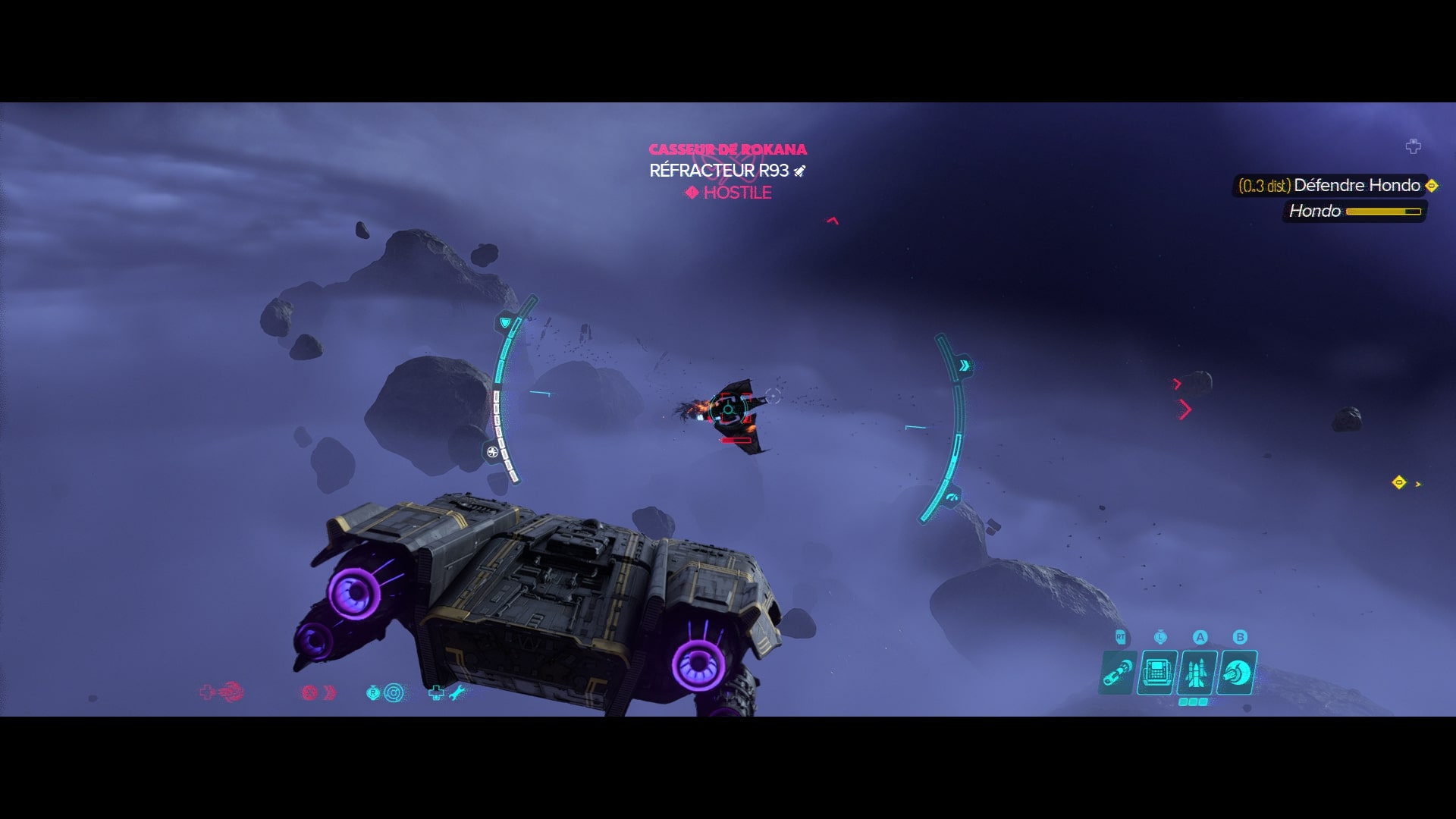
The distinctive Rokana Raider ship featured in A Pirate's Fortune has pivoting wings. Ubisoft's developer interview describes two operating configurations. The vertical orientation is used for travel and reconnaissance; switching the wings into an assault orientation allows access to additional weapons for combat. The design is more than visual decoration because the nebula's electrical hazards shape the ship's usefulness.
Kay and Hondo need a Raider ship to approach the Khepi Tomb without immediately revealing themselves as intruders. Their decision to acquire one demonstrates how technology can regulate access to territory. Stinger's organization does not rely on a legal border checkpoint. Its members instead control equipment designed to operate where ordinary vessels are at a disadvantage.
Player actions in the cockpit should not be mistaken for an exhaustive account of the Raiders' military resources. The expansion documents particular ships, combat encounters and control modes. It does not supply a verified census of all pirate vessels, a complete armory, or the precise manufacturing history of every wing mechanism. The dossier explains observable features without inventing technical specifications.
The gap between an adapted vessel and the Trailblazer also helps explain why a small pirate force can be locally formidable. A ship that is modest in a conventional fleet engagement can control a route when environmental conditions exclude most competitors. The group's material advantage lies in knowing how to travel and fight where others cannot.
Kay Vess, Hondo Ohnaka and a leadership challenge
Hondo Ohnaka enters the adventure without his former crew or ship. Kay Vess follows a message he had intended for the Trailblazer's earlier owner, Jet Kordo. Captured and threatened inside Raider territory, the two scoundrels cooperate to pursue the treasure and find a route into the tomb. Their predicament brings a once-prominent pirate captain into contact with an organization whose rank and legitimacy are defined differently from his own old gang.
Hondo's reputation is impressive, but the Rokana Code creates an additional question. Can someone who enjoys command and profit persuade a collective crew to adopt him as captain? The story permits an attempt to challenge Stinger's leadership. Kay can influence pirates and present arguments in support of Hondo. The result depends on choices in the playable story rather than one entirely immutable recorded vote.
The contrast between Hondo and Stinger should not be reduced to a contest between a good captain and a bad one. Hondo has kidnapped people and shifted loyalties in earlier canon stories. Stinger has provided a collective rule system while also manipulating and punishing dissent. Both have contradictory records, which is precisely what makes a comparison of their political authority useful.
Some documented routes place Hondo temporarily in command, but the wider code also requires sharing the reward. Accounts of the game's routes describe him refusing to sustain that role when he confronts the group's distribution rules. A story in which a captain seeks a profitable opportunity may therefore expose the limits of his willingness to accept a crew's demands.
The tomb's defenses and the breakdown of the expedition
The Khepi Tomb contains ancient defensive systems and droids. Raiders who expected a cache of profitable relics encounter danger that cannot be solved merely by owning the entrance. The circumstances in which the tomb defenses activate depend on the particular course of the story, including how the leadership dispute unfolds.
A leader who controls access to a ruin still cannot guarantee control over the buried technology. This is an important point about archaeological sites in fiction. Modern raiders can misjudge the functions and risks of objects they interpret primarily as treasure. The inhabitants who built and guarded the tomb are absent from the new struggle over ownership.
Ubisoft's presentation and subsequent game documentation support an expedition ending in turmoil, with surviving protagonists escaping the site's lethal hazards. What happens at the decisive council and who triggers particular dangers is variable in the playable mission. This dossier therefore identifies the alternate routes rather than insisting that every player witnessed the same sequence.
The collapse puts the apparent solidarity of the Raiders to a severe test. Formal votes and fixed plunder shares are of little use if members cannot trust the captain's judgment or safely leave an operation. Survival becomes more urgent than distributing hypothetical winnings from a tomb that cannot be plundered without consequences.
What the Raiders reveal about political community
The Raiders provide an unusual case of shared decision-making among criminals. Their code rejects exclusive loyalty to governments and syndicates, while establishing obligations to crew members. Yet the system is not universal or without hierarchy. Veteran members have different economic rewards, droids are excluded, and the captain can intimidate dissenters in practice.
The group thus invites at least three separate questions. Who belongs to the political community? What material advantages follow from membership? What can ordinary members do when their leader breaches the rules? These are not interchangeable concerns. An organization may permit participation in some decisions while denying other people a voice and distributing wealth unequally.
Stinger's pursuit of treasure shows how a single project can undermine rules intended to restrain individual power. Hondo's attempt to use those same rules reveals that a new leader may dislike the obligations he has just accepted. Neither outcome makes the Rokana Code meaningless; instead, the story demonstrates how difficult it can be to keep rules binding when a group faces danger or tempting wealth.
The raiders are distinct from the Starfallers on Toshara and from the Miyuki Trade League. They use armed piracy and their own code to control people and routes in the nebula. The Miyuki network, by contrast, brokers contracts and cargo delivery among multiple syndicates. Those institutional differences deserve separate research files rather than one broad category of interchangeable outlaws.