
01 · Orientation
World overview
Dagobah is a remote swamp world strong in the Force, best known as Yoda's place of exile and as the setting where Luke Skywalker received intensive Jedi training away from Imperial surveillance. IDS treats Dagobah as a lived world rather than background scenery. Its location in Outer Rim, its classification as Remote swamp world, and its association with Sparse sentient population; Yoda in exile create a social setting shaped by geography, institutions, mobility, and historical change. The purpose of the file is to connect those conditions instead of reducing the planet to a single battle, character, or visual landmark.
02 · Environment
Landscape, climate, and adaptation
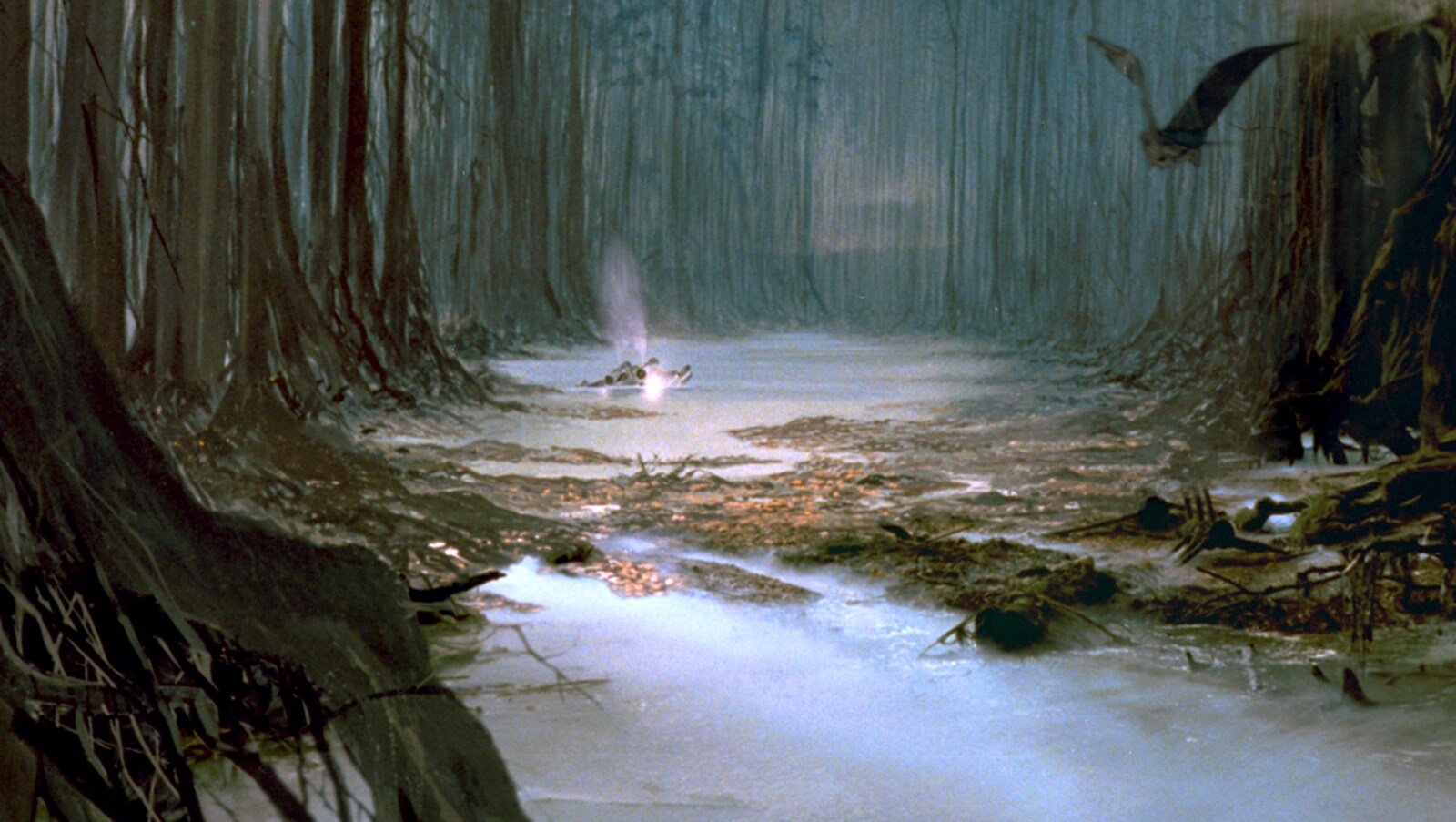
Dense swamps, wetlands, forests, mist, and abundant animal life define Dagobah. The environment is physically demanding and comparatively undeveloped, requiring visitors to adapt to mud, water, limited visibility, dangerous fauna, and isolation. Quick Facts identifies the climate as Humid and the terrain as Swamps, bogs, forests. Those environmental conditions affect where settlements can develop, how people travel, what resources become politically important, and which forms of infrastructure are practical. Environment does not mechanically determine culture, but it places real constraints on labor, architecture, transportation, defense, and everyday life.
03 · Built environment
Settlement, architecture, and infrastructure
Dagobah contains little monumental architecture in the current canon record. Yoda's hut is deliberately modest, making domestic space, improvised shelter, and the surrounding environment more important than urban infrastructure. IDS treats Dagobah as a lived world rather than background scenery. Its location in Outer Rim, its classification as Remote swamp world, and its association with Sparse sentient population; Yoda in exile create a social setting shaped by geography, institutions, mobility, and historical change. The purpose of the file is to connect those conditions instead of reducing the planet to a single battle, character, or visual landmark.
04 · Society
People, community, and everyday life
Canon shows almost no settled sentient society on Dagobah. That absence is analytically important because the planet functions less as a civic world than as a place of retreat, concealment, ecological immersion, and religious training. The communities most closely associated with this file are Sparse sentient population; Yoda in exile. The IDS focus is isolation, ecology, religious retreat, which means the planet is read through differences in institution, class, occupation, migration, and political experience rather than as a single unified culture. A world can contain neighboring populations with distinct languages, religions, histories, and relationships to state power.
05 · Economy & labor
Resources, work, and political economy
Canon does not document a conventional market economy on Dagobah. Subsistence, repair, scavenged resources, and adaptation to the local ecosystem matter more than trade or formal employment in the stories set there. IDS treats Dagobah as a lived world rather than background scenery. Its location in Outer Rim, its classification as Remote swamp world, and its association with Sparse sentient population; Yoda in exile create a social setting shaped by geography, institutions, mobility, and historical change. The purpose of the file is to connect those conditions instead of reducing the planet to a single battle, character, or visual landmark.
06 · Religion & worldview
Sacred landscape, belief, and moral order
Dagobah is strongly associated with the Force through Yoda's exile and training of Luke Skywalker. The planet's dense living ecosystem makes it important to Jedi teachings about the living Force, but canon does not establish a native organized religion. Religion and worldview are treated as parts of social life rather than decorative lore. Sacred places, collective memory, ritual, moral authority, and relationships to land can influence how communities understand belonging and legitimate power. Where canon documents no shared planetary religion, IDS keeps that absence visible instead of inventing a uniform belief system for everyone living on the world.
07 · Institutions
Government, authority, and power
Dagobah lies outside the major administrative centers of the Republic and Empire. Its remoteness allowed Yoda to avoid Imperial detection, making political marginality itself a form of protection. The major eras associated with Dagobah are Clone Wars aftermath, Galactic Civil War. Political authority can therefore change as governments, militaries, occupations, local elites, resistance movements, or outside institutions gain and lose control. The archive uses isolation, ecology, religious retreat to ask who can make decisions, who bears the costs of those decisions, and how planetary institutions connect local communities to larger galactic systems.
08 · Mobility
Movement, travel, and connection
Dagobah's isolation makes reaching it difficult and leaving it consequential. The world is not a routine transit hub, and Yoda's survival depends partly on remaining outside ordinary political and commercial routes. IDS treats Dagobah as a lived world rather than background scenery. Its location in Outer Rim, its classification as Remote swamp world, and its association with Sparse sentient population; Yoda in exile create a social setting shaped by geography, institutions, mobility, and historical change. The purpose of the file is to connect those conditions instead of reducing the planet to a single battle, character, or visual landmark.
09 · Conflict & security
War, policing, occupation, and defense
Dagobah is not a conventional battlefield during the films. Conflict appears through training, fear, memory, and the psychological challenges of the dark-side cave rather than through armies or state security forces. IDS treats Dagobah as a lived world rather than background scenery. Its location in Outer Rim, its classification as Remote swamp world, and its association with Sparse sentient population; Yoda in exile create a social setting shaped by geography, institutions, mobility, and historical change. The purpose of the file is to connect those conditions instead of reducing the planet to a single battle, character, or visual landmark.
10 · Points of interest
Places that make Dagobah legible
Places inside Dagobah make large planetary histories concrete. Cities, temples, factories, homes, bases, ruins, and landscapes show where institutions actually operate and where people work, worship, govern, travel, fight, remember, and build community. IDS treats these locations as evidence of social life rather than as a sightseeing checklist. Each point is included because it helps explain how geography, political authority, material culture, religion, or historical change becomes visible on the ground.
Yoda's hut
A small dwelling that became the practical center of Luke Skywalker's Jedi training.
Open connected IDS file →Dark-side cave
A Force-charged place where Luke confronted fear, aggression, and self-knowledge during training.
Open connected IDS file →Swamp landing site
Luke's difficult arrival and recovery of his X-wing make the surrounding wetlands a practical lesson in environment, technology, and dependence on the Force.
11 · Change over time
Historical significance
Yoda withdrew to Dagobah after the fall of the Jedi Order. Years later Luke Skywalker traveled there for training, turning an obscure world into an important site in the restoration of Jedi knowledge. The principal appearances listed for Dagobah are The Empire Strikes Back, Return of the Jedi, The Clone Wars. Those stories capture particular moments rather than the complete history of the world. IDS reads wars, occupations, migrations, regime changes, reconstruction, and institutional continuity as processes that reshape social life over time. Historical significance therefore comes from what changes for communities, not only from whether a famous event happened there.
12 · IDS lens
What this world reveals
Dagobah shows how remoteness can preserve knowledge when institutions collapse. It also foregrounds the relationship between religious practice, bodily discipline, landscape, and ecological awareness. The archive emphasis for Dagobah is isolation, ecology, religious retreat. That focus is useful because it connects geography to social organization instead of treating the world as scenery. IDS asks how people experience institutions differently depending on class, community, mobility, political status, access to resources, and historical circumstance, and how those differences become visible in the built and natural environment.
13 · Canon record
Official sources used for this file
The factual baseline for this Dagobah file comes from official Star Wars reference material and the canon appearances listed in Quick Facts. IDS uses those sources for names, geography, political events, communities, and chronology, while the surrounding discussion of institutions, religion, settlement, labor, and social change is independently written analysis. Where canon leaves ordinary planetary life undocumented, the article keeps that gap visible rather than inventing detail.
Mentioned in this file