
01 · Orientation
World overview
Kamino is an ocean world whose advanced cloning industry supplied the Republic's clone army, making a remote scientific society central to the militarization of the Republic and the birth of the Empire. IDS treats Kamino as a lived world rather than background scenery. Its location in Beyond the Outer Rim · Near the Rishi Maze, its classification as Oceanic cloning world, and its association with Kaminoans, clones and military personnel create a social setting shaped by geography, institutions, mobility, and historical change. The purpose of the file is to connect those conditions instead of reducing the planet to a single battle, character, or visual landmark.
02 · Environment
Landscape, climate, and adaptation
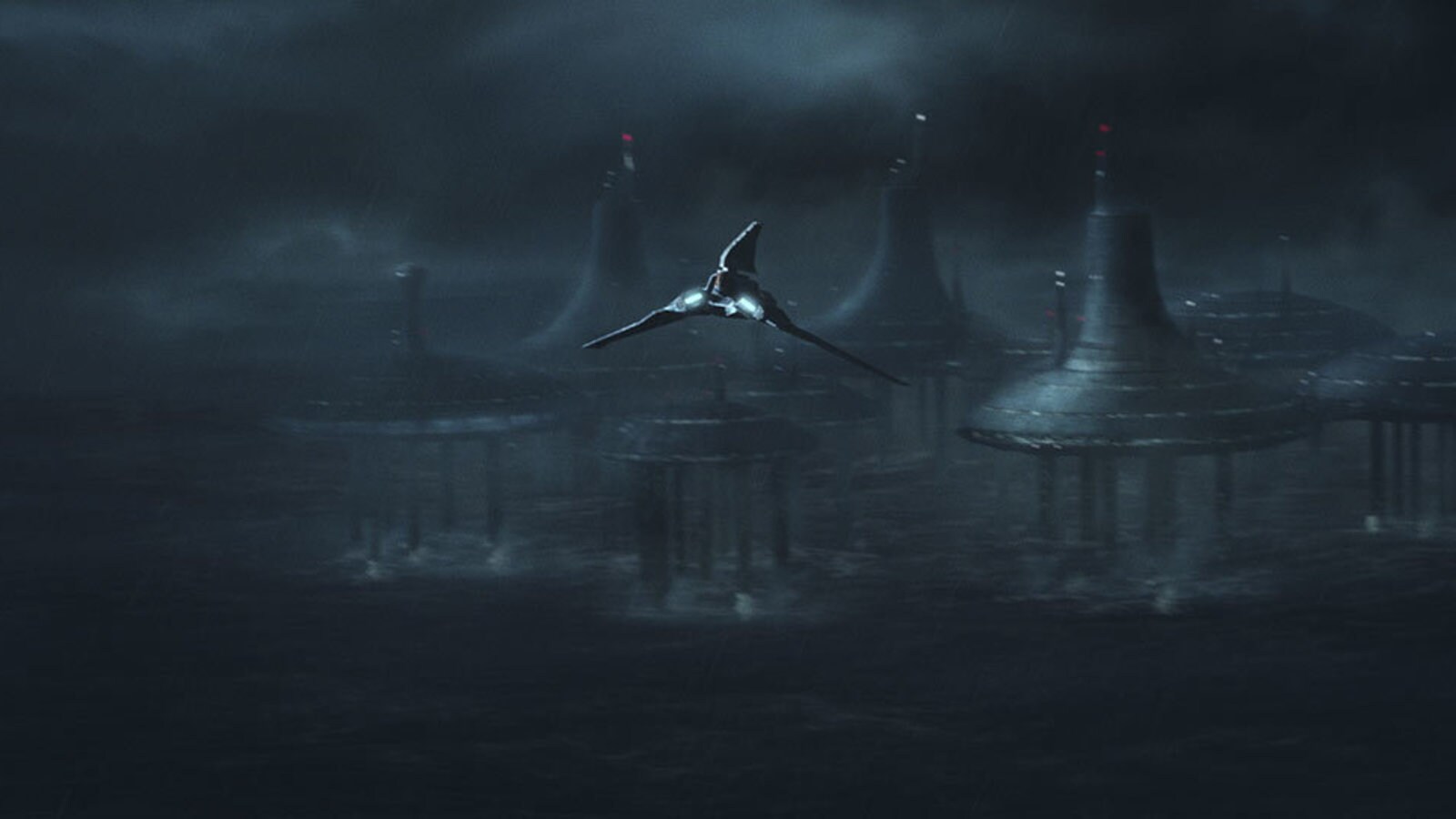
Continuous oceans and severe storms leave little conventional land for settlement. Kaminoan cities such as Tipoca City rise above the sea on vast supports, creating controlled interior environments dedicated to administration, research, training, and production. Quick Facts identifies the climate as Stormy and the terrain as Global ocean and stilt cities. Those environmental conditions affect where settlements can develop, how people travel, what resources become politically important, and which forms of infrastructure are practical. Environment does not mechanically determine culture, but it places real constraints on labor, architecture, transportation, defense, and everyday life.
03 · Built environment
Settlement, architecture, and infrastructure
Kaminoan settlement is adapted to an ocean world with little visible land. Elevated cities such as Tipoca City rise on platforms above violent seas and concentrate laboratories, residences, training areas, administrative offices, landing facilities, and military infrastructure into controlled complexes. The built environment separates inhabitants from the surrounding ocean while making institutions highly centralized. When Tipoca City is destroyed, the loss is therefore social and administrative as well as architectural.
04 · Society
People, community, and everyday life
Kaminoan institutions place exceptional value on biotechnology, controlled reproduction, technical expertise, and standards of quality. Clone troopers were created within that system but developed individual names, relationships, loyalties, and cultures that exceeded the categories assigned to them by their makers. The communities most closely associated with this file are Kaminoans, clones and military personnel. The IDS focus is biotechnology, state militarization, personhood, which means the planet is read through differences in institution, class, occupation, migration, and political experience rather than as a single unified culture. A world can contain neighboring populations with distinct languages, religions, histories, and relationships to state power.
05 · Economy & labor
Resources, work, and political economy
Kamino’s cloning industry converts advanced biotechnology into a contracted service with enormous political consequences. Scientists, technicians, administrators, trainers, medical staff, and supply systems support the production of clone soldiers for outside clients. The arrangement blurs commerce and state formation: a government effectively purchases an army whose members were created for service. Kaminoan expertise gives the planet bargaining power, but dependence on a narrow strategic industry also makes it vulnerable when the Empire decides that model is no longer useful.
06 · Religion & worldview
Sacred landscape, belief, and moral order
Canon provides little evidence for a shared Kaminoan religion. Kaminoan worldview is more clearly expressed through cloning science, controlled reproduction, technical expertise, hierarchy, and an instrumental approach to bodies. IDS treats that as social worldview rather than inventing a theology. Religion and worldview are treated as parts of social life rather than decorative lore. Sacred places, collective memory, ritual, moral authority, and relationships to land can influence how communities understand belonging and legitimate power. Where canon documents no shared planetary religion, IDS keeps that absence visible instead of inventing a uniform belief system for everyone living on the world.
07 · Institutions
Government, authority, and power
Kamino's relationship with the Republic was contractual but politically enormous. The clone army allowed the Republic to wage the Clone Wars at a scale that would otherwise have been impossible. After the war, the Empire moved to end Kamino's independence and control the future of military personnel production. The major eras associated with Kamino are Fall of the Jedi, Clone Wars, early Empire. Political authority can therefore change as governments, militaries, occupations, local elites, resistance movements, or outside institutions gain and lose control. The archive uses biotechnology, state militarization, personhood to ask who can make decisions, who bears the costs of those decisions, and how planetary institutions connect local communities to larger galactic systems.
08 · Mobility
Movement, travel, and connection
Kamino’s remoteness once helped conceal the clone project. Travel depends almost entirely on starships and landing facilities because ocean conditions limit ordinary surface movement. Clone cadets are raised inside tightly controlled institutions and then dispersed across the galaxy, giving them far less choice over mobility than visiting Jedi, contractors, or officials. After Imperial consolidation, control over departures and records becomes especially important as the regime attempts to absorb Kaminoan knowledge while eliminating independent oversight.
09 · Conflict & security
War, policing, occupation, and defense
Kamino moves from protected contractor to strategic target. During the Clone Wars, attacks on cloning facilities threaten the Republic’s military supply. After the war, the Empire no longer needs Kamino’s independent institutions and destroys Tipoca City, demonstrating the danger of building an economy around a single state customer. Security therefore changes meaning over time: defenses first protect production from external attack, then become useless when the government that benefited from the system becomes the force dismantling it.
10 · Points of interest
Places that make Kamino legible
Places inside Kamino make large planetary histories concrete. Cities, temples, factories, homes, bases, ruins, and landscapes show where institutions actually operate and where people work, worship, govern, travel, fight, remember, and build community. IDS treats these locations as evidence of social life rather than as a sightseeing checklist. Each point is included because it helps explain how geography, political authority, material culture, religion, or historical change becomes visible on the ground.
Tipoca City
Tipoca City concentrated cloning laboratories, military training, administration, and housing above Kamino’s ocean, making one built complex central to the Republic’s creation of an entire army.
Cloning facilities
Kaminoan laboratories transformed genetic knowledge into military infrastructure. Their importance raises questions about personhood, ownership, reproduction, and institutions that treated cloned people as state resources.
Training complexes
Clone training spaces converted biological production into disciplined military identity, showing that soldiers were produced not only through cloning but through education, routine, hierarchy, and socialization.
11 · Change over time
Historical significance
Jedi Master Sifo-Dyas was linked to the secret commission that produced the clone army, though the project was manipulated by the Sith. Kamino became a wartime target, then faced Imperial destruction after the transition away from clone forces. The principal appearances listed for Kamino are Attack of the Clones, The Clone Wars, The Bad Batch. Those stories capture particular moments rather than the complete history of the world. IDS reads wars, occupations, migrations, regime changes, reconstruction, and institutional continuity as processes that reshape social life over time. Historical significance therefore comes from what changes for communities, not only from whether a famous event happened there.
12 · IDS lens
What this world reveals
Kamino raises questions about commodification and personhood. The same system that describes clones as products also produces people who create identities, friendships, moral commitments, and claims to autonomy. The archive emphasis for Kamino is biotechnology, state militarization, personhood. That focus is useful because it connects geography to social organization instead of treating the world as scenery. IDS asks how people experience institutions differently depending on class, community, mobility, political status, access to resources, and historical circumstance, and how those differences become visible in the built and natural environment.
13 · Sources & continuity
Official primary source
The factual baseline for this Kamino file comes from official Star Wars reference material and the canon appearances listed in Quick Facts. IDS uses those sources for names, geography, political events, communities, and chronology, while the surrounding discussion of institutions, religion, settlement, labor, and social change is independently written analysis. Some aspects of everyday life on this world remain undocumented in current Canon.