01 · Historical life
Control technology hidden in everyday life
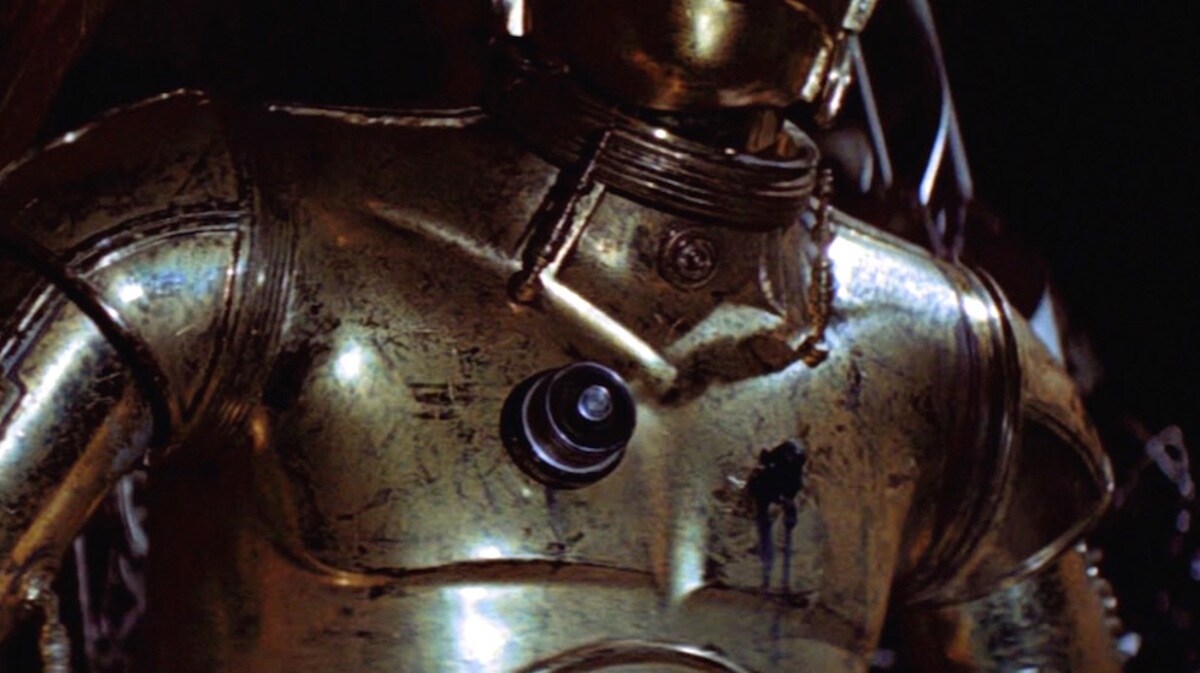
Restraining bolts appear in ordinary commercial and domestic contexts, which is precisely what makes them important. They do not belong only to prisons or military laboratories. Jawas, purchasers, owners, and handlers can use them as routine tools for controlling droids. That normality reveals a social assumption: droid autonomy can be limited by default when ownership interests demand it. The device makes a broad institution of control visible in a small piece of hardware attached directly to a body.
02 · Construction and material
Constraint designed as an accessory
A restraining bolt works because droids are built within technological environments where external control can be imposed. The device is physically modest compared with the droid itself, yet it can override meaningful aspects of movement or choice. That asymmetry is politically revealing. Power does not always require a larger or more sophisticated machine; it can operate through a strategically placed interface that takes advantage of how another system is designed. The bolt converts architectural compatibility into social control.
03 · Use and operation
Obedience made technical
When a restraining bolt is active, an owner's command does not rely only on persuasion, employment, loyalty, or threat. Hardware reinforces the relationship. This changes the meaning of obedience because refusal is no longer equally available. Star Wars often portrays droids with preferences, fear, memory, attachments, humor, and initiative, which makes technical restriction especially noticeable. The gap between visible person-like behavior and legally or socially accepted control is one of the franchise's recurring tensions around droid status.
04 · Institutions and authority
Property claims reach into the body
Restraining bolts show how ownership can be embedded materially. A person does not merely say that a droid belongs to them; the control relationship can be physically installed on the droid chassis. That makes property enforceable through design. Markets in droids, salvage, military procurement, domestic service, and repair all operate within a world where such interventions may be normalized. The technology therefore belongs to larger institutions of ownership rather than to isolated acts of cruelty.
05 · Labor, access, and maintenance
Technicians can enable or undo control
Because the restraint is technological, technical knowledge becomes a route to both enforcement and resistance. A person who can install, remove, disable, or bypass the device can change the droid's practical autonomy. Mechanics and droids themselves may therefore occupy politically important positions even when their work is described as repair. Control also depends on maintaining compatible systems. The bolt's authority lasts only as long as the social and technical environment continues to recognize and support its function.
06 · Material-culture reading
Autonomy attached to a piece of hardware
Restraining bolts are among the clearest examples of Star Wars turning an abstract social relationship into an object. Questions about ownership, consent, obedience, and personhood become visible on the surface of the droid body. Removing the bolt is not automatically equivalent to full political freedom, but it changes what actions are materially possible. IDS reads the device as a technology of governance at miniature scale: a small object through which a larger social order reaches directly into agency.
07 · IDS synthesis
What this object reveals about the galaxy
A restraining bolt is small, but its social meaning is enormous: it lets an owner limit a droid's movement and choices through hardware. The device turns questions of droid autonomy into something physically attached to the body. Read together with the sections above, the object shows that technology in Star Wars never operates outside society. Materials have owners and histories. Devices depend on labor and infrastructure. Institutions decide who may use them and what uses are legitimate. People then attach identity, memory, fear, status, or moral obligation to the same physical system. The IDS technology archive follows those relationships so technical function remains connected to the social world that makes the object consequential.
08 · Source record
Evidence and interpretation
The official StarWars.com Databank entry below anchors the baseline description and identification of this technology or artifact. IDS adds the material-culture analysis about institutions, labor, access, political authority, identity, and historical use. Interpretive claims are presented as analysis rather than additional canon.
StarWars.com Databank source ↗Mentioned in this file