The Nightsisters were a Force-using society rooted on Dathomir. They practiced what outsiders often called magick, using the Force through ritual, incantation, spirits, and the green energy associated with their traditions. Their methods differed from Jedi training and Sith doctrine, even when their goals or alliances brought them into conflict with both orders.
Dathomir was not simply a dark-side planet. It was a world of clans, rivalries, predators, and histories that outsiders repeatedly misunderstood. The Nightsisters’ power came from community and inherited knowledge as much as from individual combat. That makes their survival story different from the stories of Jedi or Sith who are usually remembered through one master and one apprentice.
Dathomir and clan memory
Dathomirian culture was organized through relationships between clans and leaders. The Nightsisters preserved knowledge through ritual and collective practice. Their identities were tied to the planet, to their dead, and to the obligations created by membership in a group.
This structure made the Nightsisters powerful but also vulnerable. A centralized enemy could target a leader or exploit a division between clans. A society built on memory could be attacked by destroying the people who carried that memory. The history of Dathomir repeatedly turns on that tension between communal resilience and concentrated violence.
Mother Talzin and outside alliances
Mother Talzin was the most prominent Nightsister leader during the Clone Wars. She understood that Dathomir could not remain isolated from galactic politics, so she negotiated with figures such as Count Dooku and Darth Maul. Those relationships brought resources and opportunities, but they also invited powerful outsiders to treat the Nightsisters as tools.
Talzin’s alliance with Dooku broke down when the Count saw the Nightsisters as a threat rather than a partner. The resulting attack showed the limits of relying on a larger military power for protection. Dathomir’s traditions could not be preserved by diplomacy alone when the other side had decided that the clan was expendable.
Asajj Ventress between identities
Asajj Ventress is one of the clearest examples of how Dathomirian identity can be separated from a single allegiance. She was trained by Count Dooku, used as a Separatist assassin, and later returned to Nightsister networks. Her history includes betrayal, exploitation, revenge, and the search for a life not defined by another master.
Ventress also demonstrates why the Nightsisters should not be reduced to a dark-side version of the Jedi. Her choices are shaped by Dathomirian relationships and by her refusal to remain someone else’s property. The Force is part of her story, but so are labor, loyalty, and the political conditions that make independence difficult.
The massacre of Dathomir
During the Clone Wars, General Grievous led an assault that destroyed much of the Nightsister population. The attack was carried out with military force, but its effect was cultural as well as physical. A living network of teachers, fighters, healers, and ritual specialists was broken.
Survivors carried the memory of the massacre into later eras. Their stories show why Dathomir remains associated with ghosts, ruins, and unfinished obligations. A destroyed clan is not the same as an erased tradition. The survivors preserve fragments that can reappear when a new generation finds a way to use them.
Merrin and the work of survival
Merrin became one of the best-known surviving Nightsisters after the massacre. Her early story is defined by grief and a desire to punish the people who destroyed her home. Her later relationships with Cal Kestis and the Mantis crew create a different model of survival. Merrin does not abandon Dathomirian identity when she forms new alliances. She chooses how to carry it forward.
That choice is important to the wider lore. The Nightsisters are not only a lost civilization waiting to be mourned. They are people who adapt, preserve knowledge, and decide which parts of their tradition can travel beyond Dathomir. Their survival changes the meaning of the planet’s ruins.
Why Nightsister cards stand out
Nightsister cards often attract collectors because the subjects have a strong visual language and a distinct position in the Force’s history. Mother Talzin, Ventress, Merrin, and other Dathomirians can represent different periods of the tradition: political power, exploitation by the Sith, massacre, or reconstruction.
A sketch or autograph can also preserve details that a standard portrait leaves out. Smoke, green magick, clan markings, ruined temples, and the landscape of Dathomir all place the character inside a cultural history. That setting is why these cards can matter even when the subject appears in only one part of the larger saga.
The Nightsisters in animation and live action
The Nightsisters are introduced most fully through The Clone Wars, where Asajj Ventress, Mother Talzin, Savage Opress, and the people of Dathomir are drawn into the war between the Republic and the Separatists. Star Wars Rebels connects the Dathomirian legacy to the fall of Maul, while Ahsoka expands the story through Morgan Elsbeth, the Great Mothers, and the journey beyond the known galaxy. Comics, novels, games, and reference works add different accounts of witches, clans, spirits, and the long history of Dathomir.
The label “Nightsister” should not be treated as a synonym for every woman who uses the Force or every dark-side practitioner. It names a specific Dathomiri tradition, although that tradition contains internal differences and changes over time. The stories distinguish between communal identity, individual ambition, and outside attempts to use Dathomir's power. Their conflict is therefore about colonization, survival, gendered authority, and the right to define a sacred practice.
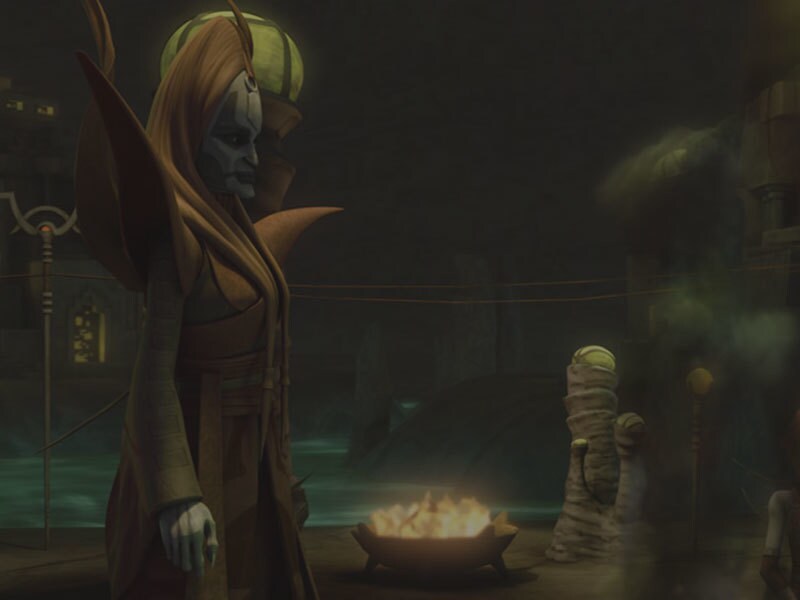
Dathomir as ecology, homeland, and archive
Dathomir is not just a dark landscape. It is a social ecology in which geography, animals, spirits, and ancestry shape political life. Clans live with the planet's dangers rather than treating them as a background to civilization. The red soil, forests, caves, rancors, and spectral imagery create a material environment where the boundary between the living and the dead is never entirely stable.
That environment becomes an archive. A cave can be a sanctuary, burial site, laboratory, or route between communities. A rancor can represent both kinship and military value. A ritual object can hold memory that an outside observer mistakes for a weapon. The Empire, Separatists, Sith, and later visitors repeatedly approach Dathomir as a resource. The Nightsisters' resistance begins with insisting that a homeland cannot be reduced to what outsiders can extract.
The destruction of the Nightsister community during the Clone Wars is therefore a cultural catastrophe as well as a military event. Survivors lose relatives, institutions, teachers, and the everyday places where knowledge was practiced. Later appearances of a single surviving witch or a group of Great Mothers carry that absence with them. The tradition survives, but it survives in fragments shaped by displacement.

Mother, clan, and the distribution of power
Nightsister society is frequently organized through powerful mothers and clan relationships. The title is not only biological. It names authority over ritual, protection, memory, and political decisions. Mother Talzin's influence comes from her ability to combine spiritual knowledge with diplomacy and strategic calculation. Other mothers and clan leaders may share the title while pursuing different futures.
This structure gives women institutional power in a galaxy where many governments and armies are organized around male command. It should not be romanticized as a perfect alternative. The Nightsisters have their own hierarchies, punishments, rivalries, and forms of exclusion. The important difference is that authority is grounded in a communal tradition that outsiders repeatedly misunderstand because they are looking for a single ruler or a single doctrine.
Asajj Ventress illustrates the tension between individual and collective identity. She is shaped by Dathomiri knowledge, Jedi training, Sith manipulation, and her own choices, but she cannot be reduced to any one affiliation. Her story shows how a person can be used by several institutions and still build an identity from their ruins. The Nightsister tradition remains present even when it is no longer the only language she speaks.

Magick, science, and the problem of translation
The word “magick” is useful because it marks a Dathomiri way of relating to the Force, but it can also become a cage when outsiders use it to make the tradition seem irrational. Nightsister practices include healing, transformation, concealment, spirit work, prophecy, and combat. They are learned through ritual and relationship, not only through abstract doctrine. Calling them magic can describe their appearance while missing the social system that makes them meaningful.
Outside powers repeatedly translate the practice into their own categories. Dooku sees an asset; Sidious sees a threat or a resource; Grievous sees a target; the Empire sees a strategic world; and later seekers see a path to power. Each translation strips away something. The Nightsisters' knowledge is treated as a tool detached from the community that teaches it.
Ahsoka turns that problem outward by introducing the Great Mothers in exile. Their survival makes the tradition translocal. They carry Dathomiri practices across space, but their exile also forces adaptation. The story asks whether a culture remains itself when its homeland is gone, its members are scattered, and its sacred knowledge is recruited into a new political order.
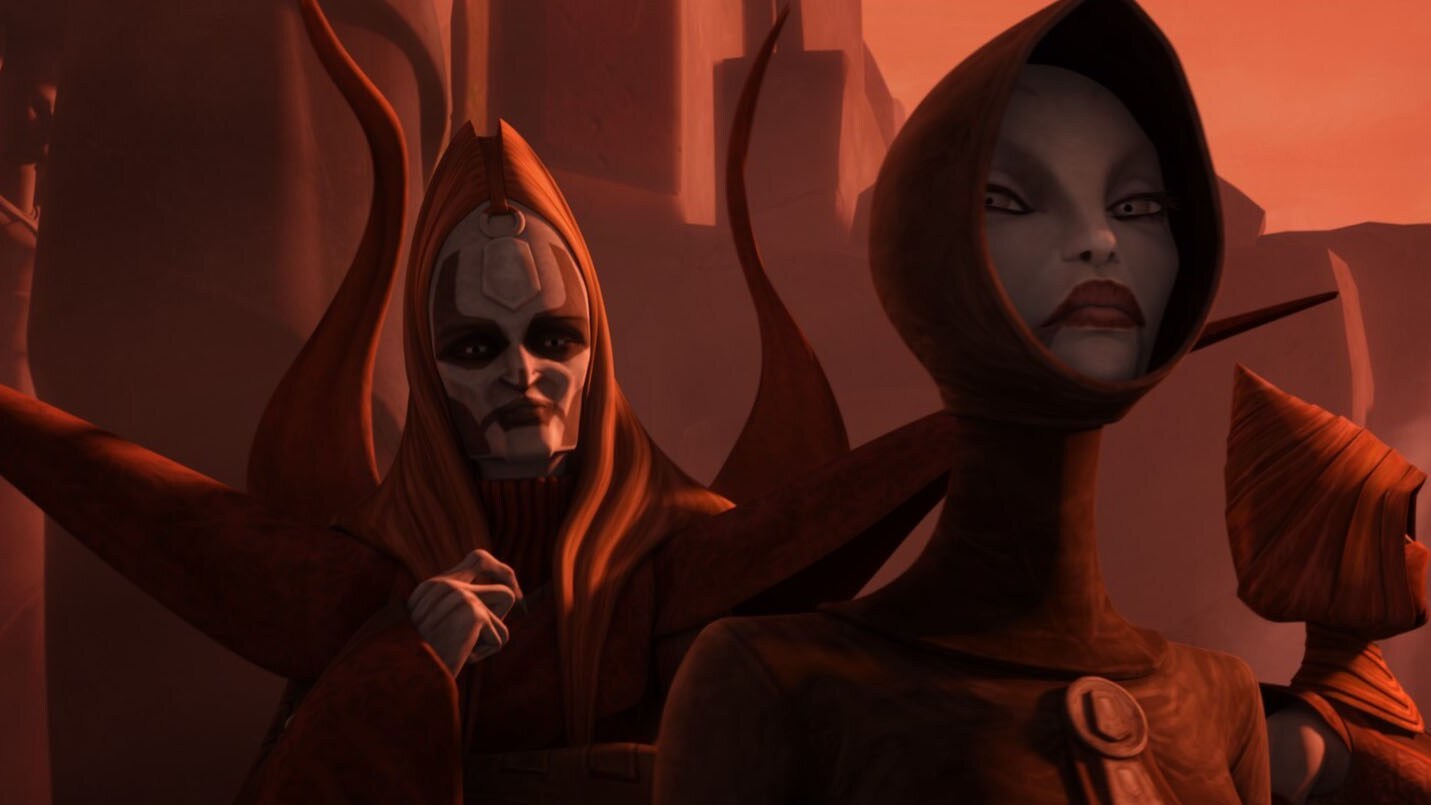
Survival, ghosts, and cultural memory
The Nightsisters survive in Star Wars as a people who refuse to disappear neatly. Their dead return as spirits; their names remain in the practices of descendants and allies; their enemies continue to fear what they cannot fully destroy. This is not simply a supernatural flourish. It is a metaphor for how cultural memory behaves after genocide and displacement. A tradition can be wounded, fragmented, and appropriated without becoming irrelevant.
Their afterlife also complicates the Jedi–Sith binary. The Nightsisters are not a hidden version of either order. They hold their own relationship to power, community, and the dead. Their presence reminds the galaxy that Force traditions are plural and that the most powerful institutions are not the only ones with history.
For collectors, Nightsister imagery should be read through that tension between visibility and survival. A mask, blade, spirit cloud, rancor, or red landscape can signify more than “dark side.” It may mark a homeland, a matriarchal archive, a displaced clan, or a community negotiating the difference between being remembered and being used.
Sources and further reading
- Nightsisters, StarWars.com Databank
- Dathomir, StarWars.com Databank
- Mother Talzin, StarWars.com Databank
- Asajj Ventress, StarWars.com Databank
- Nightsisters, StarWars.com Databank
- The Clone Wars, StarWars.com
- Star Wars Rebels, StarWars.com
- Ahsoka, StarWars.com
Connected archive