
IDS Film Hub · Episode VIII · 2017
The Last Jedi
One screen story, connected to the larger Imperial Dark Sector archive through anthropology, characters, institutions, places, events, and lore.
Story record
Movie summary
2017 · Episode VIII
The Last Jedi begins immediately after the destruction of Starkiller Base, with the Resistance evacuating its base before the First Order can retaliate. Poe Dameron disobeys a retreat order to lead an attack on a First Order dreadnought. The bomber assault succeeds, but the Resistance loses many pilots, ships, and crew members in the process. General Leia Organa demotes Poe because he treats destruction of the enemy target as sufficient justification for the losses. The surviving Resistance fleet jumps to hyperspace, only to discover that the First Order can track it through hyperspace. This removes the Resistance's normal ability to escape by mobility. With limited fuel and a larger enemy fleet following at a distance, the Resistance enters a slow-moving crisis in which logistics, command decisions, and time become as important as direct combat.
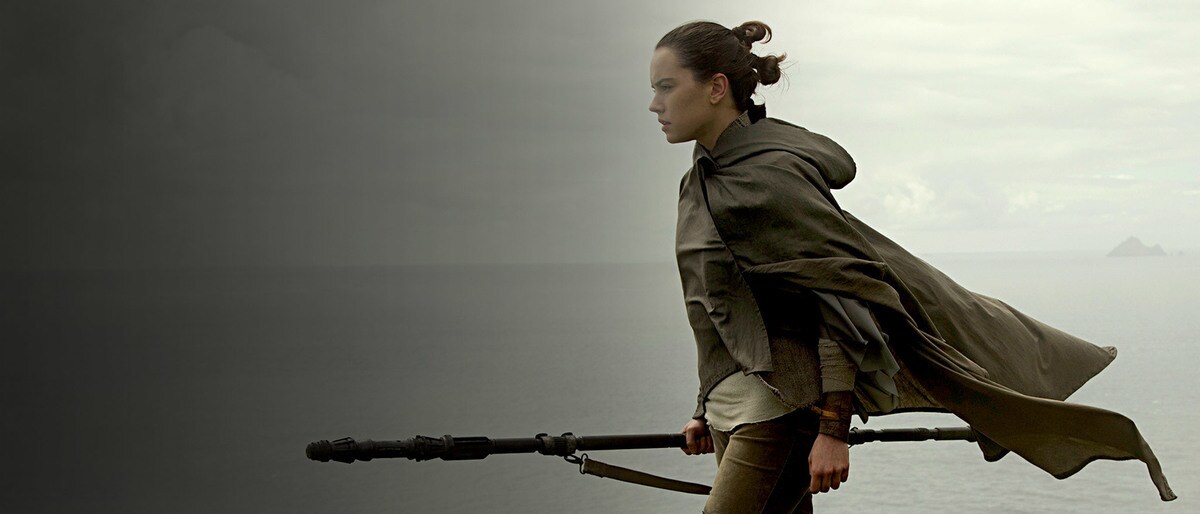
At the same time, Rey has reached Ahch-To with Chewbacca and R2-D2. She presents Luke Skywalker with his old lightsaber, but he throws it away and refuses to return. Luke has cut himself off from the Force and believes the Jedi should end. Rey learns that his isolation followed the destruction of his training temple and the fall of Ben Solo. Luke eventually agrees to give Rey lessons, but his teaching is deliberately critical of the Jedi institution. He emphasizes that the Force does not belong to the Jedi and argues that the Order's historical failures contributed to the rise of Darth Sidious and the fall of Anakin Skywalker. Rey, who arrived expecting a heroic figure from stories, instead finds someone whose personal memory of failure has turned into a larger rejection of the institution he once represented.
Kylo Ren and Rey begin experiencing unexplained Force connections that allow them to see and speak to one another across great distances. Supreme Leader Snoke claims responsibility for linking them, though their connection later appears deeper than his manipulation alone. Rey sees Kylo's conflict and becomes convinced that he can be turned away from Snoke, much as Luke once believed Vader could be redeemed. Luke presents a different account of what happened with Ben. He admits that he sensed immense darkness in his nephew and, for a brief moment, considered killing him while he slept. Luke did not carry out the act, but Ben awoke, saw his uncle holding an ignited lightsaber, and interpreted the moment as betrayal. He destroyed Luke's temple and left. The same event becomes politically consequential because the people involved remember and interpret it differently.
Within the fleeing Resistance fleet, Leia is incapacitated when Kylo's wingmen destroy the bridge of her cruiser. Leia survives exposure to space by using the Force and is taken for medical treatment. Vice Admiral Holdo assumes command. Poe distrusts her because she refuses to explain the fleet's plan and because she does not share his preference for immediate aggressive action. Believing leadership is failing, Poe supports a secret mission proposed by Finn and mechanic Rose Tico. They believe they can disable the First Order's hyperspace tracker if they find someone capable of breaking into the flagship's systems. BB-8 accompanies them to Canto Bight, a wealthy casino city where Rose points out that the luxury surrounding them is connected to arms manufacturing, exploitation, and the profits of selling weapons to both sides of galactic conflict.
Finn and Rose fail to recruit the codebreaker Maz Kanata recommended but escape custody with a slicer known as DJ. He presents himself as detached from political causes and emphasizes that war enriches people on multiple sides. The group infiltrates the First Order flagship but is captured after DJ betrays them in exchange for money and freedom. The betrayal exposes Holdo's actual strategy: the Resistance is quietly transferring personnel to small transports that will head toward an abandoned Rebel base on Crait while the main cruiser continues as a decoy. Because Poe did not know the plan, Finn and Rose unknowingly give DJ access to information that helps the First Order detect the transports. The storyline turns a dispute about secrecy and trust inside a military hierarchy into a direct strategic consequence.
Rey leaves Ahch-To despite Luke's warning and surrenders herself to the First Order, believing she can reach Ben Solo. Kylo brings her before Snoke. Snoke mocks Rey's confidence and orders Kylo to kill her. Instead, Kylo secretly turns Luke's lightsaber beside Snoke and cuts the Supreme Leader in half. Rey and Kylo then fight Snoke's guards together. For a moment it appears that Kylo has chosen Rey over the First Order. He then asks her to join him in ruling the galaxy, arguing that they should let the Sith, Jedi, Resistance, and old political categories die. Rey refuses because his rejection of inherited institutions is paired with a desire for personal domination rather than a new form of shared political life. Their struggle over Luke's lightsaber breaks the weapon and leaves them on opposite sides again.
Holdo remains aboard the Resistance flagship after the evacuation begins. Once the First Order starts destroying the exposed transports, she turns the cruiser and jumps to hyperspace directly through Snoke's flagship, devastating the pursuing fleet and creating an opening for survivors to reach Crait. Leia awakens and ends Poe's attempted mutiny, but later tells him that Holdo's plan was sound. On Crait, the remaining Resistance occupies an old fortified base while the First Order brings in walkers and a massive battering cannon. Poe initially looks for another attack opportunity but begins to understand that preserving the surviving community is more important than achieving a dramatic tactical victory. His development mirrors the lesson Leia tried to teach him at the beginning of the film: leadership requires thinking about people as a continuing political body, not only about defeating targets.
Finn attempts a suicidal attack on the battering cannon, but Rose stops him before he can crash into it. She argues that their struggle should be about protecting what they love rather than destroying what they hate. The First Order breaches the base. At that moment Luke Skywalker appears and confronts Leia, giving her Han's dice and apologizing for failing Ben. He then walks alone onto the battlefield and faces Kylo Ren. Kylo orders concentrated fire on him, but Luke survives untouched. Their lightsaber confrontation delays the First Order while the Resistance searches for another exit. Poe notices that Luke is not leaving footprints and understands that the confrontation is a diversion. He guides the survivors through tunnels where Rey, having returned aboard the Falcon, uses the Force to clear a blocked exit.
Luke reveals himself to be a projection created through the Force from Ahch-To. He tells Kylo that the war is not over and that he will not be the last Jedi. Once the Resistance has escaped, Luke ends the projection. The effort leaves him exhausted. Sitting before the horizon of Ahch-To, he sees twin suns reminiscent of Tatooine and dies peacefully, becoming one with the Force. His final action reverses the isolation that defined him through most of the film. He does not return as a battlefield commander who destroys the First Order. Instead, he uses a symbolic confrontation to preserve the Resistance and create a story that can travel beyond the small number of people who directly witness it.
The Resistance escapes aboard the Millennium Falcon with very few people remaining, but Leia tells Rey that they have everything needed to rebuild. The film closes elsewhere in the galaxy, where enslaved children on Canto Bight retell the story of Luke Skywalker standing against the First Order. One child, Temiri Blagg, uses the Force casually to pull a broom into his hand before looking toward the stars. The scene connects political resistance to storytelling and shows that Luke's importance now lies partly in how other people remember his act. The Last Jedi ends with institutions damaged but not erased. The Jedi tradition can be reinterpreted rather than simply restored, the Resistance survives as a tiny network rather than a conventional military, Poe begins learning a different model of leadership, Rey chooses affiliation over Kylo's offer of power, and Luke's failure becomes part of a new public myth instead of the final definition of his life.
IDS anthropology
Anthropological analysis
The full IDS long-form analysis is included directly on this film page.
01 · Central reading
What an anthropology lens changes
The Last Jedi challenges inherited authority more directly than most Star Wars films. Characters dispute who deserves to lead, what the Jedi tradition should preserve, whether heroic individual action is responsible, and whether political identity must come from exceptional ancestry.
This review does not score the film. It asks what kinds of social relations the story makes visible: who has authority, how institutions reproduce themselves, what counts as family, how belief is organized, who performs necessary labor, how violence is justified, and how people attach meaning to places and objects. The aim is to connect character decisions to the systems around them without pretending that one interpretive framework exhausts what the film can mean.
02 · Anthropology lens
Leadership and institutional trust
Poe's conflict with Leia and Holdo turns military leadership into a problem of information, hierarchy, and trust. Poe interprets secrecy as failure, while the command structure treats operational knowledge as restricted. The film asks when subordinates should obey, when leaders should explain themselves, and how organizations manage dissent during crisis.
What makes this especially important in The Last Jedi is that authority is never only a matter of who gives an order. Power has to move through institutions, recognized offices, information systems, material resources, and relationships that persuade or compel other people to act. The film repeatedly distinguishes formal legitimacy from practical capacity: a government may possess law without control, a commander may possess rank without autonomy, and a resistance movement may lack legal recognition while still exercising real political coordination. Reading the sequence this way shifts attention from individual intention to institutional conditions. It asks who can convert a decision into action, who can challenge that decision, which groups are excluded from the process, and what happens when public rules and lived experience stop matching one another.
03 · Anthropology lens
Failure as institutional knowledge
Yoda tells Luke that failure can be taught. This reframes tradition as something more than the preservation of sacred success stories. Institutions also transmit mistakes, unresolved conflicts, and selective memory. Luke's disillusionment with the Jedi becomes an argument over whether failed institutions should be abandoned, reformed, or reinterpreted.
This theme deepens the anthropology of The Last Jedi because the scene connects individual choice to a wider social environment. Characters act through institutions, relationships, objects, inherited expectations, and unequal access to information or resources. The question is therefore not only why one person behaves as they do, but what social arrangements make that behavior possible, rewarding, dangerous, or difficult to refuse. Looking at those arrangements also reveals variation inside groups that the plot can otherwise make appear uniform. People who share a government, religion, military, species identity, or homeworld do not automatically share the same interests. The film becomes more interesting when those differences are kept visible and when personal decisions are read alongside the systems that shape their consequences.
04 · Anthropology lens
Sacred texts and religious authority
The ancient Jedi texts symbolize textual authority, but the film complicates their role. Luke is prepared to destroy the tree, Yoda appears to burn it, and Rey has already removed the books. Religious continuity therefore survives not through a single sacred location but through interpretation, transmission, and possession of texts.
What makes this especially important in The Last Jedi is that authority is never only a matter of who gives an order. Power has to move through institutions, recognized offices, information systems, material resources, and relationships that persuade or compel other people to act. The film repeatedly distinguishes formal legitimacy from practical capacity: a government may possess law without control, a commander may possess rank without autonomy, and a resistance movement may lack legal recognition while still exercising real political coordination. Reading the sequence this way shifts attention from individual intention to institutional conditions. It asks who can convert a decision into action, who can challenge that decision, which groups are excluded from the process, and what happens when public rules and lived experience stop matching one another.
05 · Anthropology lens
War, wealth, and Canto Bight
Canto Bight exposes people who profit from both sides of conflict. The setting shifts attention away from battlefield morality toward arms production, luxury, labor, and inequality. The stable children make class visible from below, while the casino presents war as a source of wealth for actors whose position is insulated from direct fighting.
The Last Jedi also makes this theme useful for material anthropology because political life depends on things being built, moved, repaired, bought, extracted, and maintained. Weapons, ships, droids, fuel, housing, sacred objects, uniforms, factories, and transport systems distribute possibilities unevenly across the galaxy. The characters who control those resources do not necessarily perform the labor that keeps them functioning, and the people who do that work are often pushed to the edge of the story. Following the material chain makes inequality easier to see. It connects spectacular events to ordinary work, infrastructure, property, and supply. It also shows why the same object can mean something different depending on who owns it, who repairs it, who is allowed to use it, and what institution gives it value.
06 · Anthropology lens
Lineage and achieved identity
Rey's search for parental significance ends, within this film, with the claim that her parents were socially unimportant. Whether later films revise that genealogy, the dramatic function here is clear: worth does not require elite descent. The final image of a child using the Force extends that idea beyond Rey.
In The Last Jedi, this relationship matters because kinship and belonging create obligations that formal institutions cannot fully control. Family, mentorship, adoption, friendship, descent, and chosen partnership each establish different claims about care, loyalty, inheritance, and responsibility. Those claims become politically significant when they collide with military orders, religious discipline, class position, state violence, or expectations about succession. The anthropology lens therefore treats relationships as social structures rather than private emotion alone. A person may belong to several communities at once, and those communities can demand incompatible actions. The resulting conflicts help explain why characters sometimes resist the roles assigned to them and why a change in relationship can reorganize identity more deeply than a change in title.
07 · Anthropology lens
Myth and resistance
Luke's stand on Crait is simultaneously strategic deception and public symbol. The act allows the Resistance to escape, but its wider importance comes from being retold. The final children reenact Luke's story with improvised objects. Heroism becomes politically powerful through circulation, memory, and imitation.
The Last Jedi treats identity as something produced through recognition, memory, classification, and material signs rather than as a fixed inner essence. Names, uniforms, ancestry, scars, masks, reputations, occupations, and institutional records all tell other people how a person is supposed to be understood. Those labels can provide belonging and authority, but they can also restrict movement or preserve a version of the past that a character no longer accepts. This is why memory becomes political. Communities decide which stories to repeat, which failures to hide, and which figures become models for later generations. The film's characters inherit those stories unevenly, and their attempts to accept, reject, or reinterpret them become part of the larger struggle over social identity.
08 · Synthesis
What the film reveals when the lenses are connected
Taken together, the major lenses in this review — Leadership and institutional trust, Failure as institutional knowledge, Sacred texts and religious authority, War, wealth, and Canto Bight, Lineage and achieved identity, and Myth and resistance — show why The Last Jedi works as more than a sequence of plot events. The Last Jedi challenges inherited authority more directly than most Star Wars films. Characters dispute who deserves to lead, what the Jedi tradition should preserve, whether heroic individual action is responsible, and whether political identity must come from exceptional ancestry. The recurring pattern is that large historical changes become real through ordinary social mechanisms. Institutions classify people, families create competing obligations, religious traditions authorize some forms of knowledge, labor and technology make political projects possible, and places shape who can move or act safely. The film also leaves tensions unresolved, which is analytically useful. Social systems rarely change all at once, and a victory, revelation, or regime shift does not erase the institutions and memories that came before it. For IDS, the value of the film lies in following those continuities and contradictions instead of reducing the story to a single political message.
09 · Method
How IDS is reading this film
The analysis treats Star Wars as a fictional social world rather than evidence about any real population. Anthropological concepts are used as questions, not as claims that fictional societies map directly onto real cultures. The review distinguishes events shown or established by the story from IDS interpretation about institutions, kinship, belief, political economy, identity, material culture, and historical change. That distinction matters because interpretation should make the source material more legible without quietly turning analysis into additional canon.
People in this story
Character list
Open existing IDS dossiers or search the archive for additional coverage.