
SPONSORED / AMAZON
Shop this game
Related games, collectibles and accessories. Check platform and availability on Amazon.
As an Amazon Associate I earn from qualifying purchases.
60-SECOND GAME BRIEF / START HERE
Know the game in three moves
- 01 / YOUR ROLEWho you play
Faction leadership
- 02 / INFORMATIONWhat to know next
Identify victory conditions before committing units.
- 03 / GAME STYLEWhat to expect
Real-time strategy
FIELD MANUAL / START PLAYING
Your first mission briefing
Practical orientation for this particular title. Instructions are not presented as a verified step-by-step walkthrough or as a substitute for edition-specific controls.
Secure your economy and key hyperspace routes before committing to a long offensive.
Separate the galactic campaign's planet management from the tactics needed to win a single land or space battle.
Inspect the unit counters and reinforcements available at each encounter; winning a battle can still weaken the campaign.
PLAYER ORIENTATION / YOUR FIRST SESSION
How to approach the game
Know your next objective
Identify victory conditions before committing units. Check range, cover, resources and the cost of replacing a squad or vehicle, then advance with a plan for your next action.
What to pay attention to
Notice which kinds of power the rules model: logistics, territory, reinforcements, cohesion or control of strategic locations.
Your role
The playable perspective recorded for this title is Faction leadership. Its story context is Galactic campaign before A New Hope.
Controls and available objectives can vary by game version.
PLAYER GUIDE / GAME-SPECIFIC DIRECTIONS
Empire at War: galactic map to tactical victory
The most important distinction is between Galactic Conquest and local battles. Building ships, moving troops, and earning credits happen primarily on the galaxy map, while space and land encounters each have their own combat objectives.
- 01 / CHOOSE THE RIGHT VIEW
Use the galaxy map for the strategic campaign
The galactic map manages fleets, planets, building queues, and income. Space and land tactical battles are separate combat environments. A missing building option may mean you are in the wrong map layer or that a planet lacks the needed capacity.
- 02 / WIN ORBIT THEN SURFACE
Do not confuse space control with planet conquest
An enemy world can require a space battle followed by a ground assault. Secure orbit and make sure you have transportable ground forces; winning a fleet engagement does not automatically destroy the planet's remaining ground defenses.
- 03 / MANAGE REINFORCEMENTS
Bring the correct unit composition before engaging
A fleet with only capital ships can be vulnerable to bombers. A land army of vehicles may struggle in unsuitable terrain or against dedicated counters. Inspect the opponent's units and use appropriate counters and reserve forces.
- 04 / PRESERVE ECONOMY
Protect income and move without exposing the rear
Build productive territory, defend valuable planets, and avoid stretching every fleet far from reinforcements. Trade routes and holdings can affect the wider campaign. A short retreat can be preferable to losing an experienced fleet.
- 05 / UNDERSTAND AUTOREsolve
Use tactical combat when preserving units matters
Galactic Conquest can resolve battles automatically, but autoresolve can produce different losses from manual control. Consider fighting difficult battles directly, especially when expensive ships or essential ground troops are at risk.
- 06 / DISTINGUISH THE EXPANSION
Forces of Corruption adds an underworld faction
The Gold Pack includes the base game and Forces of Corruption. Tyber Zann's underworld faction adds different campaign mechanics and units. Confirm which expansion and mode are loaded before using advice about corruption or piracy.
Where to go next: story route
Find your current chapter, finish its objective, then follow the next destination. Some games allow optional stages or different mission order.
- MISSION 1 OF 6
Choose campaign or Galactic Conquest
The story campaign and Galactic Conquest are different experiences. Start with the tutorial or desired faction, then review the victory conditions before committing your starting planets.
NEXT MISSION → Galactic map: build an economy↑ BACK TO MISSION INDEX - MISSION 2 OF 6
Galactic map: build an economy
Inspect income-producing worlds, construction queues, and fleet positions. Protect the planets generating needed credits and the routes linking strongholds before ordering a distant offensive.
NEXT MISSION → Move a fleet into hostile orbit← PREVIOUS MISSION↑ BACK TO MISSION INDEX - MISSION 3 OF 6
Move a fleet into hostile orbit
Bring the chosen fleet to an enemy system. In a tactical space battle, defeat its defenders or achieve the displayed victory conditions; winning space alone does not always secure the surface.
NEXT MISSION → Space battle: counter enemy craft and stations← PREVIOUS MISSION↑ BACK TO MISSION INDEX - MISSION 4 OF 6
Space battle: counter enemy craft and stations
Protect your larger ships from specialized threats, use fighter and bomber roles deliberately, and target critical hardpoints on enemy capitals or stations. Regroup before a damaging assault instead of feeding one ship at a time.
NEXT MISSION → Land assault: deliver and deploy ground forces← PREVIOUS MISSION↑ BACK TO MISSION INDEX - MISSION 5 OF 6
Land assault: deliver and deploy ground forces
Transport a suitable land force to the planet, gain access to the surface engagement, and deploy reinforcements where the battle permits. Use units appropriate for infantry, vehicles, and defenses rather than relying only on expensive armor.
NEXT MISSION → Hold territory and expand← PREVIOUS MISSION↑ BACK TO MISSION INDEX - MISSION 6 OF 6
Hold territory and expand
After victory, review planetary control, damaged forces, available construction, and the next required objective. If fighting has left a fleet weak, retreat or consolidate instead of allowing a nearby enemy to exploit it.
END OF ROUTE← PREVIOUS MISSION↑ BACK TO MISSION INDEX
If you get stuck
- I won in orbit, but the planet is still not mine
- Check the ground defenses and whether a suitable land army is available. Space victory and planetary occupation are distinct stages.
- I cannot deploy all my reinforcements
- Verify reinforcement limits and the required control or landing conditions for that tactical battle. Units on the galactic map are not necessarily all available simultaneously.
- My economy collapsed after taking several worlds
- Inspect planetary income, buildings, defended trade routes and construction queues; pause costly offensives while rebuilding a sustainable force.
- My game does not have an underworld faction
- Check whether you launched the original Empire at War or the Forces of Corruption expansion.
GAMEPLAY / OFFICIAL SCREENSHOTS
See the game in action
Select an image to enlarge it. These are actual gameplay images from this game's official Steam store listing. Screenshots can reflect a later PC edition.
Source: Official Steam game page ↗. Images © their respective rights holders.
01 · Orientation
What the game is
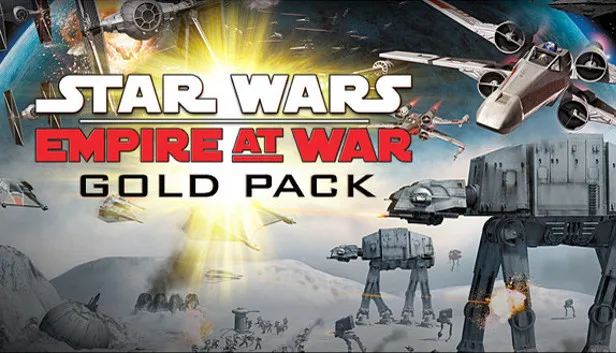
Empire at War turns galactic conflict into fleets, production, planetary control, ground forces, heroes, and logistics. Its campaign map makes the material capacity of the Empire and Rebellion visible as systems that must be built and maintained.
IDS places the game in the Age of Rebellion era and records its continuity as Legends.
02 · Publication file
Release, studio, and platform context
Star Wars: Empire at War was developed by Petroglyph Games and published by LucasArts. Its primary release platforms in the IDS record are Windows; Mac.
Star Wars: Empire at War is cataloged as a released Star Wars game. Later ports, remasters, backward-compatible versions, or storefront reissues remain attached to this core record unless they substantially alter the underlying work.
IDS stores the game itself as one work rather than creating separate records for every port, storefront release, compatibility update, or remaster. Platform history still matters, but the archive avoids inflating a single game into several supposedly different titles.
03 · Story
Narrative and player position
The current IDS story label is Galactic campaign before A New Hope. The playable role is recorded as Faction leadership.
Rather than reducing the game to plot summary, IDS tracks what position the player occupies in the galaxy. Playing as Faction leadership changes which institutions, conflicts, and social relationships the game can make visible.
04 · Gameplay systems
How Star Wars becomes playable
Strategy and tactics systems make positioning, resource allocation, unit composition, timing, and institutional capacity visible as things the player must manage rather than simply watch.
IDS classifies the title as Real-time strategy. That label is useful because genre changes what parts of Star Wars become legible: a strategy game foregrounds institutions and logistics, an RPG foregrounds identity and relationships, and an action game often foregrounds bodies, movement, combat, and environmental navigation.
05 · Place
Worlds, routes, and environments
Major locations in the current record include Galaxy map; multiple planets. Those places matter because games convert fictional geography into routes, obstacles, hubs, battlefields, workplaces, ruins, or social spaces the player must navigate.
Interactive scale can reveal details that screen media pass over quickly: how far locations are from one another, which areas are restricted, where people gather, what infrastructure connects spaces, and how movement is shaped by vehicles, architecture, terrain, enemies, or local authority.
06 · Institutions
Power, organizations, and social systems
The story context is Galactic campaign before A New Hope. That places the player inside or alongside institutions whose authority is usually encountered through missions, ranks, restricted spaces, enemies, allies, contracts, or rules.
Games are especially useful for IDS because institutions become operational systems. A faction can control checkpoints, issue objectives, distribute equipment, reward loyalty, restrict movement, organize training, or shape reputation. Those mechanics make political power experiential rather than only descriptive.
07 · People
Characters and playable roles
The current playable-role record is Faction leadership. IDS uses this field as a route into the characters, crews, military roles, factions, or created player identities through which the game is experienced.
Games often make character identity interactive. Abilities, dialogue choices, party membership, equipment, reputation, and mission access can determine how a player experiences relationships that screen media presents from the outside.
08 · Anthropology
Anthropological analysis
The strongest IDS entry point is the relationship between real-time strategy mechanics and the story context described as Galactic campaign before A New Hope. The player does not only learn about the setting; the player is required to act through a particular set of rules.
That distinction matters anthropologically. Interactive media can make hierarchy, labor, mobility, violence, ritual, reputation, resource management, or identity into repeatable behaviors. IDS therefore reads games as designed social systems as well as narrative texts.
09 · Source record
Verify the game
IDS separates release facts from independently written summaries and analysis. External links are retained as verification sources, but the substantive game description now lives inside IDS instead of requiring the visitor to leave the archive.
GO DEEPER / CONNECT THE ARCHIVE
Keep exploring Star Wars games
Star Wars: Empire at War belongs to a wider catalog of interactive Star Wars stories. Follow a neighboring game or trace characters, places and factions through the IDS archives.
KEEP EXPLORING / MORE STAR WARS GAMES
More Star Wars games to explore
 Game-specific promotional, cover or archival artwork
 Game-specific promotional, cover or archival artwork
 Game-specific promotional, cover or archival artwork