SPONSORED / AMAZON
Shop this game
Related games, collectibles and accessories. Check platform and availability on Amazon.
As an Amazon Associate I earn from qualifying purchases.
60-SECOND GAME BRIEF / START HERE
Know the game in three moves
- 01 / YOUR ROLEWho you play
Luke Skywalker / Rebel pilot
- 02 / INFORMATIONWhat to know next
Start by identifying the immediate win condition, available controls and how the game signals success or failure.
- 03 / GAME STYLEWhat to expect
Rail shooter / arcade
FIELD MANUAL / START PLAYING
Your first mission briefing
Practical orientation for this particular title. Instructions are not presented as a verified step-by-step walkthrough or as a substitute for edition-specific controls.
Line up the vector cockpit sights during the Death Star assault.
Read the sparse HUD, anticipate turns, and prepare for repeated attack runs.
Treat repeated trench runs as arcade survival and scoring, not a modern campaign.
PLAYER ORIENTATION / YOUR FIRST SESSION
How to approach the game
Know your next objective
Start by identifying the immediate win condition, available controls and how the game signals success or failure. Practice the core loop before attempting optional objectives.
What to pay attention to
Follow how the game's rules constrain movement, reward actions and turn familiar Star Wars settings into playable spaces.
Your role
The playable perspective recorded for this title is Luke Skywalker / Rebel pilot. Its story context is Death Star trench run.
Controls and available objectives can vary by game version.
PLAYER GUIDE / GAME-SPECIFIC DIRECTIONS
Star Wars (1983): survive all three Death Star attack phases
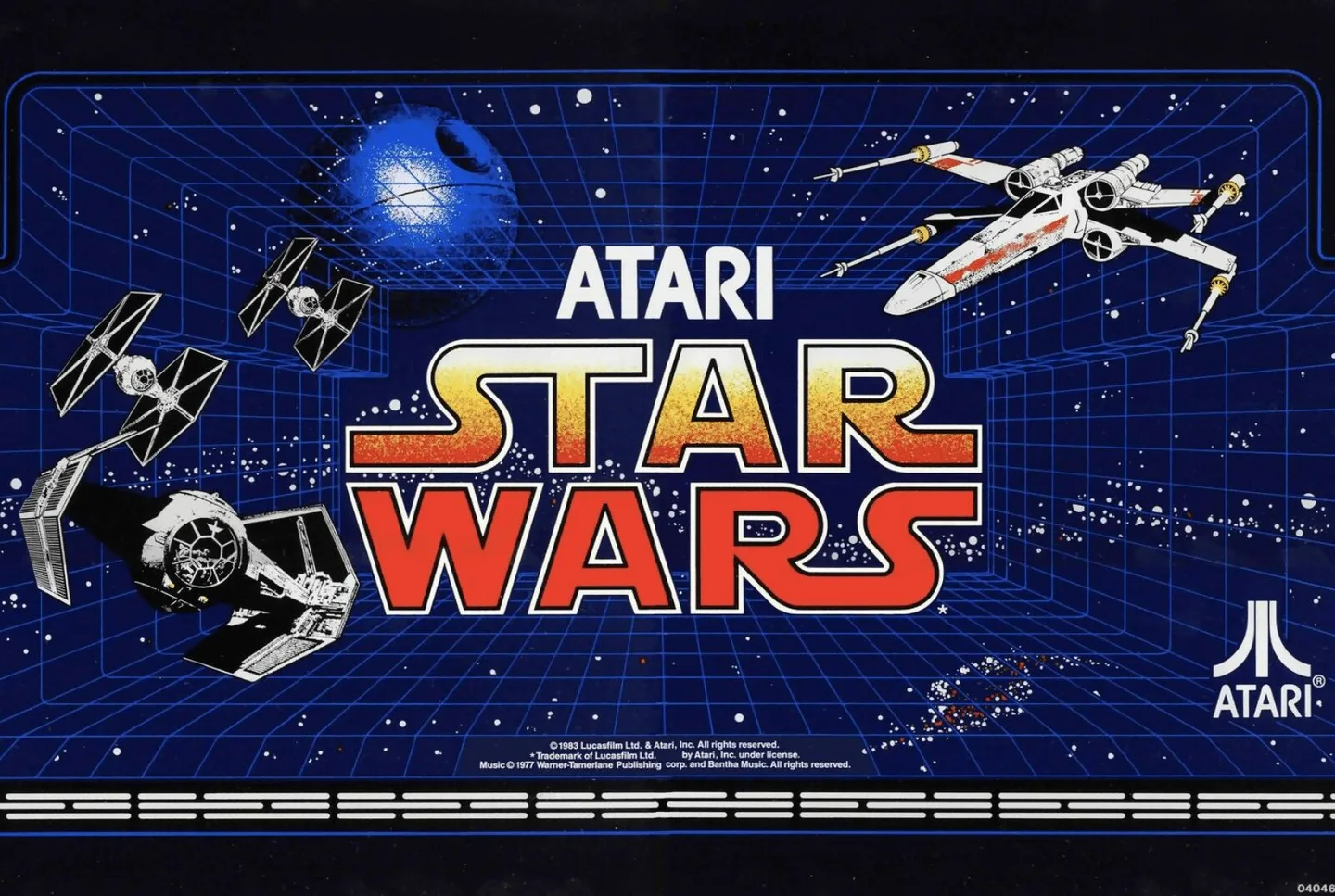
Atari's color-vector arcade game repeats the Death Star assault in increasingly dangerous waves. It has no mission-select screen or final ending: learn the TIE dogfight, surface defenses and trench-run exhaust port.
- 01 / SPACE
Shoot the TIE fighters and intercept enemy shots
In the opening space phase, enemy fireballs can be shot down. Do not waste all your attention trying to destroy Vader's protected TIE.
- 02 / SURFACE
Fly over the Death Star's defensive towers
Later waves include towers and laser bunkers. Avoid collisions and intercept shots to preserve the limited shield supply.
- 03 / TRENCH
Navigate the Death Star trench
Avoid laser-turret fire and catwalk structures. Learn to steer over or under obstacles without losing deflector shields.
- 04 / TARGET
Shoot the exhaust port at the trench's end
The final goal of each attack run is the exposed exhaust port. Missing it sends you back into another dangerous pass.
- 05 / SHIELDS
Protect your limited damage buffer
Your X-wing has a finite number of deflector shields. Every shot or collision that reaches the ship brings the session closer to ending.
- 06 / LOOP
The Death Star is rebuilt for the next wave
After a successful shot, score your bonus and begin a harder version of the attack. There is no Chapter 4 or conventional story completion.
If you get stuck
- Darth Vader's TIE will not explode
- His fighter is specially protected; concentrate on the other targets and on preserving shields.
- I keep missing the final target
- At the end of the trench, aim carefully at the exhaust port. A miss costs a shield and requires another run.
- The game keeps restarting after the Death Star explodes
- That is the normal arcade loop, with increasing speed and difficulty.
01 · Orientation
What the game is
Atari's vector-graphics arcade game turned the Death Star assault into a first-person cockpit experience. Voice samples, targeting, and repeated trench runs helped establish flight combat as one of the defining ways Star Wars would be translated into games.
IDS places the game in the Age of Rebellion era and records its continuity as Legends / adaptation.
02 · Publication file
Release, studio, and platform context
Star Wars was developed by Atari and published by Atari. Its primary release platforms in the IDS record are Arcade.
Star Wars is cataloged as a released Star Wars game. Later ports, remasters, backward-compatible versions, or storefront reissues remain attached to this core record unless they substantially alter the underlying work.
IDS stores the game itself as one work rather than creating separate records for every port, storefront release, compatibility update, or remaster. Platform history still matters, but the archive avoids inflating a single game into several supposedly different titles.
03 · Story
Narrative and player position
The current IDS story label is Death Star trench run. The playable role is recorded as Luke Skywalker / Rebel pilot.
Rather than reducing the game to plot summary, IDS tracks what position the player occupies in the galaxy. Playing as Luke Skywalker / Rebel pilot changes which institutions, conflicts, and social relationships the game can make visible.
04 · Gameplay systems
How Star Wars becomes playable
The game translates Star Wars into repeated player actions, objectives, feedback systems, and rules that determine what kinds of behavior the experience rewards.
IDS classifies the title as Rail shooter / arcade. That label is useful because genre changes what parts of Star Wars become legible: a strategy game foregrounds institutions and logistics, an RPG foregrounds identity and relationships, and an action game often foregrounds bodies, movement, combat, and environmental navigation.
05 · Place
Worlds, routes, and environments
Major locations in the current record include Death Star; space. Those places matter because games convert fictional geography into routes, obstacles, hubs, battlefields, workplaces, ruins, or social spaces the player must navigate.
Interactive scale can reveal details that screen media pass over quickly: how far locations are from one another, which areas are restricted, where people gather, what infrastructure connects spaces, and how movement is shaped by vehicles, architecture, terrain, enemies, or local authority.
06 · Institutions
Power, organizations, and social systems
The story context is Death Star trench run. That places the player inside or alongside institutions whose authority is usually encountered through missions, ranks, restricted spaces, enemies, allies, contracts, or rules.
Games are especially useful for IDS because institutions become operational systems. A faction can control checkpoints, issue objectives, distribute equipment, reward loyalty, restrict movement, organize training, or shape reputation. Those mechanics make political power experiential rather than only descriptive.
07 · People
Characters and playable roles
The current playable-role record is Luke Skywalker / Rebel pilot. IDS uses this field as a route into the characters, crews, military roles, factions, or created player identities through which the game is experienced.
Games often make character identity interactive. Abilities, dialogue choices, party membership, equipment, reputation, and mission access can determine how a player experiences relationships that screen media presents from the outside.
08 · Anthropology
Anthropological analysis
The strongest IDS entry point is the relationship between rail shooter / arcade mechanics and the story context described as Death Star trench run. The player does not only learn about the setting; the player is required to act through a particular set of rules.
That distinction matters anthropologically. Interactive media can make hierarchy, labor, mobility, violence, ritual, reputation, resource management, or identity into repeatable behaviors. IDS therefore reads games as designed social systems as well as narrative texts.
09 · Source record
Verify the game
IDS separates release facts from independently written summaries and analysis. External links are retained as verification sources, but the substantive game description now lives inside IDS instead of requiring the visitor to leave the archive.
GO DEEPER / CONNECT THE ARCHIVE
Keep exploring Star Wars games
Star Wars belongs to a wider catalog of interactive Star Wars stories. Follow a neighboring game or trace characters, places and factions through the IDS archives.
KEEP EXPLORING / MORE STAR WARS GAMES