
Around 17,000 BBY in the Legends chronology, rogue Arkanian scientists encountered the Xexto of Troiken while seeking a place to continue genetic research that the Galactic Republic prohibited on sentient beings. They moved a portion of the Xexto population to the nearby planet Quermia, terraformed the world, and conducted genetic experiments on the transplanted subjects. After only a few generations, the scientists abandoned the project out of fear of Republic punishment. The altered population remained behind and eventually became the Quermian species.
Troiken and the Xexto
Troiken was the homeworld of the Xexto, a small, long-necked, six-limbed sentient species adapted to an environment of dangerous predators and difficult terrain.
Legends describes early Xexto society around the time of first Arkanian contact as loosely organized into hunter-gatherer communities, including villages built among trees.
The Xexto already possessed their own social systems before the Arkanians arrived. They were not raw material waiting to be “improved.”
Arkanian science
Arkania had developed a formidable reputation for medicine, genetics, and biological engineering. Arkanian researchers repeatedly pushed beyond the ethical limits recognized by the Republic.
That scientific tradition later produced important medical advances, but it also generated experiments on sentient populations and social hierarchies built around ideas of biological perfection.
The Quermian project belongs to the darker side of that history.
Why the experiment happened outside the Republic
Sentient genetic experimentation of the kind the rogue Arkanians wanted to conduct was illegal inside Republic territory.
The scientists therefore sought subjects beyond effective Republic oversight.
This makes the location of the experiment politically important. Moving beyond jurisdiction did not make the research ethical. It merely reduced the chance that the researchers would be stopped.
First contact with the Xexto
Legends sources place Arkanian contact with the Xexto at approximately 17,000 BBY, while the Republic was occupied with the First Alsakan Conflict.
The Xexto were attractive research subjects because the scientists wanted a sentient population on which they could perform genetic manipulation away from Republic scrutiny.
The encounter therefore began under a severe imbalance of knowledge and power.
Relocation to Quermia
The Arkanians moved a group of Xexto from Troiken to the nearby world of Quermia.
Some Legends accounts describe the Xexto as having been enticed by promises of settling a new world, without understanding that the relocation was part of a genetic experiment.
If so, apparent participation in migration did not constitute informed consent to experimentation.
Terraforming Quermia
The scientists transformed Quermia into a highly favorable environment before or during the project. Later descriptions characterize the planet as a carefully engineered paradise lacking the dangerous predators that had shaped Xexto life on Troiken.
The experiment therefore changed both bodies and environment.
Instead of adapting only the settlers to a new world, the Arkanians redesigned the world and the settlers together.
Genetic manipulation
The transplanted Xexto became subjects of deliberate genetic alteration. Over generations, the experimental population diverged sharply from the people who remained on Troiken.
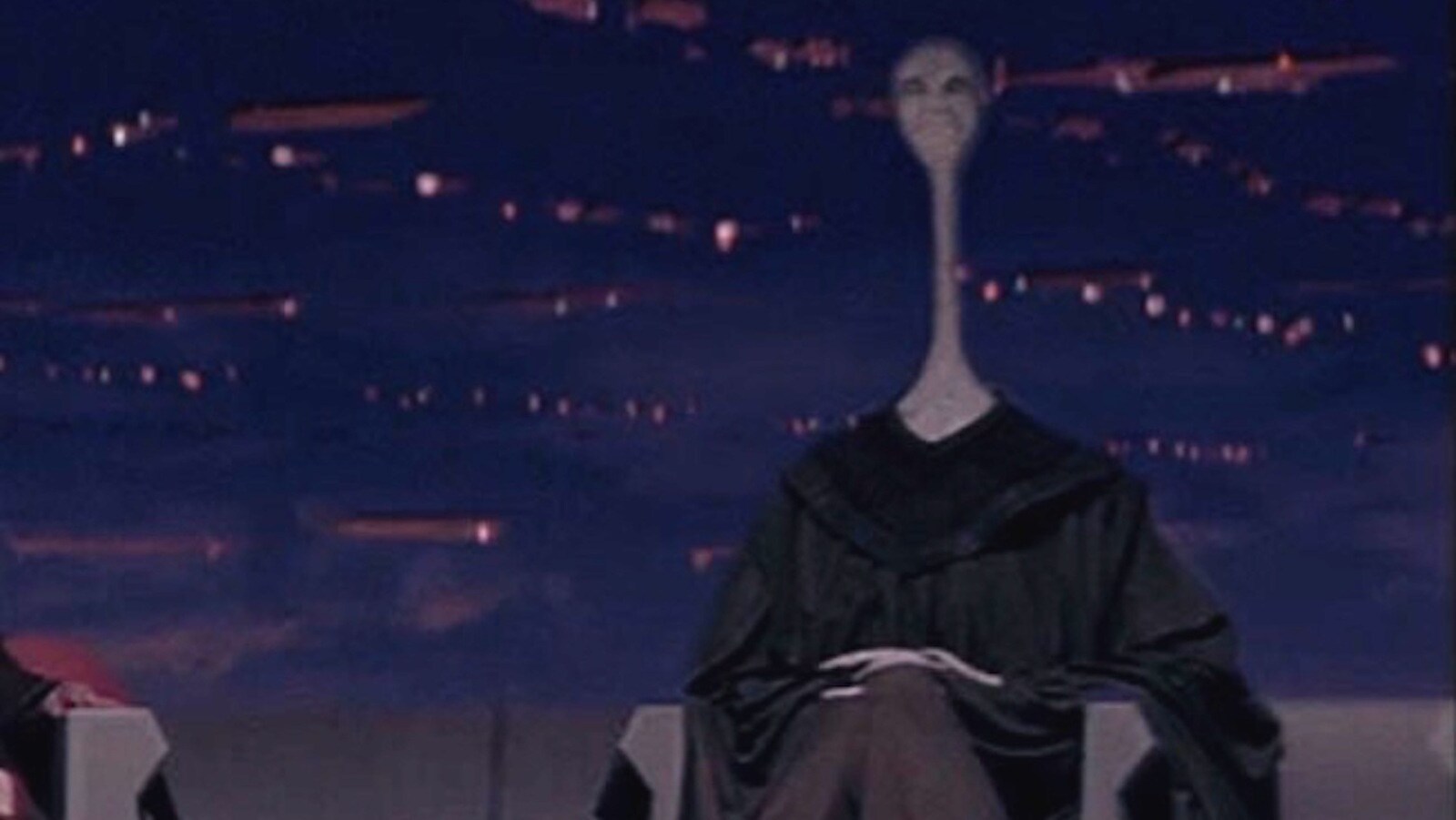
Quermians eventually became much taller than Xexto while retaining the recognizable long neck, four arms, two legs, and unusual two-brain body plan inherited from their ancestors.
The creation of the Quermians was therefore not simple selective breeding. It was directed sentient bioengineering.
Experiments also occurred on Troiken
Legends material indicates that Arkanian experimentation was not confined completely to Quermia. Some manipulation also affected Xexto who remained on Troiken.
The surviving descriptions are not detailed enough to reconstruct exactly how extensive those interventions were.
What matters is that the research project reached beyond the transplanted group.
Only a few generations
The Arkanians monitored and altered the Quermian population for only a few generations before abandoning the project.
That relatively short intervention produced consequences that lasted for thousands of years.
The scale of the result demonstrates the power of genetic engineering to alter future populations long after the researchers who initiated the changes have disappeared.
The scientists abandon the project
Eventually the Arkanian researchers became afraid that the Galactic Republic would discover their work and punish them.
They left Quermia and ended direct supervision of the experiment.
The subjects were not restored to their previous condition or returned to Troiken. The altered population was left to continue developing independently.
The emergence of the Quermians
Over time, the genetically altered Xexto on Quermia became recognized as a distinct species: the Quermians.
The species retained many biological similarities to Xexto while developing a markedly different body size and appearance.
The new population also formed its own society, language, institutions, and cultural identity.
A species is more than its designers
It is tempting to say that the Arkanians “created” the Quermians and end the story there. Biologically, the intervention was decisive. Socially, however, the Quermians became far more than the product imagined by their experimenters.
Once abandoned, later generations built their own communities and meanings without Arkanian supervision.
A violent origin does not reduce a people to the intentions of those who altered their ancestors.
The Xexto continue independently
The Xexto remaining on Troiken continued to develop their own society. They were not replaced by the Quermians and did not become a single shared culture with them.
By later eras both species had technologically advanced civilizations.
Shared ancestry did not erase separate historical experience.
Rediscovery by the wider galaxy
When Troiken and Quermia later entered broader galactic awareness, the similarities between Xexto and Quermians were obvious enough to inspire theories of common ancestry.
The full truth of the Arkanian intervention was not initially part of common public knowledge.
Genetic history had become hidden history.
Xexto rejection of the connection
Legends accounts describe Xexto initially resisting the claim that they were related to Quermians.
That reaction is understandable in light of what the relationship represented. Genetic kinship was evidence that outsiders had taken members of their species and altered them without meaningful consent.
The discovery was therefore not merely scientific. It implicated identity, dignity, and historical violation.
Genetic testing changes the story
Later genetic evidence demonstrated that the two species were indeed related.
The Xexto eventually accepted the relationship, though learning that connection also meant confronting the Arkanian deception.
Scientific evidence altered collective history by revealing a past that neither society had fully preserved through ordinary memory.
The engineered Quermian body
Quermians possessed extremely long necks, four arms, two legs, and two brains, one located in the chest. They lacked a conventional spinal column and had unusually flexible bodies.
They also possessed olfactory organs in their hands rather than a conventional nose.
Some of these traits paralleled Xexto anatomy while others reflected the altered developmental path created by the Arkanian project.
Two brains and perceived telepathy
Later Quermians developed a reputation for near-telepathic communication. Some observers attributed this to unusual brain activity, while Quermians themselves sometimes explained it through highly refined interpretation of body language.
The species' two-brain physiology complicated outsider attempts to understand cognition and communication.
Biological difference repeatedly became the basis for cultural assumptions.
Yarael Poof
Thousands of years later, one of the most famous Quermians was Jedi Master Yarael Poof, a long-serving member of the Jedi High Council.
His presence at the center of Republic power creates a striking historical contrast. A species that originated through illegal experimentation beyond Republic oversight eventually included a senior figure in the Republic-era Jedi Order.
That later prominence did not erase the violence of the species' origin.
The long Arkanian legacy
The Quermian experiment was not the last time Arkanian science intervened in sentient biology. Later Arkanian societies produced engineered populations, modified subspecies, and powerful biotechnology industries.
Ideas of biological perfection repeatedly justified distinctions between “pure” Arkanians and engineered offshoots.
The c. 17,000 BBY project therefore belongs to a much longer history of scientific achievement intertwined with hierarchy and exploitation.
Republic law had limits
The existence of a ban on sentient experimentation shows that the Republic recognized an ethical boundary.
But law was only as strong as the Republic's ability to monitor and enforce it. The scientists evaded regulation by operating beyond effective oversight during an era of political distraction and frontier expansion.
Formal prohibition did not protect populations outside the center of state power.
The First Alsakan Conflict as context
The experiments occurred while the Republic was consumed by the First Alsakan Conflict.
This does not mean the war caused the project, but it created a wider political environment in which central attention was directed elsewhere.
Periods of war can create spaces where illicit activity becomes easier to hide.
Science on the frontier
The experiment also reveals how frontier geography can be used by powerful institutions and individuals. Distance from regulation becomes a resource for researchers who want fewer constraints.
Troiken's Xexto were vulnerable not because they lacked society, but because their society lay outside the legal and political systems capable of restraining the Arkanians.
Scientific exploitation followed an unequal geography of power.
Consent and deception
The ethical problem extends beyond physical experimentation. The Xexto taken to Quermia were not fully informed about the purpose of their relocation.
A promise of a new home cannot be treated as consent to permanent genetic alteration.
The distinction matters because coercion can operate through deception as well as open force.
Subjects, not specimens
Arkanian researchers approached sentient beings as experimental material. That classification made invasive intervention easier to justify within the logic of the project.
From the perspective of the Xexto, however, the subjects were members of families and communities with their own identities and futures.
The ethical conflict begins with whose definition of the subjects controls the situation.
A manufactured biological difference becomes social reality
The Arkanians intentionally created biological difference. Over time that engineered difference became the foundation of a distinct social identity.
Quermians were not merely “modified Xexto” in everyday life. They became Quermians, with a homeworld, history, culture, and political relationships of their own.
Biological origin and cultural identity are related but not interchangeable.
Anthropological assessment
The creation of the Quermians is one of the clearest Star Wars examples of science, colonial power, and identity intersecting. A technologically dominant group crossed political boundaries, relocated a less powerful population, altered the environment, altered bodies, and then withdrew before taking responsibility for the long-term consequences.
The later Quermian society demonstrates that communities can transform conditions imposed upon their ancestors into identities that belong to themselves. Their culture was not owned by the Arkanians merely because Arkanian scientists initiated the biological divergence.
The episode also shows why scientific knowledge cannot be separated from institutions and ethics. The capacity to change life does not by itself establish the right to do so.
What the sources establish
Canon versus Legends
Where the experiment fits
Sources and further reading
- Daniel Wallace and Jason Fry, Star Wars: The Essential Atlas, Del Rey, 2009.
- Eric Cagle et al., Ultimate Alien Anthology, Wizards of the Coast, 2003.
- Savage Spirits, Fantasy Flight Games, 2016.
- Yarael Poof, StarWars.com Databank
- 17,000 BBY, Wookieepedia
- Quermian/Legends, Wookieepedia
- Xexto/Legends, Wookieepedia