
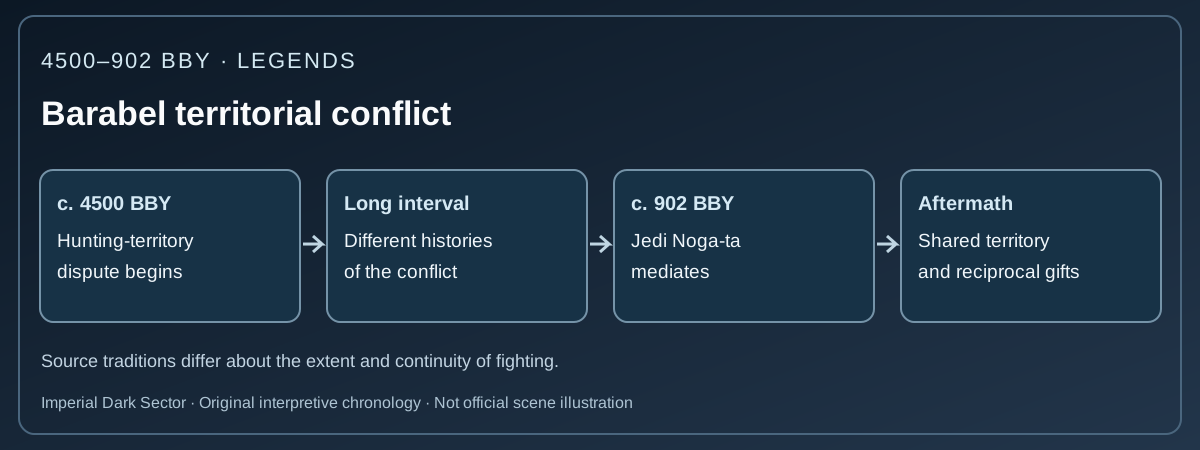
Image: original IDS symbolic illustration, not an image from the story or an exact map. Source context →
Around 4500 BBY, disputes over valuable hunting grounds on Barab I developed into the conflict later known as the Barabel War. The disagreement persisted in different forms for millennia, becoming part of Barabel collective memory until Jedi intervention around 902 BBY produced a settlement that redefined access to hunting territory.
Hunting territory as political territory
For Barabel clans, hunting grounds were tied to subsistence, prestige, and social standing.
A dispute over access therefore threatened more than recreation.
A conflict remembered across millennia
Later sources place the final Jedi settlement around 902 BBY.
The enormous interval suggests changing phases rather than continuous full-scale war.
Anthropological assessment
The Barabel War illustrates how resource disputes become cultural institutions when generations inherit unresolved claims.
Its eventual settlement also shows how outside mediation can succeed when it creates rules accepted as legitimate by local communities.
Legends · Post-Manderon period
A hunting dispute that lasted across generations
The Barabel War began around 4500 BBY when rival groups on Barab I disputed access to valuable hunting grounds. The conflict is unusual among dated Star Wars wars: the surviving later references place its eventual settlement many centuries after the opening dispute, around 902 BBY. That span should not be narrated as a continuous, uninterrupted battle. It describes an inherited conflict in which claims over territory and the right to hunt endured as parts of social memory, sometimes expanding toward wider violence. The Barabels possessed their own means of organizing society before any Jedi appeared as a mediator.
For a society in which hunting carried practical importance, territory was more than a cartographic line. Access could affect food, prestige, relations among families and expectations about who had the right to move through particular places. A settlement would have to address those competing claims rather than simply order combatants to stop. The much later Jedi Noga-ta gained a remarkable position in Barabel tradition because the resolution was remembered as legitimate. Legends reference works retain slight differences about the duration and period of intervention, so this entry separates the approximate beginning from the later endpoint.
Why a dispute can survive its original participants
People inherit accounts of earlier agreements and injuries even after those directly involved have died. Such histories may become part of group identity. The Barabel story illustrates how resource claims can acquire authority through repetition, ancestry and collective memory without every generation experiencing identical fighting.
The later Jedi settlement is not the starting event
Accounts of Noga-ta's intervention should not be transported into 4500 BBY. The relevant distinction is between the earliest dispute and the resolution dated around 902 BBY. This preserves nearly four millennia of changing history rather than compressing it into a single encounter.
Did Jedi Noga-ta end the Barabel War in 4500 BBY?
No. The early dispute is placed around 4500 BBY, while later references place the Jedi-mediated settlement near 902 BBY. Those are separate phases of the same long conflict.
Source evidence: The New Essential Guide to Alien Species; Galaxy at War; The Complete Star Wars Encyclopedia. Secondary source chronology and bibliography →. Explanatory analysis is distinguished from events established by published sources.
Conflict chronology · Legends
One remembered war, several historical phases
The Barabel War is often summarized by its beginning around 4500 BBY and its resolution around 902 BBY. That shorthand can be misleading. A span of nearly four millennia is not evidence that two armies fought without interruption throughout that period. The available reference tradition identifies a long-running dispute over hunting territory and a later intervention, but does not supply a continuous campaign diary.
Competing claims over hunting grounds become the starting point of a conflict remembered by later Barabel communities.
Later histories preserve the persistence of the dispute, not an independently dated battle for every generation.
Accounts associate Jedi Noga-ta with a resolution. This belongs to a much later period than the original territorial disagreement.
Why hunting grounds can become inherited political claims
Access to hunting territory can shape food supply, social obligations and recognition between communities. When claims are passed down, an unresolved boundary can become part of a group's identity even when the intensity of open conflict changes. This is an anthropological interpretation of the dispute's significance, not an invented account of Barabel rituals or a claim that every clan held the same view.
Evidence check: can we date every battle between 4500 and 902 BBY?
No. The source record does not support a continuous battle-by-battle chronology. Treat the early dispute, its long historical memory and the later settlement as distinct evidentiary claims.
Source boundary: The New Essential Guide to Alien Species, Galaxy at War and The Complete Star Wars Encyclopedia supply the Legends reference framework. The phase-based presentation is an editorial aid, not a newly discovered primary account.
Ancient Republic · Legends · Historical field note
Interpreting The Barabel conflict
The outbreak of war invites attention to how communities describe territorial claims and justify violence.
Research distinction: The documented event anchors this article. Its political and cultural implications are analytical observations, not invented scenes or claims about undocumented participants.
Open the historian's evidence question
What is directly established by the cited account, and what is an interpretation of its significance? Avoid treating an approximate date or a short reference entry as evidence for exact dialogue, motives or casualty totals.
c. 4500 BBY · Legends · Historical source comparison
Barabel factions dispute hunting grounds
- Territory matters beyond its monetary value
The dispute on Barab I centered on hunting grounds valued by large Barabel factions. Rights to those places implicated access to food, prestige and the relationships among clans. The earliest accounts emphasize a conflict that was close to becoming a bloody war. Later chronological compilations date an eruption to around 4500 BBY. This is a case where a named 'war' can cover both actual conflicts and the long memory of a dispute that later stories describe as being settled before a final battle.
- The timeline of the war is itself contested
The New Essential Guide to Alien Species associates the conflict with approximately 4500 BBY. A separate encyclopedia account places the legendary peace intervention of the Ithorian Jedi Noga-ta around 900 years before the Galactic Civil War, commonly converted to c. 902 BBY. Galaxy at War presents a millennia-long dispute that helps connect those different dates. The exact continuity of combat during every year of that span is not established. Some retellings say the decisive fighting had not yet begun when the Jedi arrived.
- Noga-ta is remembered through a rule of exchange
In the story of reconciliation, Noga-ta listened to competing Barabel groups and required shared hunting rights. One remembered rule obliged the tribe that made the greatest kill to give it to another, converting individual achievement into mutual dependence and a lasting public obligation. The later reputation of Jedi as respected arbiters among the Barabels is explained through this remembered mediation. That is a local account of political tradition, not evidence that the Jedi administered Barab I as an occupying government.
Was Barab I literally at war without interruption from 4500 to 902 BBY?
Not proven. Legends sources differ: some describe a dispute defused before major fighting, while later references reconcile the dates as a millennia-long war. The interval belongs in the chronology with this uncertainty visible.
Original source tradition: The New Essential Guide to Alien Species (2006); The Complete Star Wars Encyclopedia (2008); Galaxy at War (2009). Compiled source references →. Dating and certainty: The Legends sources disagree about whether the war was continuous and about how to place Noga-ta's intervention. The article explicitly shows both interpretations and the later reconciliation instead of hiding the conflict. Exact sourcebook pages and publication image rights remain under review.
Legends · Historical source dispute
The Barabel War: a name spanning several kinds of conflict
The Barabel War is unusually difficult to compress into an ordinary battlefield entry. Legends sourcebooks describe a long conflict over access to valuable hunting territories on Barab I. Later accounts also emphasize the final mediation, by the Jedi Noga-ta, of clans that were on the brink of another disastrous confrontation. Some retellings stress prolonged civil war, while others use the word war for a dispute that almost escalated into a final battle. Those interpretations should be shown to readers rather than flattened into one invented continuous front stretching unbroken over millennia.
The reconciliation associated with roughly 902 BBY is a different dated historical milestone from the approximate 4500 BBY origin of the dispute. The settlement traditionally involved sharing hunting grounds and presenting a clan's largest kill to another clan. These details matter anthropologically because ritualized exchange turned competition over resources into reciprocal obligations, while the memory of Jedi arbitration became part of later Barabel attitudes toward the Order. Even the status of the precise ending date is source-dependent. The dossier should not claim a continuous census of war deaths or a fully transcribed treaty where no such document is available.
Why the accounts disagree
The New Essential Guide to Alien Species, Galaxy at War, and The Complete Star Wars Encyclopedia are later Legends references rather than one contemporary battle diary. Later compilations disagree over how much bloodshed to attribute to the entire duration of the conflict. Compare the source citations and competing summaries →. IDS records this as a source-review issue pending page-specific examination, not as certainty.
Research challenge · Legends
Interpret the Barabel record
Receive your score and explanatory corrections after answering both questions.
Sources and further reading
- The New Essential Guide to Alien Species.
- Galaxy at War.
- Barabel War, Wookieepedia