
Around 6000 BBY, current canon places the beginning of civilization on Bardotta under the Frangawl. The Frangawl presided over a militant society in which warriors meditated before combat and drew on the dark side of the Force to intensify battle rage. They also produced monumental temples and animal-themed stone architecture across the planet.
The Frangawl order
The Frangawl combined religion, warfare, and political authority.
Their later descendants preserved a secret cult even after losing control of Bardotta.
Meditation used for battle
Frangawl practice drew on the dark side to produce battle rage.
This created a Force tradition distinct from Jedi institutional culture.
A monumental landscape
Temples and carved structures gave the regime a visible material presence across the planet.
Architecture helped turn religious authority into a permanent feature of place.
Anthropological assessment
Bardotta is important because canon presents the Force as culturally diverse. Jedi practice was not the only way communities organized relationships with the Force.
The Frangawl also show how political order can be reproduced through ritual, monumental architecture, and martial identity at the same time.
c. 6000 BBY · Canon · Source-reviewed evidence
The Frangawl and Bardotta's ancient political-religious order
Evidence and chronology
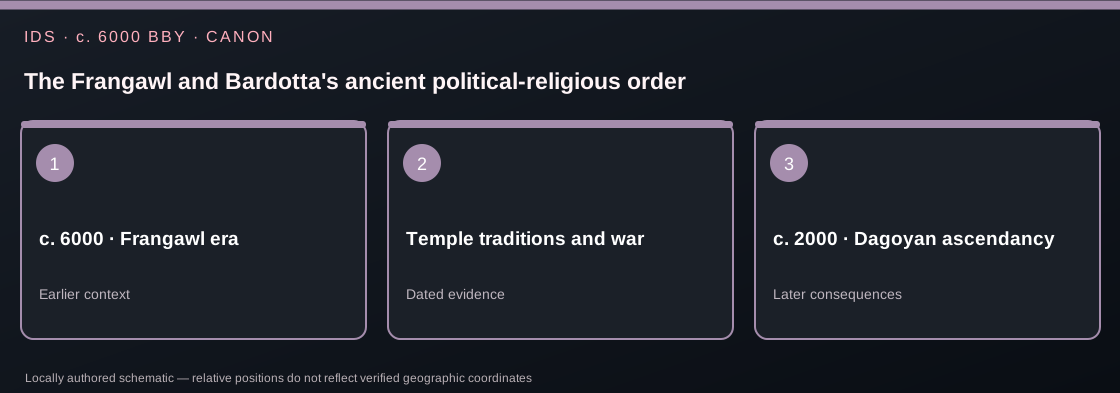
Canon reference material dates Bardotta's earliest described civilization to approximately 6000 BBY under the Frangawl. The Frangawl practiced a martial religion drawing upon the dark side and built imposing temples decorated with animal motifs. Later, the Dagoyan Order displaced Frangawl political authority and reused some of those religious sites. The Clone Wars episodes depict the long aftermath, not the 6000 BBY beginning.
Anthropological interpretation
Religious change can also be architectural change. A temple may survive the collapse of the institution that built it and acquire new uses and meanings, making later landscapes layered records of competing traditions. Neither the Frangawl's military practices nor the Dagoyans' later contemplative approach defines all Bardottan individuals.
What the sources do not establish
The phrase civilization begins is a source-period label, not evidence that no Bardottan people lived there previously. The later Dagoyan ascendancy is placed around 2000 BBY, not at the 6000 BBY starting point. This article is Canon, not an adaptation of the Legends Jedi-Sith chronology.
Test the record: Were the Dagoyan Order and Frangawl Cult the same institution in 6000 BBY?
Explanation: No. The Dagoyan tradition rose to authority much later and transformed earlier sacred sites.
Research trail: Nexus of Power (2016), Bardotta entry; Star Wars: The Clone Wars, The Disappeared I–II. View reference and bibliographic notes →. Printed page confirmation remains part of the editorial QA checklist.
Sources and further reading
- Nexus of Power, Fantasy Flight Games.
- The Clone Wars Rewatch: “The Disappeared,” StarWars.com