
LEGENDS · 137 ABY · IMPERIAL CIVIL WAR
Battle of Borosk: stormtroopers resist Darth Maleval
Joker Squad survives a brutal civil-war campaign and confronts a Sith commander's demand for absolute obedience.
Principal figures: Darth Maleval · Anson Trask · Gil Cassel · Hondo Karr
← Back to the full timeline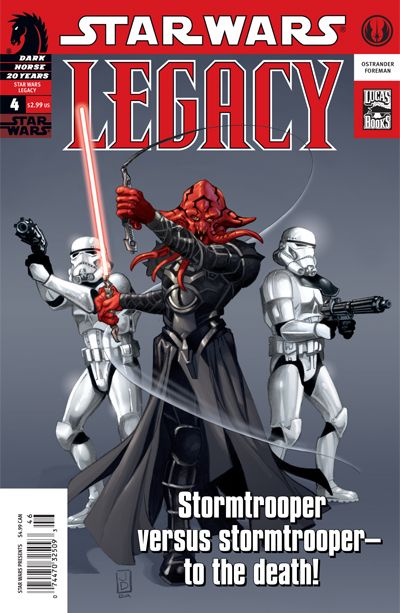
Two divisions, one Imperial identity
In 137 ABY, the Galactic Empire's split forced stormtroopers to decide which emperor they would obey. The 908th Stormtrooper Division had pledged loyalty to deposed Emperor Roan Fel. The 407th Division, including Joker Squad, remained within Darth Krayt's command structure. Darth Maleval accompanied the assault on the Fel-aligned base at Borosk. Both groups retained familiar Imperial weapons, training and ranks. Their uniformity exposed how civil war turns the same military identity into evidence for opposite political loyalties.
The assault on the 908th fortress
The opening attack secured gun positions around the 908th's headquarters. Fighting continued into the fortress, where defenders withdrew to prepared internal positions. The battle developed into close-quarters combat around the former mess hall, with elevated firing points and mines. The 908th force was wiped out. On the victorious side, the 407th had also suffered casualties. The source did not present the combat as the effortless triumph of either supposedly superior ideology.
A test of loyalty becomes murder
After the victory, Maleval brought Captain Jared Cassel, a prisoner from the loyalist 908th, before his brother Lieutenant Gil Cassel of the attacking force. Maleval ordered Gil to kill Jared as proof of loyalty. Gil refused. Maleval killed both brothers. Rather than rewarding discipline, the Sith used a family bond as a deliberately cruel instrument of political control. The scene shows a leader treating ordinary human attachment as an offense when it conflicts with his authority.
The Sith commander's final moments
Hondo Karr attacked Maleval after the murders. Maleval retaliated with his electro-whip and appeared close to killing Karr. The inexperienced stormtrooper Anson Trask shot Maleval from behind, saving Karr. Surviving soldiers concealed the true circumstances in their official report. This matters because an official military account and what participants saw were different things. A historian who had only the command paperwork would encounter a different version of the battle's aftermath.
Not the same as Borosk in 138 ABY
There is a separate Battle of Borosk in 138 ABY, during the revived Darth Krayt's military advance. In that later encounter, Imperial Knight Rand Ko commanded Fel's forces and the Sith again took the world. The 137 battle centered on Joker Squad, the 407th, the 908th and Maleval. Conflating the two events would give the wrong commanders, casualties and political setting.
Anthropological assessment: coercion inside an institution
Joker Squad was not simply a band of rebel soldiers. Most members initially carried out an operation for Krayt's Empire, even while disagreeing about the severity of his agent's actions. The story follows how discipline, group identity, fear and moral resistance coexist within a state security institution. Maleval tried to define loyalty as the willingness to kill family. The subsequent decision to kill him and conceal that act shows both opposition to a specific abuse and the limited capacity of soldiers to challenge the structure that had produced it.
Publication evidence
The principal narrative appears in Star Wars: Legacy (2006) #4, Noob, originally published by Dark Horse in October 2006 and collected in Shards. The year of the story is 137 ABY. The linked comic cover depicts the chapter; it is not external photography or a modern television still. No invented first-hand survivor testimony has been added.
Interactive evidence lab
Check your understanding of the sources and their limits. Select two answers and review the explanations at the bottom.
Source record and further reading
Published comic issues establish the principal actions. Supplementary Legends summaries help locate chronology and connect issues; they are not treated as eyewitness accounts of imaginary undocumented events.