
- Date
- 3962 BBY
- World
- Eres III
- Outcome
- Mandalorian victory
- Known participant
- Meetra Surik
- Long-term damage
- Xoxin plains burn for years
Historical narrative and evidence
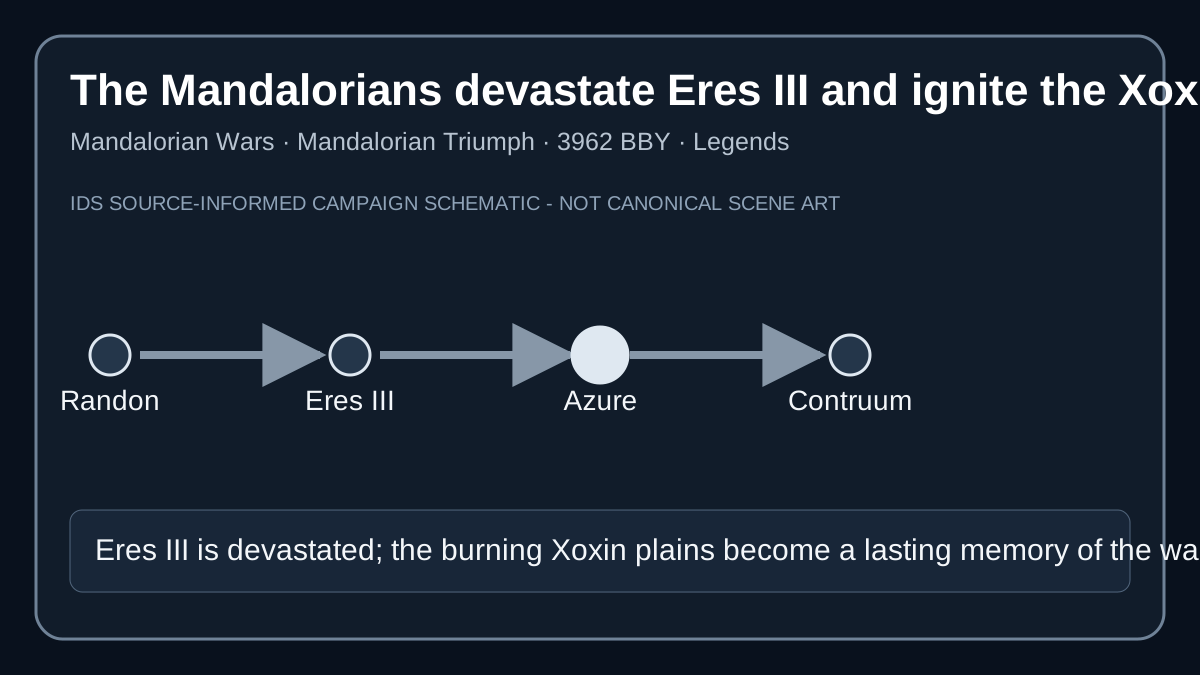
Eres III was not remembered simply as another point on the Mandalorian Triumph. The Neo-Crusaders devastated the world in 3962 BBY and set the Xoxin plains on fire. The destruction was severe enough that the fires were still remembered as burning years later, when Atton Rand confronted Meetra Surik with the human cost of the war in Knights of the Old Republic II: The Sith Lords.
The attack targeted more than a military position
The burning plains make Eres III different from many map-only battles. The evidence indicates environmental devastation that outlasted the immediate engagement. The Mandalorian victory therefore changed the physical landscape as well as political control.
Atton's later recollection groups Eres III with other traumatic memories of the Mandalorian Wars, including Serroco and Duro. The point of the comparison is not simply strategic. These are places where warfare became memorable because destruction exceeded the boundaries of a conventional battlefield.
Meetra Surik carries the battle into the Dark Wars
Meetra's later companions encounter the Mandalorian Wars through fragments of survivor memory. That makes Eres III part of the moral background of KOTOR II. The war is not over simply because fleets stopped fighting. Characters carry knowledge of burned worlds, dead soldiers, and decisions made under command pressure into the next conflict.
This is one reason the event deserves more than a short sentence. Eres III helps explain why veterans in the later game interpret the Jedi Exile through what they believe she did, witnessed, or represented during the war.
Environmental damage becomes historical evidence
A battlefield can disappear once wreckage is cleared, but long-lived ecological destruction remains visible. Burning plains become a material archive. They provide later communities with a physical reminder that a war occurred and that its consequences were not confined to combatants.
Anthropological assessment
Eres III shows how collective memory attaches to damaged landscapes. A community does not need a monument when the environment itself keeps displaying the effects of violence. The Xoxin plains become a form of involuntary memorial, one created by destruction rather than ritual commemoration.
The event also complicates heroic histories of the Mandalorian Wars. Later stories often center Revan, Meetra, and military strategy. Eres III shifts attention toward what large campaigns do to inhabited places. Political victory, military movement, and environmental harm become part of the same historical process.
Evidence check
What is firmly established?
The date or date range, location, continuity, broad combatants, outcome, and campaign placement are retained only where the cited Legends sources support them.
What has IDS deliberately not invented?
Unnamed commanders, exact force sizes, casualty totals, dialogue, tactical phases, and civilian experiences are omitted whenever the surviving sources do not establish them.
Why use a schematic instead of borrowed battle art?
For events without a verified source-specific illustration, this page uses an original labeled reconstruction rather than presenting unrelated comic or game art as though it depicts the battle.
Editorial field note · 3962 BBY · Legends
How to interpret the Eres III engagement
Recorded outcome: Mandalorian devastation. The event belongs to the consequences of planetary warfare. A single battle cannot describe every front of the war.
Historical method: Campaign maps and later summaries can establish an event without preserving individual commanders, tactical formations, civilian testimony or precise hourly timing. Detailed scene reconstruction without those sources would mislead readers.
Test the evidence: what can this entry establish?
It supports the documented event and stated outcome, but not casualty totals, spoken orders or motives of unnamed participants. Compare the references and related events before inferring broader causes.
Historical judgment · Legends · Source literacy
Test your interpretation of this battle
Answer both questions for a score, specific corrections and an explanation of what the record can establish.
Source method: This assessment follows the references in this entry. A later campaign map can document a system and a result without documenting conversations, exact numbers or undocumented motives.
Sources and further reading
- Star Wars: Knights of the Old Republic II: The Sith Lords (LucasArts/Obsidian, 2004), relevant dialogue, field records, and Mandalorian Wars material.
- The Essential Atlas, Daniel Wallace and Jason Fry (2009), Mandalorian Wars chronology and campaign mapping.
- The Essential Guide to Warfare, Jason Fry (2012), where applicable to later in-universe military-historical accounts.
About these links: Publisher and Lucasfilm records identify the referenced editions. A book description or game listing is not a scene-by-scene record of this battle; map placements, dialogue, casualty claims and historical interpretations must be checked against the original pages or gameplay.