
- World
- Yavin 4
- Jedi force
- Thousands
- Sith leader
- Exar Kun
- Outcome
- Great Sith War ends
After Ossus, Ulic Qel-Droma gave the Jedi the one piece of strategic information they had never possessed: the location of Exar Kun's hidden base on Yavin 4. Jedi from across the Order converged on the jungle moon. Kun, facing overwhelming force and the collapse of his coalition, abandoned conventional defense and attempted a ritual that would separate his spirit from his body.
3996 BBY · Legends · Evidence and cultural history
Yavin 4: the last battle and the Massassi sacrifice
What the sources establish
After Cay's death, Ulic provided the Jedi with information about Exar Kun's refuge on Yavin 4. The Jedi arrived in overwhelming numbers. Kun used Massassi lives as part of an attempt to escape physical defeat through a dark-side ritual. His body died and his spirit survived in a confined state on Yavin 4, rather than continuing to command the Sith as an ordinary living monarch.
What can be misunderstood
The end of the Great Sith War is not a complete restoration of what Kun had exploited. The Massassi were a society on Yavin 4 before his arrival, and their near destruction was a consequence of his ritual and political domination. The loss of people, rituals and institutions is not undone by the Jedi's tactical victory. The conclusion also should not be described as Kun's spirit freely escaping to conquer the galaxy elsewhere.
Did Exar Kun survive the battle as a living ruler of the Sith Empire?
No. His physical life ended; his spirit remained bound to Yavin 4. The Jedi's success came with devastating losses among the Massassi.
Source tradition: Tales of the Jedi — The Sith War #6; Jedi vs. Sith: The Essential Guide to the Force. Read the publisher record / sourced reference →. The hero is an original IDS conceptual drawing, not licensed comic art. For stories reconstructed through later reference books, original page/panel verification is still needed.
A former Sith commander becomes the map to victory
Ulic could no longer use the Force, but his strategic knowledge remained intact. He knew where Kun had built his secret temples and power base.
Defection mattered because hidden organizations often depend on information asymmetry more than raw military strength. Once an insider exposed the location, secrecy collapsed.
The Jedi surround the moon
Thousands of Jedi combined their power around Yavin 4. The scale of the response reflected both Kun's danger and the Order's determination to prevent another escape.
This was not a conventional fleet bombardment alone. The confrontation centered on a massive collective use of the light side against Kun's ritual.
Kun sacrifices the Massassi
The Massassi had lived on Yavin 4 for roughly a thousand years, descended from followers brought there by Naga Sadow. Kun had already exploited them as laborers, warriors, and subjects of alchemical experiments.
In the final ritual he treated their lives as energy. Most of the remaining population died so that one ruler could attempt to survive his political defeat.
The ritual succeeds only partially
Kun shed his physical body, but the Jedi assault prevented the freedom he wanted. His spirit became trapped within the temple complex.
The result gave Kun a form of survival without political agency: he existed, but could not rebuild the movement that had made him powerful.
The Great Sith War ends, but its consequences do not
The Brotherhood collapsed, Ulic entered exile, Mandalore was dead, Ossus was devastated, and Sithspawn remained scattered across the galaxy.
The next period was therefore not simple peace. The Republic and Jedi immediately entered reconstruction, purges, hunts, and arguments over what the war meant.
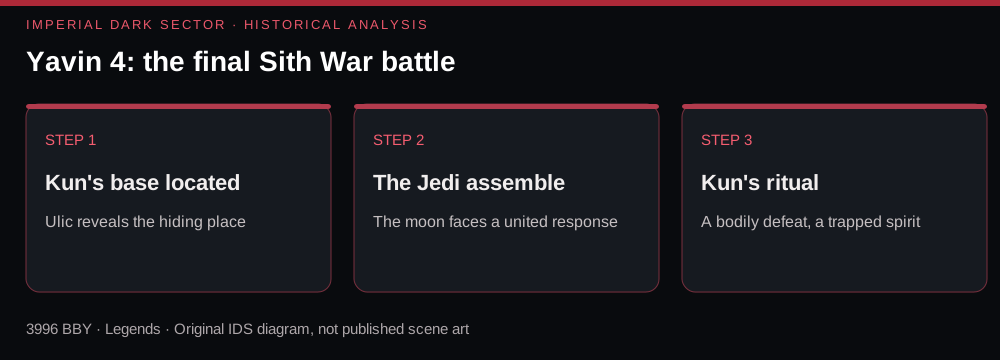
Event sequence
Ulic kills Cay and is severed from the Force.
Ulic reveals Kun's base on Yavin 4.
Thousands of Jedi surround the moon.
Massassi lives fuel an attempt at spiritual escape.
Jedi power interacts with Kun's ritual.
Kun's body dies; his spirit is trapped.
Explore this entry
Why didn't the Jedi simply bombard Yavin 4?
The threat was not only military. Kun was attempting a dark-side transformation tied to the temples and Massassi. The Jedi response therefore involved collective Force action as well as conventional containment.
Did any Massassi survive?
Legends material treats the ritual and battle as devastating to the Massassi population. Small traces of Massassi culture and structures survived, but the society Kun exploited was effectively destroyed.
Was Exar Kun truly dead?
Physically, yes. Spiritually, not entirely. His trapped presence remained in the temple complex and later influenced visitors to Yavin 4.
Anthropological assessment
Yavin 4 is a stark example of authoritarian sacrifice. Kun's followers were valuable while they built, fought, and obeyed; when his own survival was threatened, he converted their lives into ritual resources.
The battle also shows the strategic value of insider knowledge. Hidden organizations can appear invulnerable until a defector reveals the information that secrecy had protected.
Original comic / interpretive case study
A victory that could not restore the Massassi
The Jedi's arrival at Yavin 4 was made possible by information from Ulic Qel-Droma, who knew where Exar Kun had built a power base outside ordinary Republic observation. Once the location was exposed, thousands of Jedi could coordinate against a ruler who had relied on secrecy as well as Sith knowledge. Kun responded with a ritual designed to preserve his own existence by drawing life from the Massassi population. The moon was not a deserted temple complex: it was home to descendants of people brought there by Naga Sadow, whose communities Kun had already used for labor and military projects.
The resulting destruction of Massassi life was an atrocity distinct from the formal defeat of the Sith command. Kun's physical body was lost, while his spirit remained bound to the temple system rather than escaping to restore his movement. The Republic and Jedi could regard the immediate military campaign as finished without claiming that the cultural losses or hidden consequences had disappeared. Later Legends stories return to Kun's imprisoned spirit. Those later appearances should be noted as consequences, not retroactively turned into immediate events of the 3996 BBY battle.
Intelligence can defeat isolation
Kun's fortified moon could no longer function as a concealed headquarters after a former ally revealed its location. His fleet and followers did not have to be individually hunted across the galaxy before the Jedi could strike the organizational center.
Whose victory is remembered?
A chronology focused only on Jedi victory can omit the Massassi who died so Kun could attempt to survive. Their society should be identified as a community exploited and sacrificed by its ruler, not merely an energy source in a mystical contest.
Did the combined Jedi attack permanently erase Kun from every future Legends storyline?
No. His body was destroyed and his spirit trapped. The immediate Sith organization collapsed, but Kun's spirit later reappeared in Legends.
Original issue: Tales of the Jedi: The Sith War #6, 'Dark Lord' (1996). Dates and continuity refer to Legends; analysis of institutions, memory and aftermath is interpretation rather than a depiction of unshown dialogue or events.
Sources and further reading
- Tales of the Jedi – The Sith War #6.
- Jedi vs. Sith: The Essential Guide to the Force.
- The New Essential Chronology.