
Around 4010 BBY, Candra Kitai was born on Kesh into the Human ruling population of the Lost Tribe of Sith. By adulthood, the Tribe's founding conquest of the Keshiri was already more than nine centuries old. Candra later became a High Lord and sat on the Circle of Lords, retaining enough political independence to act as a balance between rival factions.
A Sith society generations removed from its founders
Candra belonged to a population that had never seen Korriban or Dromund Kaas.
For her generation, Kesh was not exile territory but home.
An inherited colonial hierarchy
Human Sith families occupied privileged positions over Keshiri subjects and slaves.
Candra's later political status grew inside institutions created by the Omen survivors centuries earlier.
Anthropological assessment
Candra's birth shows how conquest can become normalized across generations.
People born centuries after the founding violence inherit social categories that feel ordinary even though they were created through colonization.
c. 4010 BBY · Legends · evaluated historical source
Candra Kitai: a birth date inferred from a later story
How the event is dated
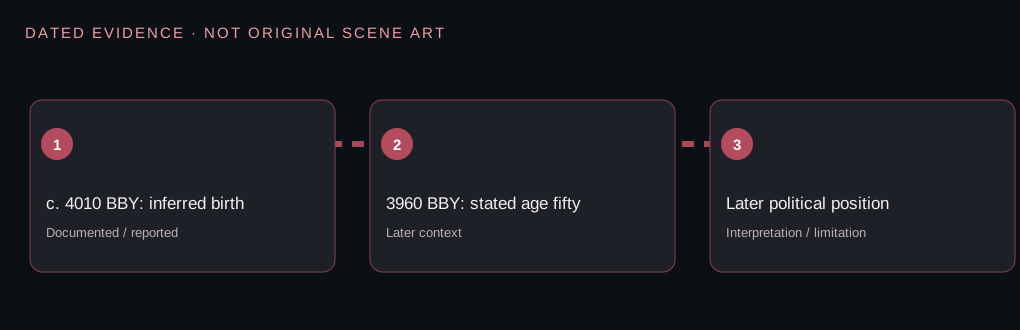
The date is approximate because the later Purgatory narrative identifies Candra as fifty years old in a story dated to 3960 BBY. This is a calculation from a biographical age, not a directly depicted birth scene.
What the source documents
Candra belonged to the long-established ruling population of the Lost Tribe on Kesh. The colony's origins lay in the arrival of the Omen and the subordination of the Keshiri population; by the era of Candra's adult life, its political institutions had continued for many generations. Her later position as a High Lord and her daughter Orielle's standing illuminate elite family networks. These events should not be presented as if their details were known at the time of her birth.
Institutions and culture
The distinction between ancestry and lived experience is important. Candra inherited a colonial power structure but was born long after the initial landing and conquest. Kesh would have been her home rather than a temporary camp. An anthropological treatment asks how systems of rank are reproduced through family networks, material control and education, while making clear that no childhood ceremony, natal location or immediate family conversation survives in the dated source.
Limits of reconstruction
The original novella establishes her later status and age. It does not provide a birth certificate, an exact birthday, a depiction of infant Candra, or reliable knowledge of what she thought as a child. Links to the Keshiri population concern wider Lost Tribe institutions, not personal observations from 4010 BBY.
Test your source judgment: Why is Candra's birth marked circa 4010 BBY?
Explanation: The date is inferred from her later stated age of fifty during events placed in 3960 BBY. The story does not depict her birth.
Source trail: John Jackson Miller, Lost Tribe of the Sith: Purgatory; The Essential Reader's Companion. Read the reference record and bibliography →. The original publication may require page-level verification.
c. 4010 BBY · Legends · Historical research
Candra Kitai: birth into a society shaped by conquest
Evidence and dating method
Candra Kitai's approximate birth date of 4010 BBY is inferred from her being about fifty years old in the Lost Tribe of the Sith story set in 3960 BBY. Her family belonged to the human Sith ruling population on Kesh. By the time she was born, the Omen's arrival and the founding violence through which the Lost Tribe secured rule over the Keshiri were distant ancestral events. Candra's later political career is well known, but the 4010 BBY entry is not the date of her appointment as High Lord or her leadership in Sith factional struggles.
Separate the birth or early event from later history
The Tribe preserved an elite Sith structure in a world with limited contact beyond Kesh. Candra eventually owned an estate at Starfall near Tahv, held a place on the Circle of Lords, and acted as an independent figure in competition involving Red and Gold factions. Her daughter Orielle became associated with the Sith Sabers. These are descriptions of a later stage of the family's history. A biography that introduces all those institutions at her birth risks making the political future appear predetermined. Her later rise depended on offices, alliances and crises that had not yet occurred in 4010 BBY.
Anthropological assessment
The history of Kesh is especially important for distinguishing species, culture and rank. The Human Sith aristocracy claimed political and religious dominance over Keshiri communities, including through slavery. Those were institutional relations, not evidence of biological superiority. Candra's inherited status helped place her in a political world where aristocratic estates, social obligations and coerced labor were normalized. Examining her birth as a point within a much older conquest society brings ordinary institutions of power into view rather than treating political privilege as an inevitable personal quality.
Limits of the surviving source
The published date is an age-based approximation; the story does not supply her birthday, early childhood testimony or complete family genealogy. Her later independence among the High Lords must not be backdated to infancy. The details derive from the Legends Lost Tribe of the Sith prose cycle and cannot be imported into Canon without separate evidence.
Historical reasoning: Was Candra born a High Lord and already the tie-breaker in Sith politics?
Correction and explanation: No. Her position and factional influence are later adult developments, and the c. 4010 BBY entry concerns only her approximate birth.
Source: John Jackson Miller, Lost Tribe of the Sith: Purgatory and related stories; The Essential Reader's Companion. Reference and bibliography ↗. Published-edition pagination requires further collation.
Sources and further reading
- John Jackson Miller, Lost Tribe of the Sith: Purgatory.
- Candra Kitai, Wookieepedia