
In 4009 BBY, the Systino crime syndicate discovered Sraato, a planet rich in valuable natural resources. Control of the new resource frontier strengthened the syndicate enough that it dominated much of the surrounding sector's criminal activity for the next two centuries.
Criminal organizations also build frontiers
The discovery was not led by Republic scouts or a chartered scientific institution.
An underworld group converted route knowledge into economic power.
Two centuries of regional influence
Sraato helped support long-term criminal dominance rather than one short extraction boom.
Control of territory and resources gave the syndicate institutional durability.
Anthropological assessment
Sraato shows that criminal economies can create stable political geographies of their own.
A syndicate with resource access, routes, and enforcement can function as a durable regional institution even without formal sovereignty.
Legends · Post-Manderon source research
The Systino syndicate makes a secret treasury world
In 4009 BBY the Systino syndicate discovered a resource-rich world identified in the original material as 244Core and later named Sraato. Rather than establishing an open Republic research station, the syndicate treated the planet as a source of wealth and strategic secrecy. It transported enslaved workers to mine mineral deposits on the southern continent, using the resulting supply of precious metals, crystals and gems to acquire equipment and influence. The operation made the planet an important financial support system for a criminal organization, not simply an unexplored dot added to a galactic map.
The syndicate's control lasted for generations and expanded toward islands and the southern polar region. The original Legends source describes an eventual environmental catastrophe triggered by a meteor storm, which made the planet much harder to exploit and led to abandonment. That later outcome should not be imported into the 4009 BBY discovery itself as though the first crew could have foreseen it. The most important immediate result was an ongoing system of forced labor, resource extraction and covert investment that supported influence beyond Sraato.
A hidden supply base can govern distant events
A criminal group may not have a recognized seat in the Galactic Senate, but it can convert resources into weapons, transport and favors. Exploitation of one remote world therefore helps explain the syndicate's reach in places where its leaders were not physically present.
The workers are part of the discovery history
A history focused only on the discovering syndicate misses the enslaved people who made the mines profitable. Their labor was not an incidental commercial detail. It was an organized coercive system through which the newly found resources could be moved into underworld markets.
Was Sraato discovered as a peaceful Republic mineral colony?
No. The Legends account identifies the Systino syndicate, which renamed the planet and developed secret mining operations using enslaved labor.
Evidence: The Unknown Regions, 244Core/Sraato and Systino syndicate entries. Source reference and bibliography →. Distinguishes contemporary evidence, later historical summaries and IDS interpretation.
4009 BBY · Legends · evaluated historical source
Sraato: a corporate and criminal resource frontier
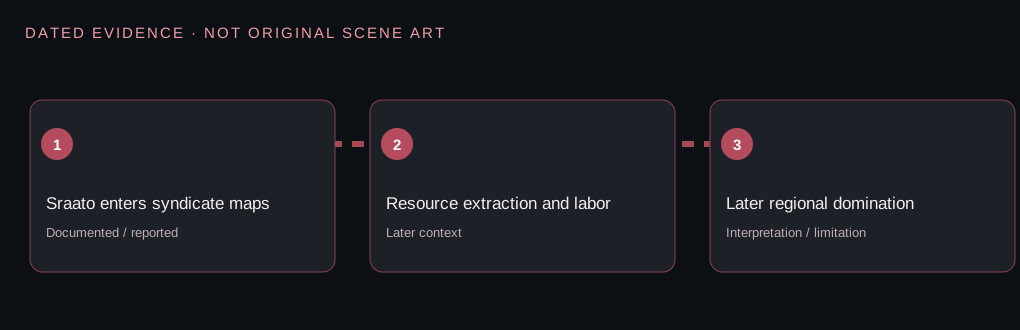
How the event is dated
The source identifies Sraato as a world exploited by the Systino syndicate and formerly designated 244Core. Its 4009 BBY discovery belongs to regional records, not to a Republic-led expedition account.
What the source documents
The wider Legends history describes valuable resources and an operation built on enslaved labor. This distinguishes the discovery of a route or mineral reserve from lawful occupation. The syndicate controlled economic access, worker mobility and the flow of extracted materials. That pattern provides a specific way to analyze how clandestine organizations can reproduce political functions without conventional sovereignty.
Institutions and culture
Discovery narratives often omit the people whose work turns geographic knowledge into profit. In this case, the reported enslaved workforce deserves attention alongside the syndicate leadership. Describing the planet merely as resource-rich obscures the institutions of compulsion, supply and enforcement behind its exploitation.
Limits of reconstruction
The exact expedition crew, landfall, quantities mined and a verified contemporary map are not established by a short historical timeline. Later environmental changes belong to the planet's later history and must be separated from the initial 4009 BBY contact.
Test your source judgment: Does the first discovery record prove Sraato was a peaceful mining outpost?
Explanation: No. The cited Legends account identifies a criminal operation that exploited enslaved workers.
Source trail: The Unknown Regions (2010), 244Core/Sraato reference. Read the reference record and bibliography →. The original publication may require page-level verification.
4009 BBY · Legends · Source and historical interpretation
Sraato: an undisclosed resource colony and the power of coerced labor
What is directly established
In 4009 BBY, the Systino crime syndicate discovered a mineral-rich planet that became known as Sraato. The world was also designated 244Core in later accounts. The criminal organization transported hundreds of enslaved people to extract valuable metals, gemstones and crystals, using the site as a concealed source of revenue. This history matters because a simple headline saying the planet was discovered can conceal what followed: not an open public exploration mission, but a project involving secrecy, resource control and forced labor.
Later events in their proper order
The secret mining operation increased the syndicate's financial resources and capacity to influence activity across surrounding sectors. The larger criminal organization expanded over the following two centuries. Its eventual withdrawal followed severe environmental damage associated with a meteor storm, not a sudden end to the original 4009 BBY discovery. A timeline should therefore distinguish four stages: initial charting, establishment of extraction, the period of regional dominance and the later environmental collapse. The presence of deposits does not imply the site was uninhabited before the syndicate arrived, unless a source independently establishes that claim.
Anthropological reading
The Sraato case shows how geographic knowledge can become a private instrument of coercion. An organization with hidden routes, captives and access to resources can exercise important powers without being a recognized sovereign state. The enslaved miners were central to its economic capacity, yet such people can almost disappear from short political summaries that name only the syndicate. An anthropological account should distinguish the discoverers, those compelled to work and the institutions that profited. The term resource frontier describes the syndicate's expanding extraction network, not a judgment that the planet lacked history or social meaning before their arrival.
Source disagreements and limitations
The account does not provide the first expedition's crew, the exact mine count, the identities of enslaved workers, or an export ledger. The later meteor impact should not be backdated to 4009 BBY. The chronology entry is Legends-specific.
Evaluate the evidence: Did Systino's discovery mean the site immediately became a lawful Republic mining settlement?
Correction and explanation: No. The operation was clandestine and involved enslaved workers and organized crime; formal Republic authorization is not established.
References: 244Core and Sraato Legends source history; Galactic chronology of 4009 BBY. Source record and bibliography ↗. Original-edition pagination and image rights remain under review.